Chili’s Brand Guidelines
A Dallas burger bar in a green-painted post office, marked by a pepper.
Aa
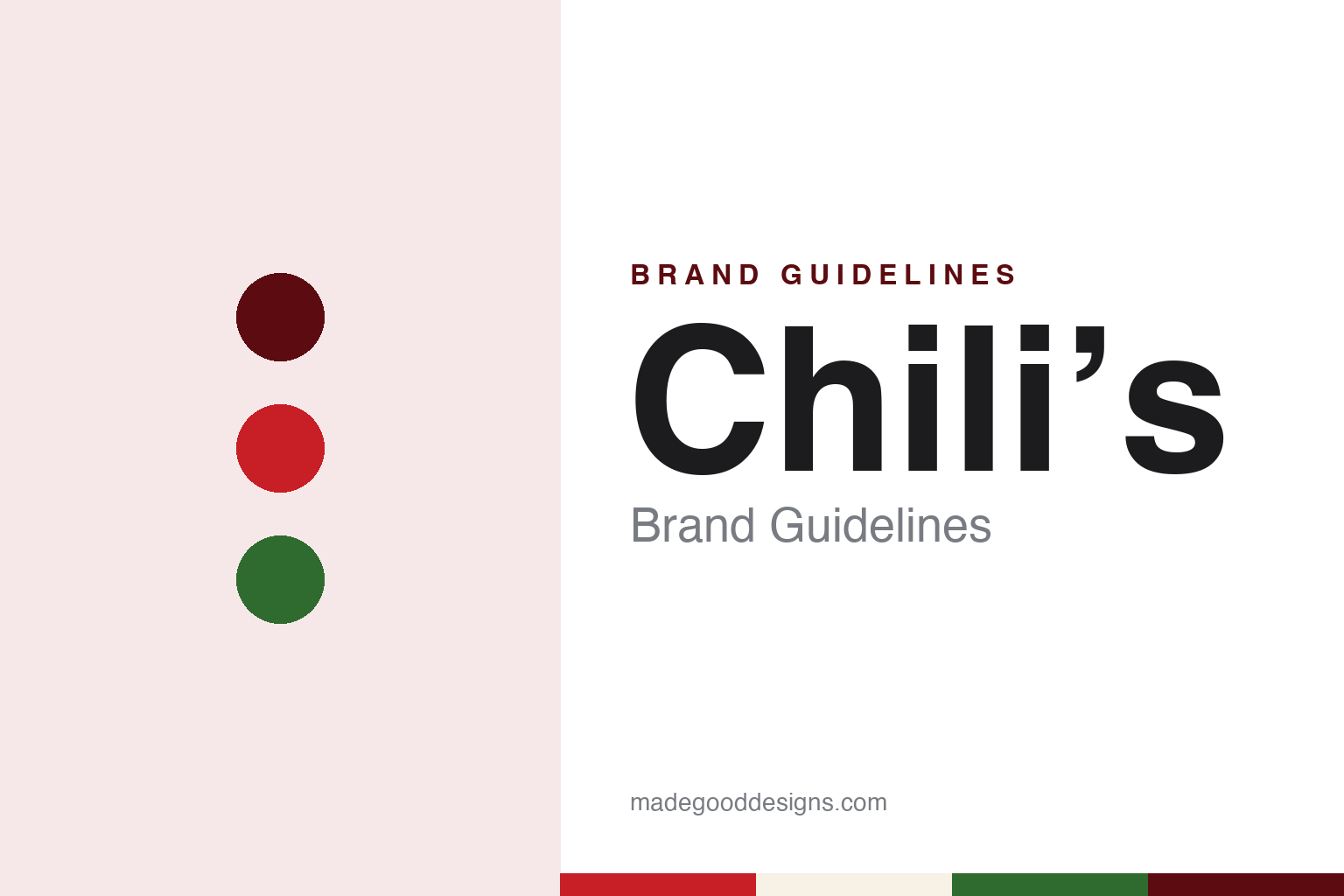
Two constants: a pepper red, stem green and adobe white palette and a rounded lowercase sans register. Abstract homage — not a Chili’s product or mark; no pepper, sign or logo is reproduced.
Greenville Avenue
Chili on the menu, a post office for a room.
Chili’s opened in 1975 in an unlikely building: an old post office on Greenville Avenue at Meadow Road in Dallas. The Dallas television station WFAA reported in July 2022, in an interview with the founder, that Larry Lavine started the restaurant with Malloy Buckner and John Foshee. Lavine had worked in clubs and band booking and had run a steak-and-seafood restaurant with Buckner before the three partners set out to build something between a cafe and a steakhouse — a casual room where a customer could get a burger and a drink.
The name came straight from the menu. Lavine told WFAA that they called the place Chili’s because they had chili on the menu and figured “it was something people would talk about”, adding that people do not talk about spaghetti and meatballs. The building had already been converted into a darkened bar, and the partners revamped it with a coat of fresh green paint. Lavine said the challenge was to make it fun: they lowered the lights at night and played popular music, and they added frozen margaritas to a short opening menu of chili, burgers, fries and tacos, later joined by fajitas and nachos.
The International Directory of Company Histories, in a 2001 profile of the parent company, dates the opening to March 1975 and describes Lavine’s concept as an informal, full-service restaurant with a menu built around different kinds of hamburgers at reasonable prices. It says the restaurants that followed in the late 1970s and early 1980s shared a similar Southwest décor. Lavine told WFAA that praise from a Dallas Times Herald food writer helped fill the room, and that the second Chili’s opened in Houston.
English Wikipedia, citing the company, says the original Greenville Avenue restaurant moved into a new building on the same site in 1981. Wikipedia gives the brand’s stylisation as a lowercase “chili’s”, and its trading name today is Chili’s Grill & Bar.
Colour
Norman Brinker and the company that took his name.
The chain’s second chapter belongs to a restaurant executive. The International Directory of Company Histories says that in 1983 Lavine’s restaurant chain was taken over by Norman E. Brinker, who bought a significant share and became chairman and chief executive. Brinker had begun his career in 1957 at the Jack in the Box fast-food chain, founded the Steak & Ale restaurants, and after his S & A Restaurant Corporation was sold to the Pillsbury Company in 1976 ran Pillsbury’s restaurant group. In 1983 he left to build a smaller company of his own, the directory says, quoting a 1992 interview in which he said he wanted to see if he could develop a very small company against the big chains.
Brinker took Chili’s public in 1984, the directory says, with shares trading under the ticker symbol EAT. Over the following years the menu shifted from burgers toward ribs, fajitas, salads and chicken, and the company called its loyal customers “chiliheads”. Lavine told WFAA that he left the company around the time of the Brinker purchase.
The parent company soon added a second concept. In 1989, according to the directory, Chili’s bought the rights to Romano’s Macaroni Grill, an Italian restaurant concept from the Texas restaurateur Phil Romano, and in 1991 the company that had been Chili’s was renamed Brinker International, Inc., after the man who had built it into a national chain. The directory says the company was incorporated in 1975 as Chili’s Bar & Grill, Inc.
Brinker International owns Chili’s today. Hoodline reported on 18 July 2026 that the parent company, Brinker International, had remodelled four Chili’s restaurants around Dallas to test a new design before taking it across the system, and it quoted the chief executive, Kevin Hochman, on the goal of making “Chili’s more Chili’s”. The company’s restaurant support centre is in the Dallas area, near the city where the post-office bar opened in 1975.
Typography
Design and documentation.
A casual-dining chain is recognised on the road before it is recognised on the plate. The sign is usually the first piece of the identity a guest meets: a pole sign near a highway exit, a lettered fascia above the door or a canopy that carries a colour from a long way off. Awnings, striped or plain, do a similar job at street level, giving a restaurant a face that reads the same in a city block and a suburban car park.
Inside, the identity moves from the façade to the room. Menus carry the logo, the typeface and the tone of voice into the guest’s hands, and they change more often than any sign. Interior décor — the lamps, the bar, the wall objects, the chairs on a porch or the booths along a window — is where a chain tells the story it wants to be known for, whether that story is a neighbourhood bar, a country store or a roadside coffee shop.
Because chains remodel, rename and change owners, the questions in each guide stay the same: who started the brand, who owns it now, and how its signs, rooms and marks have changed over time. Each guide separates what independent sources record from what the company says about itself.
Aa
A rounded lowercase sans — the register of a friendly sign and a margarita menu. (Specimen set in Rubik, a sans-serif STAND-IN; NOT the Chili’s logo.)
Chili’s
A pepper, a jingle and a room that looks back.
The Chili’s identity reduces the restaurant’s name to a single object. WFAA described the chain in 2022 as the burger restaurant with a distinctive chili pepper for a logo, and the pepper — red, with a green stem — does the same job as the word: it names the dish that gave the restaurant its name in 1975.
The brand also has a sound. Wikipedia says the “baby back ribs” jingle used in Chili’s commercials was written by Guy Bommarito and produced by Tom Faulkner Productions for the Austin advertising agency GSD&M, with Faulkner singing the main lines and the bass vocalist Willie McCoy singing “Bar-B-Q sauce”. Wikipedia, citing Today, says the jingle returned in October 2017 to advertise a new menu, and that a mascot called Joe ChiliHead starred in a licensed BurgerTime browser game the chain released in 2024.
In 2026 the chain turned its own history into interior design. Fox News Digital reported on 28 July 2026 that Chili’s was rolling out a nostalgic redesign drawn from the original Greenville Avenue restaurant and the colourful look of the 1990s. The changes include the return of red booths, tile-inspired tabletops influenced by Southwestern ceramics, refreshed bars with neon signage and oversized “Margarita Bar” signs, framed sheet music from the ribs jingle, the original 1975 menu, and custom wallpaper showing chili peppers being abducted by a tortilla-chip UFO and a margarita swimming pool. A company fact sheet gave the guiding idea as “Make Chili’s More Chili’s”. After tests at Dallas-area restaurants, remodelled restaurants outside that market reopened on 1 July 2026 in cities including Fayetteville, Arkansas, Kennesaw, Georgia, and El Paso, Texas.
For a design guide, Chili’s shows how a brand can mine its own archive — a pepper, a jingle, an opening menu and a Southwest palette — and rebuild a current dining room out of it, half a century after a post office in Dallas was painted green. Compare it with Applebee’s, another grill-and-bar chain with a food picture in its mark, and Outback Steakhouse, a casual-dining chain built on a borrowed landscape. For this guide we use pepper red, stem green and adobe white with a sans, an unofficial interpretation; no product or logo is reproduced.
Explore & save
Keep Chili’s’s identity on hand — save it to a board in the Made Good inspiration library.
Chili’s identity set
Pin the Chili’s pepper red, stem green and adobe white palette and the rounded lowercase sans register to your own board.