Las Vegas Raiders Brand Guidelines
From the Oakland Señors to silver, black and a pirate shield.
Aa
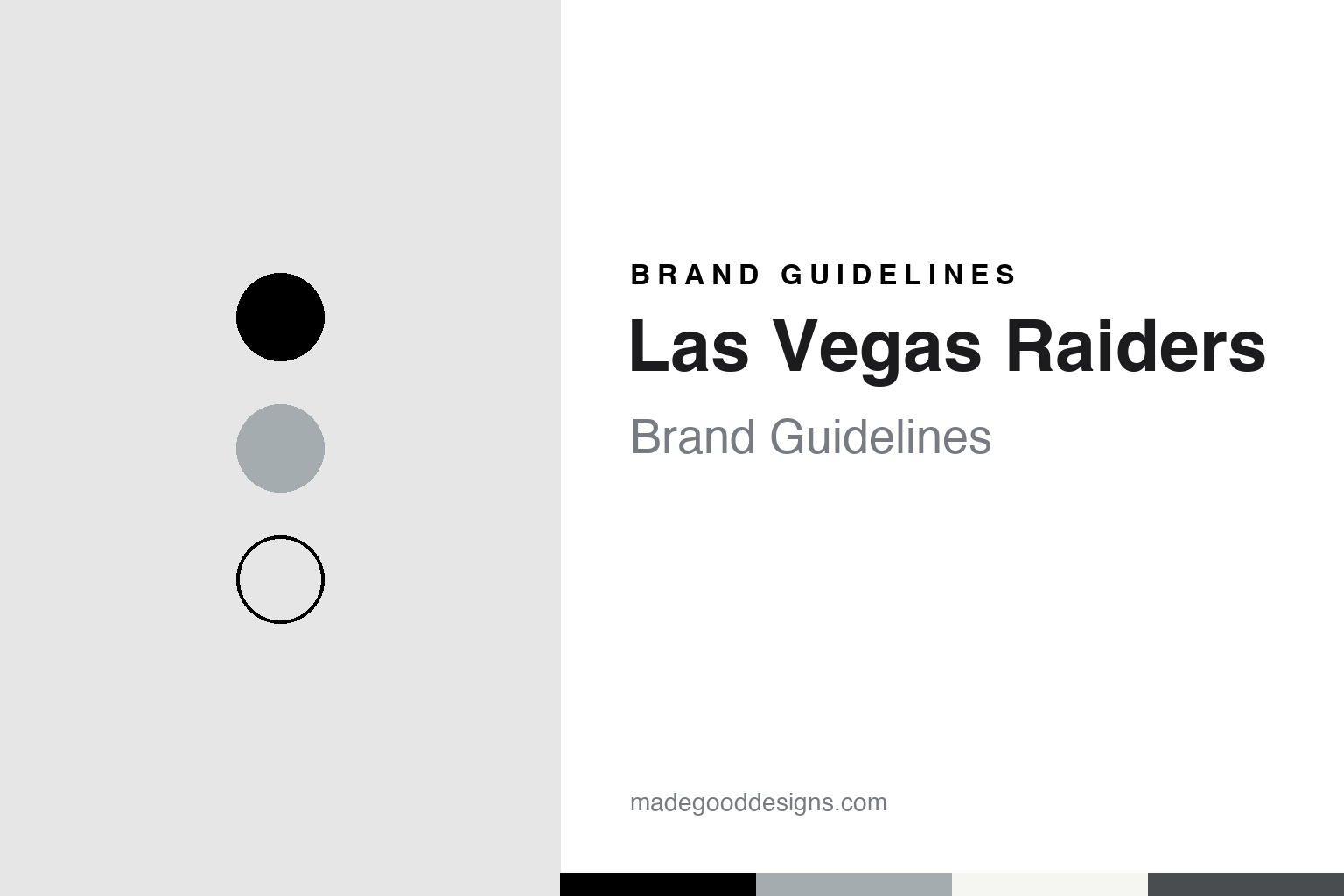
Two constants: a silver and black palette and a condensed athletic sans register. Abstract homage — not a Las Vegas Raiders product or mark; no helmet, uniform or logo is reproduced.
Oakland
A newspaper contest, a short-lived name and a pirate.
The Raiders began in Oakland. English Wikipedia says the city was awarded the eighth franchise of the new American Football League on 30 January 1960. A meeting of civic leaders chaired by William Knowland, editor of the Oakland Tribune, found local businessmen willing to invest, and a limited partnership was formed with the real estate developer Y. Charles “Chet” Soda as managing general partner, alongside Ed McGah, Robert Osborne, F. Wayne Valley and others. The team played its first regular-season game on 11 September 1960 and joined the NFL with the AFL–NFL merger in 1970.
The first name did not last. Wikipedia says the Oakland Tribune ran a name-the-team contest, and on 4 April 1960 the winner was announced as the Oakland Señors. After a few days of local jokes, and accusations that the contest was fixed because Soda was known for calling acquaintances “señor”, the owners changed the name nine days later to the Oakland Raiders, which had finished third in the contest.
The pirate came with the name. Wikipedia says Soda hired the sportswriter Gene Lawrence Perry as the club’s first director of public relations, and that Perry commissioned an unnamed Berkeley artist to draw a helmeted man with an eye patch and the firm chin of the Western film actor Randolph Scott. The first Raiders logo put that pirate, wearing a football helmet and an eye patch, on a gold football, with two white swords in black trim and gold handles crossed behind it.
The club’s early homes were borrowed. A CBS San Francisco report of 22 January 2020 says the Oakland franchise began in 1960 playing at Kezar Stadium and Candlestick Park in San Francisco, moved in 1962 to Frank Youell Field in Oakland, a site now part of the Laney College campus, and played there until the Oakland Coliseum opened in 1966.
Colour
Black and gold, then silver and black under Al Davis.
The colours changed within three years. Wikipedia says the original uniforms of 1960 to 1962 were black and gold with Gothic numerals, and the helmets were black with a white stripe and no logo. The jerseys carried each player’s full name on the back, which was cut to the surname only in 1963.
That year brought the look the club still wears. When Al Davis became head coach and general manager in 1963, Wikipedia says, he changed the colour scheme to silver and black and put a logo on the helmet. The shield he introduced carries the word “RAIDERS” across the top, two crossed cutlasses with their handles up and their edges down, and the head of a raider in a football helmet with a black patch over his right eye. In 1964 the shield’s background changed from silver to black, and Wikipedia says the mark has otherwise stayed essentially the same.
So has the uniform. Wikipedia describes silver helmets, silver pants and either black or white jerseys: the black jerseys carry silver names and numbers, and the white jerseys black names and numbers with a silver outline. The white numbers were silver with a thick black outline in 1963, black with a silver outline from 1964, and silver again for the single season of 1970 before returning to black in 1971. In 1994, for the NFL’s 75th anniversary, the team wore its 1963 helmets with the 1970 silver road numbers. The club wore white at home for the first time on 28 September 2008, wore 1960s throwbacks in 2009 for the AFL Legacy Program, and wore black cleats in 2012 and 2013 as a tribute to Al Davis. Its 2016 Color Rush set brought back white jerseys with silver numerals, worn with white pants until 2018 and with silver pants after that.
Ownership has stayed with the Davis family since the early 1970s. Wikipedia says Davis returned to the Raiders as part-owner in July 1966, gained control of the club in 1972 and owned it until 2011, when control passed to his son Mark Davis, with Al Davis’s wife Carol keeping her ownership. The team is now based in Henderson, Nevada, and plays at Allegiant Stadium in Paradise, Nevada.
Typography
Design and documentation.
An American football club’s identity has to work at very different scales. The helmet logo is the mark people see first: a single shape on a curved shell, read from the upper deck and on a phone screen, so it is usually a bold silhouette with a clear outline and few colours. A wordmark then carries the name on jerseys, sidelines and broadcasts, often in a custom or heavily modified typeface with its own numerals for the back and shoulders of the jersey.
Alternate uniforms give clubs room to play. Throwback sets bring back earlier helmets and stripes for a game or a season, and all-over single-colour “colour rush” style sets push one team colour across helmet, jersey and trousers. Each alternate has to stay recognisable on television next to the opposing side, which is why contrast between home and away kits matters so much.
Sideline apparel — coaches’ jackets, caps, hoodies and staff polos — extends the same marks into retail, away from the field. In the stadium, the palette moves onto end-zone paint, the midfield logo, ribbon boards, wayfinding and concourse signs, where large flat areas of colour and simple type need to read from a distance and in floodlight.
Aa
A condensed athletic sans — the register of a stadium wordmark and a sideline banner. (Specimen set in Oswald, a sans STAND-IN; NOT the Las Vegas Raiders logo, wordmark or numerals.)
Three cities, one shield
A mark that moved without changing.
The Raiders have changed cities three times without redrawing their identity. Wikipedia says the club played in Los Angeles from the 1982 season through 1994 as the Los Angeles Raiders, at the Los Angeles Memorial Coliseum, and that Davis signed a letter of intent on 23 June 1995 to move the team back to Oakland. On 27 March 2017 NFL owners approved a move to the Las Vegas area, and the team played its last game as a California club on 29 December 2019.
The renaming was staged as a ceremony. CBS San Francisco reported on 22 January 2020 that owner Mark Davis announced the new name for the club it called “the Silver and Black” at an event in front of the unfinished Allegiant Stadium, and that Nevada governor Steve Sisolak read a proclamation naming the day for the renaming of the Las Vegas Raiders. Earlier that month, the report says, the franchise had dropped the word “Oakland” from its social media accounts and listed itself simply as The Raiders. Wikipedia says no changes were made to the uniforms or logos for the move, apart from replacing “OAKLAND” with “LAS VEGAS” on the wordmark logos.
Words are part of the brand too. Wikipedia says Al Davis coined slogans such as “Pride and Poise”, “Commitment to Excellence” and “Just Win, Baby”, and that all three are registered trademarks of the team.
For a design guide, the Las Vegas Raiders show how a club can hold a two-colour palette and one helmet mark steady from 1963 through three home cities, letting a city name on the wordmark carry the change. Compare the other Bay Area club in our San Francisco 49ers brand guidelines, a fellow AFL charter club in our Kansas City Chiefs brand guidelines and the league in our NFL brand guidelines. For this guide we use silver, gunmetal and black with a condensed sans, an unofficial interpretation; no product or logo is reproduced.
Explore & save
Keep Las Vegas Raiders’s identity on hand — save it to a board in the Made Good inspiration library.
Las Vegas Raiders identity set
Pin the Las Vegas Raiders silver and black palette and the condensed athletic sans register to your own board.