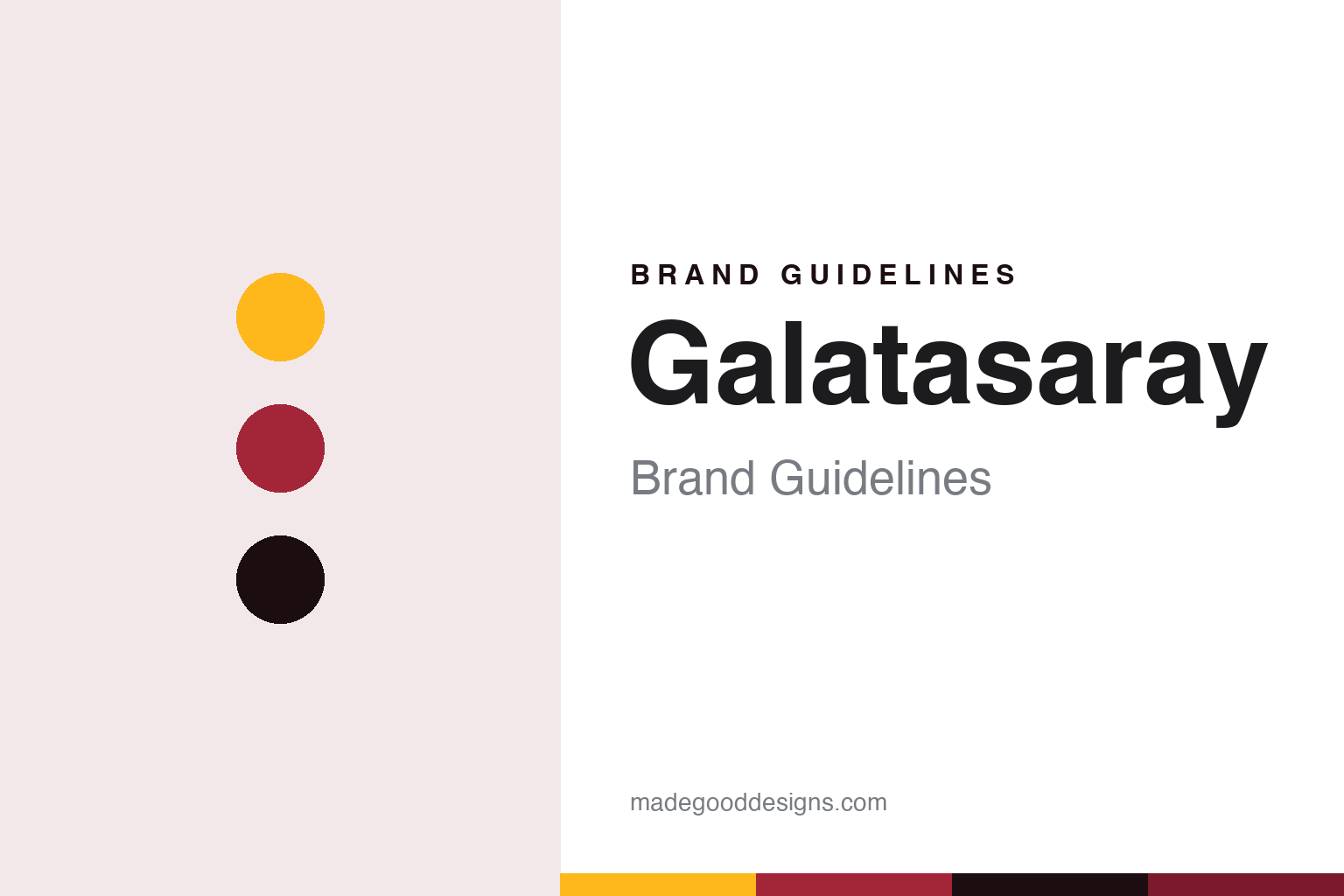
Galatasaray Brand Guidelines
Yellow and red, in eight pieces, like a flame.
Aa
Two constants: a goldfinch yellow, cherry red and ink palette and a condensed matchday sans register. Abstract homage — not a Galatasaray product or mark; no crest, shirt or logo is reproduced.
Galata Palace
A school club named after an Istanbul quarter.
Galatasaray was founded in October 1905. English Wikipedia says the exact day is disputed but is traditionally accepted as 30 October 1905, and that the club was started by Ali Sami Yen and other students of Galatasaray High School, a school in Istanbul established in 1481. Ali Sami Yen became the club’s first president and was given membership number one. The team’s first match was against Cadi-Keuy FC.
The name was a choice between several. Wikipedia says some of the founders proposed Gloria, meaning victory, and others Audace, meaning courage, before they agreed on Galatasaray, the name of the school and of its neighbourhood. Galatasaray is a quarter in Karaköy, in the Beyoğlu district of Istanbul, on the northern shore of the Golden Horn. Its name comes from that of Galata, and translates directly as “Galata Palace”, saray being the Turkish word for palace. Wikipedia says the high school was the forerunner of the sports club as well as of other institutions of the wider Galatasaray community.
The name is said as one word. Wikipedia notes that Galatasaray is a compound word, pronounced with a very brief pause between its two parts, and that there is no diminutive form. Fans use either the full name or the nickname Cim-Bom, sometimes Cim-Bom-Bom, while English speakers sometimes shorten it to “Gala”. According to Wikipedia, the slogan was brought to Turkey by Sabit Cinol, who played football while studying in Switzerland and adapted a chant of his club there, Servette, for Galatasaray. The club and its wider community took it up.
The football team is one branch of a larger organisation. Wikipedia treats the men’s football club as the football branch of Galatasaray S.K., the multi-sport club, which also runs a women’s football team and other sports. The founder’s name has stayed close to the brand: the club’s home from 1964 was named after him, and Wikipedia says the stadium that replaced it in 2011 is also known as the Ali Sami Yen Spor Kompleksi. In January 2011 the BBC’s Phil Minshull wrote that the old Ali Sami Yen Stadium was about to be demolished and that the club had moved to a new arena.
Colour
An eagle, then two Arabic letters.
The club’s first emblem was a bird. English Wikipedia says it was drawn by Şevki Ege, a student identified by his school number, 333, and showed a spread-winged eagle with a football in its beak. The design did not catch on and was set aside.
It was replaced in 1925 by the crest still in use. Wikipedia calls it the “Ghayn-Sin” crest, after the first two Arabic letters of Galata Saray, and says it was designed by Ayetullah Emin.
The colours were not the club’s first choice. Wikipedia says Galatasaray first played in red and white, like the Turkish flag. On 6 December 1908, for a match against the football team of the Royal Navy cruiser HMS Barham, the club settled on red and yellow. Wikipedia links the choice to the roses that the dervish Gül Baba offered to Sultan Bayezid II.
Ali Sami Yen’s own account is about fabric. Wikipedia quotes him describing how the founders went from shop to shop until, at a store in Bahçekapı, between Eminönü and Sirkeci, they found two wool cloths: a dark, cherry-like red and a rich yellow with a touch of orange. When a sales clerk twisted the two together, the founder recalled, they reminded him of a goldfinch and of colours flickering in a burning fire, and the team pictured those flames carrying them forward. The BBC’s Phil Minshull, writing on 20 January 2011, gave the same reason in short: the founder chose yellow and red because they looked like fire, and the flaming torches lit by fans at the old ground were emblematic of those colours.
The colours now have reference numbers. Wikipedia lists the club’s official colours as Pantone 1235 for the yellow and Pantone 201 for the red. The lion arrived later, as a sound: Wikipedia says that since 1992 the stadium has played a roaring lion after every Galatasaray goal, following the chorus of “I Will Survive” by the Hermes House Band.
Typography
Design and documentation.
Football club identities tend to be built from a small set of recurring parts, and each part carries its own design job. A motto, often written in Latin or in the club’s home language, is usually set on a ribbon or band around the crest, where it has to stay legible at the size of a phone screen as well as on a stadium façade.
Animal emblems are another common device. A bird, a big cat or a mythical creature gives a club a mascot, a nickname and a shape that can be drawn as a full heraldic figure, a flat silhouette or a costumed character on matchdays. The same animal may appear in several drawings at once, each tuned to a different medium.
Stadium names work as a second brand. Some grounds carry a historic place name, some honour a person and some are sold to a sponsor for a fixed term, which changes the signage, the wordmark and the way broadcasters refer to the venue. Kit sponsors add a third layer: a shirt front shared with a partner’s logo means the club’s colours and crest have to hold their own beside another company’s mark, season after season.
Aa
A condensed matchday sans — the register of a shirt number and a scoreboard. (Specimen set in Oswald, a sans-serif STAND-IN; NOT the Galatasaray logo.)
Galatasaray
The parçalı shirt and two grounds.
The home shirt is a pattern rather than a single colour. Wikipedia says the Galatasaray home kit has been fundamentally the same since 1908: an eight-piece halved design called parçalı, meaning “sectional”. The front, back and sleeves are each made of two colours, so the shirt is divided into eight parts, and no two parts of the same colour sit next to each other. The colours alternate from yellow to red, which means the front of the shirt is the reverse of the back and the shirt also reads as halved when seen from the side.
The pattern has been made by many suppliers. Wikipedia lists Adidas, Umbro, Lotto and others across the 1970s to the 2000s, Nike from 2011 to 2024 and Puma from 2024.
The first grounds were shared. Wikipedia says that when Galatasaray was formed no Turkish team had its own ground, and league games were played at Papazın Çayırı. From 1921 Istanbul’s clubs used the new Taksim Stadium. After it was demolished in 1940, Galatasaray set out to build its own ground, but the Second World War delayed construction for more than two decades.
The Ali Sami Yen Stadium, named after the founder, opened on 20 December 1964 in the Mecidiyeköy quarter of the Şişli district. The BBC blog recalled in 2011 the fans’ “Welcome to Hell” banners for visiting teams and the drums heard there. The club played its last match at the ground in January 2011, and the stadium was demolished that year.
The current home opened on 15 January 2011 in the Seyrantepe area of Sarıyer. Wikipedia names it Rams Park, also known as the Ali Sami Yen Spor Kompleksi, and says its roof is covered with solar panels. When it opened the BBC called it the Türk Telekom Arena and said it was already also known as Aslantepe, “Lion Hill”, after its district.
For a design guide, Galatasaray shows how a two-letter monogram and a two-colour pattern can do the work of a picture: a GS drawn in 1925 and an eight-piece shirt from 1908. Compare it with Puma, the club’s kit supplier since 2024, and Nike, which made the kit from 2011. For this guide we use goldfinch yellow, cherry red and ink with a sans, an unofficial interpretation; no product or logo is reproduced.
Explore & save
Keep Galatasaray’s identity on hand — save it to a board in the Made Good inspiration library.
Galatasaray identity set
Pin the Galatasaray goldfinch yellow, cherry red and ink palette and the condensed matchday sans register to your own board.