Alpo Brand Guidelines
The 1936 Allentown dog food named for Allen Products.
Aa
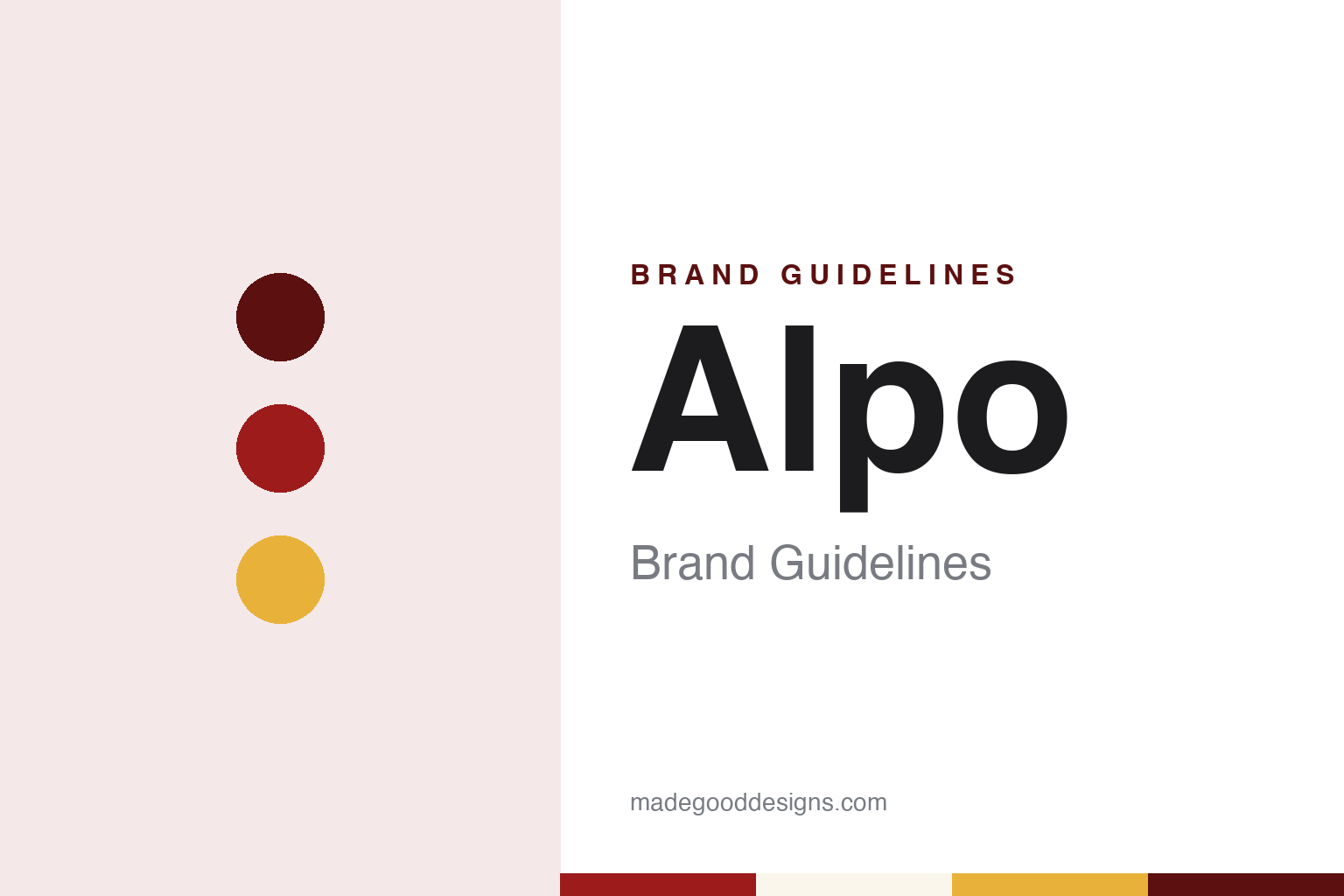
Two constants: a kennel red, biscuit gold and label cream palette and a condensed headline sans register. Abstract homage — not an Alpo product or mark; no can, bag or logo is reproduced.
Allen Products
A town, a company name and a four-letter contraction.
Alpo takes its name from a company and its company took its name from a town. English Wikipedia says the brand was founded in 1936 by Robert F. Hunsicker in Allentown, Pennsylvania, and that “Alpo” is an abbreviation of Allen Products, the name of the business that made it. The Intercept, in a 2020 report on the politics of the Lehigh Valley, gave the same account: Alpo, it wrote, was an abbreviation for Allen Products, the pet food brand founded in Allentown in 1936. The Morning Call, Allentown’s daily newspaper, described Hunsicker in February 2000 as a founder of the ALPO Dog Food company of South Whitehall Township and as a native of Allentown.
The name is a contraction rather than a description. It joins the first letters of Allen to the first letters of Products, so it carries no picture of a dog and no adjective; it is four letters drawn from the name of the business that first made the food, and it has stayed in use through every change of owner since.
The brand also kept its address. When The Intercept visited in October 2020, it photographed the Nestlé Purina buildings in Allentown and wrote that Alpo was owned by the Swiss company Nestlé and still in the city. The same report recalled that Barack Obama, on a visit to Allentown as president, stopped by a shift change at Alpo and mentioned the visit afterwards in his weekly address, alongside a metal works and a community college.
English Wikipedia describes Alpo today as an American brand of dog food marketed and manufactured by Nestlé Purina PetCare, sold as canned or packaged soft food and as dry kibble, and it gives the brand’s official website as a page on purina.com.
Colour
Tobacco, a London drinks group and Nestlé.
For decades Alpo belonged to companies that were not in the pet food business. English Wikipedia says the Allen Products Company was acquired in 1964 by Liggett & Myers, the tobacco company, and that Liggett & Myers was in turn acquired in 1980 by Grand Metropolitan, the London-based food and drinks group. When Grand Metropolitan sold the Liggett tobacco business in 1986, Wikipedia says, it kept the dog food, which by then traded as Alpo Petfoods, Inc.
The move to Nestlé ran from 1994 into 1995. The New York Times reported on 8 June 1995 that Nestlé had said in September 1994 that it would acquire Alpo from Grand Metropolitan P.L.C. of London, and that the Swiss company planned to fold Alpo into its Friskies pet care division. The Federal Trade Commission had first said, in December 1994, that Nestlé would have to sell a pet food plant in Fort Dodge, Iowa, to a competitor to resolve concerns about canned pet food. Residents of Fort Dodge, fearing for their jobs, flooded the commission with complaints, and on 7 June 1995, the Times reported, the FTC reversed itself, voided the settlement and allowed the merger to proceed without restrictions; British regulators had cleared it the same day. Nestlé has owned Alpo since 1995.
The next change came inside Nestlé. English Wikipedia says that in January 2001 Nestlé announced the merger of Nestlé Friskies with Ralston Purina, the St. Louis company, to form Nestlé Purina PetCare. Alpo has been part of that business since, alongside Friskies, Purina ONE and Dog Chow, and it is presented online as one brand among many on Purina’s own website. The arrangement means that the brand’s name, still built from the old Allen Products company, now sits under a corporate name drawn from Ralston Purina, the business it merged with in 2001.
Taken together, the record shows a business started in Pennsylvania passing from a cigarette maker to a British drinks group and then to a Swiss food company, with the four-letter name kept by each owner in turn. The corporate names above it changed — Allen Products, Liggett & Myers, Grand Metropolitan, Friskies, Nestlé Purina PetCare — while the name on the product stayed Alpo.
Typography
Design and documentation.
The brands in this group all sell food for cats, dogs and other household pets. Pet food reaches its buyer through a small set of familiar formats: the printed paper or plastic bag of dry kibble, the steel or aluminium can of wet food, the foil pouch and the cardboard multipack, each stacked in long rows on a supermarket or pet-shop shelf where many rival names sit side by side.
On a crowded aisle, a pet-food brand’s identity is carried mostly by its pack. The front panel usually pairs a wordmark with a photograph or illustration of an animal, a band of colour that separates one recipe or life stage from another, and a short line naming the flavour. The same logo may be adapted for a tall bag, a squat can lid and a small pouch, so its shape, colour and lettering have to hold together at very different sizes and on different materials.
Each guide separates what independent sources record from what the company says about itself — who started the name, who owns it now, and how its labels and advertising have changed — and marks plainly what rests only on the company’s own word.
Aa
A condensed headline sans — the register of a can label and a television super. (Specimen set in Oswald, a sans-serif STAND-IN; NOT the Alpo logo.)
Alpo
A spokesman, a phrase and a plain-spoken dog.
Alpo’s advertising leaned on people rather than drawings. For many years, English Wikipedia says, the brand’s main television spokesman was Lorne Greene, the Canadian actor known from Bonanza, who told viewers he fed Alpo to his own dogs. The line outlived the commercials. Writing in November 2022 about the technology-industry habit of “dogfooding” — staff using their own company’s products — The New York Times noted that one suggested root of the term is the commercials of the 1970s and 1980s in which Greene sang the praises of Alpo as he fed it to dogs, while another story credits a Kal Kan executive. Wikipedia makes the same connection, citing the editor of IEEE Software in 2006.
Other faces followed. Wikipedia says Ed McMahon, the announcer from The Tonight Show, was also associated with the product on television, and that the cartoon cat Garfield appeared as a “spokescat” for the brand in the 1990s. Wikipedia also records an Alpo advertisement on the outfield wall of Connie Mack Stadium in Philadelphia, the home of the Phillies, from the mid-1950s until the park closed in 1970.
In more recent campaigns the brand has spoken to owners of what it called “real dogs”. Wikipedia, citing the trade magazines Brandweek and Promo in 2009, says Alpo’s campaigns targeted the owners of “real dogs” and made light of consumers who pamper their pets. Across these campaigns the brand’s voice came in turn from a television actor, a talk-show announcer, a cartoon cat and, later, the owners of ordinary dogs, while the four-letter name stayed the constant on the can, the bag and the ballpark wall.
For a design guide, Alpo shows how a contraction of a company name can become the whole brand and pass, unchanged in name, from its founding firm to a tobacco company, a London drinks group and Nestlé. Compare it with Friskies, the Nestlé division it was folded into in 1995, and Purina ONE, a sister brand in the same company. For this guide we use kennel red, biscuit gold and label cream with a condensed sans, an unofficial interpretation; no product or logo is reproduced.
Explore & save
Keep Alpo’s identity on hand — save it to a board in the Made Good inspiration library.
Alpo identity set
Pin the Alpo kennel red, biscuit gold and label cream palette and the condensed headline sans register to your own board.