Anolon Brand Guidelines
Meyer’s hard-anodized line, marked out by colour.
Aa
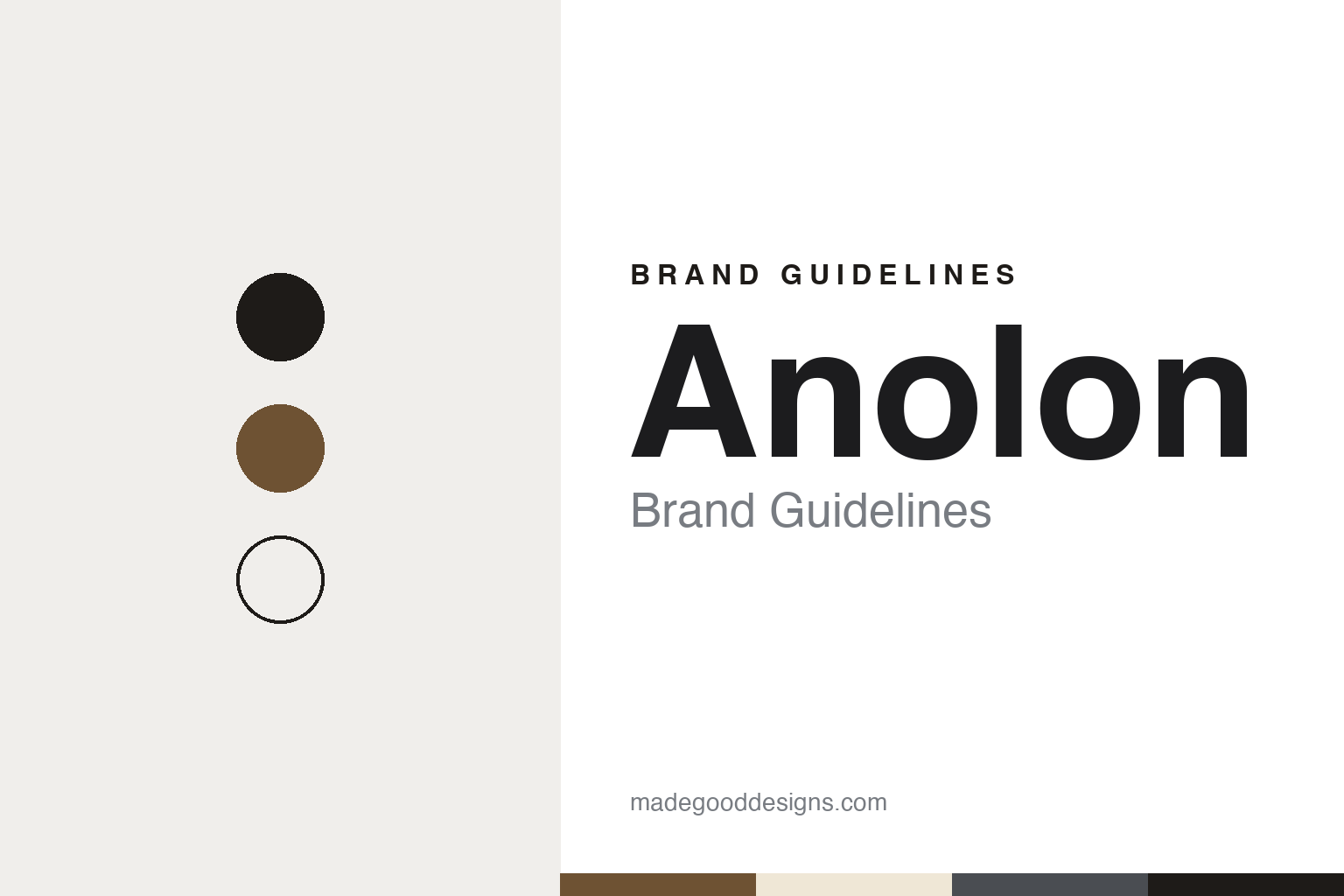
Two constants: a bronze, anodized grey and cream palette and a soft display serif register. Abstract homage — not an Anolon product or mark; no pan, box or logo is reproduced.
Meyer in America
A Hong Kong company with a California base.
Anolon is a cookware brand of Meyer Corporation, U.S., the American arm of the Meyer group, which the group’s international website places in Vallejo, California. The group’s parent, Meyer Manufacturing Company Limited, was founded in Hong Kong in 1951, according to English Wikipedia, which says it made aluminium goods before moving into cookware in 1971 under Stanley K. Cheng. Wikipedia records Meyer distribution centres in Liverpool, England, from 1976 and in Milwaukee, Wisconsin, from 1980, dates the American affiliate to 1981 and says the distribution company moved to California in 1992; Meyer still keeps its manufacturing company in Hong Kong, and lists further offices in Canada, Japan, Taiwan, the United Kingdom and mainland China.
The man behind both companies trained as an engineer. In a 2019 profile in Alta Journal, the food writer Michael Bauer reported that Cheng left Hong Kong for the United States in 1965, enrolled at the University of Oregon’s business school and then switched to mechanical engineering at Oregon State University. Back in Hong Kong he joined his father’s aluminium plants and persuaded his father to make pans; Meyer became a licensee of DuPont and introduced a Meyer cookware line in 1972, Alta reported. Meyer’s American website now calls Cheng “our founder,” and the group’s international site names him as chief executive.
The same profile described Meyer as a privately held company with offices in Hong Kong and Vallejo and manufacturing plants in China, Thailand, Italy and the United States. English Wikipedia lists Anolon among Meyer’s own cookware labels, next to Circulon and a group of lines the company makes under licence, including Farberware.
Colour
A second hard-anodized line and a coined name.
Anolon came after Circulon. Circulon, Meyer’s earlier line, was built on a pattern of concentric grooves on the cooking surface. US Patent 4,768,427, “Cooking pans,” filed on 31 December 1986 and granted on 6 September 1988, names Cheng as inventor and Meyer Manufacturing of Hong Kong as assignee, and its claims describe concentric circular grooves at a pitch of no more than two millimetres. Anolon was a different line: Alta Journal reported in 2019 that Cheng then followed Circulon with Anolon. English Wikipedia describes Anolon as a response to cooks who wanted thicker-gauge pans.
Meyer dates the brand in two ways. Anolon’s “About” page and Meyer Corporation’s brand page both use 1986. Anolon’s heritage page says the brand’s commitment to gourmet kitchenware began in 1984, when its sister brand Circulon had already been making cookware for several years, and that Anolon formally launched in 1989. The heritage page says the original range offered two hard-anodized collections, one for the home cook and one for the more experienced cook.
The name is coined. The company says “Anolon” takes “ano” from hard-anodized and adds a suffix that it glosses as meaning “one.”
The technology itself was not protected. Cheng told Alta in 2019 that his big mistake had been not protecting the Anolon work with patents, and the magazine reported that the Ohio cookware maker Calphalon began using the technology. English Wikipedia, citing a 2011 cookbook from Da Capo Press, says the Anolon technology was not patented and was taken up by rival makers.
Later ranges widened the line. Anolon’s heritage page dates the Nouvelle Copper collection, which added a copper layer to the base of hard-anodized cookware, to 2009, and names Advanced as its cornerstone line, joined by Advanced Bronze with a bronze-coloured exterior. Meyer’s brand page names its Precision Forge construction and Unity Surface flush rivets. The trade website HomePage News reported the Ascend collection in December 2022 and the Achieve collection in May 2023, both introduced by Meyer Corporation, U.S. The magazine described Ascend as an expansion of the brand and Achieve as a collection of hard-anodized cookware with a coloured exterior.
Typography
Design and documentation.
Cookware reaches most people through a shop shelf before it reaches a stove, so a pan’s identity is carried first by its packaging. A box or sleeve usually shows the piece from above or at an angle, names the range and the collection, and gives the brand a fixed corner where the logo sits from one product to the next. Colour on the box often signals the range rather than the company, which lets one maker run several lines side by side without each one looking like the others.
Smaller printed pieces carry the name once the box is gone. Hang-tags and card wraps travel with pans sold loose on a rail, while the underside of a pan or the end of a handle may carry a stamped or cast mark that stays with the piece for as long as it is used. Those small marks are where a name is most often seen at home.
Each guide in this group sets out who started the brand, who owns it now and how its name has been presented, and separates what independent sources record from what the company says about itself.
Aa
A soft display serif — the register of a kitchen-shop shelf. (Specimen set in Fraunces, a serif STAND-IN; NOT the Anolon logo.)
Anolon
Ranges told apart by colour and metal.
Several of Anolon’s ranges are named for, or described by, colour and metal. The Advanced Bronze line is defined by its bronze-coloured exterior, according to the company, and Nouvelle Copper by the copper layer in its base. When HomePage News reported the Ascend collection in December 2022, it described the pans as bronze-coloured with two-toned metal handles and tempered glass lids. When it reported Achieve in May 2023, it said the exterior came in teal, cream and silver, with stainless steel handles and glass lids with metal rims, and that the collection was sold at retailers and on Anolon’s own website.
The brand’s website gathers these ranges under one name. Its “About” page sets out the company’s account of the brand’s history and of features such as flush rivets and sealed rims, and its current range includes a line called Anolon X. Meyer Corporation’s brand page lists Anolon alongside Circulon, Farberware and the other names in the Meyer portfolio.
Circulon is tied to the grooves patented in 1988, while Anolon, by the company’s account, takes its name from anodizing, and its later collections include bronze and copper ranges and the teal, cream and silver finishes of Achieve.
For a design guide, Anolon shows how one material can be presented through a sequence of named ranges, each given its own colour or metal finish under a single coined name. Compare Circulon, Meyer’s grooved line, and Calphalon, the Ohio maker that Alta Journal reported took up the technology. For this guide we use bronze, anodized grey and cream with a serif, an unofficial interpretation; no product or logo is reproduced.
Explore & save
Keep Anolon’s identity on hand — save it to a board in the Made Good inspiration library.
Anolon identity set
Pin the Anolon bronze, anodized grey and cream palette and the soft display serif register to your own board.