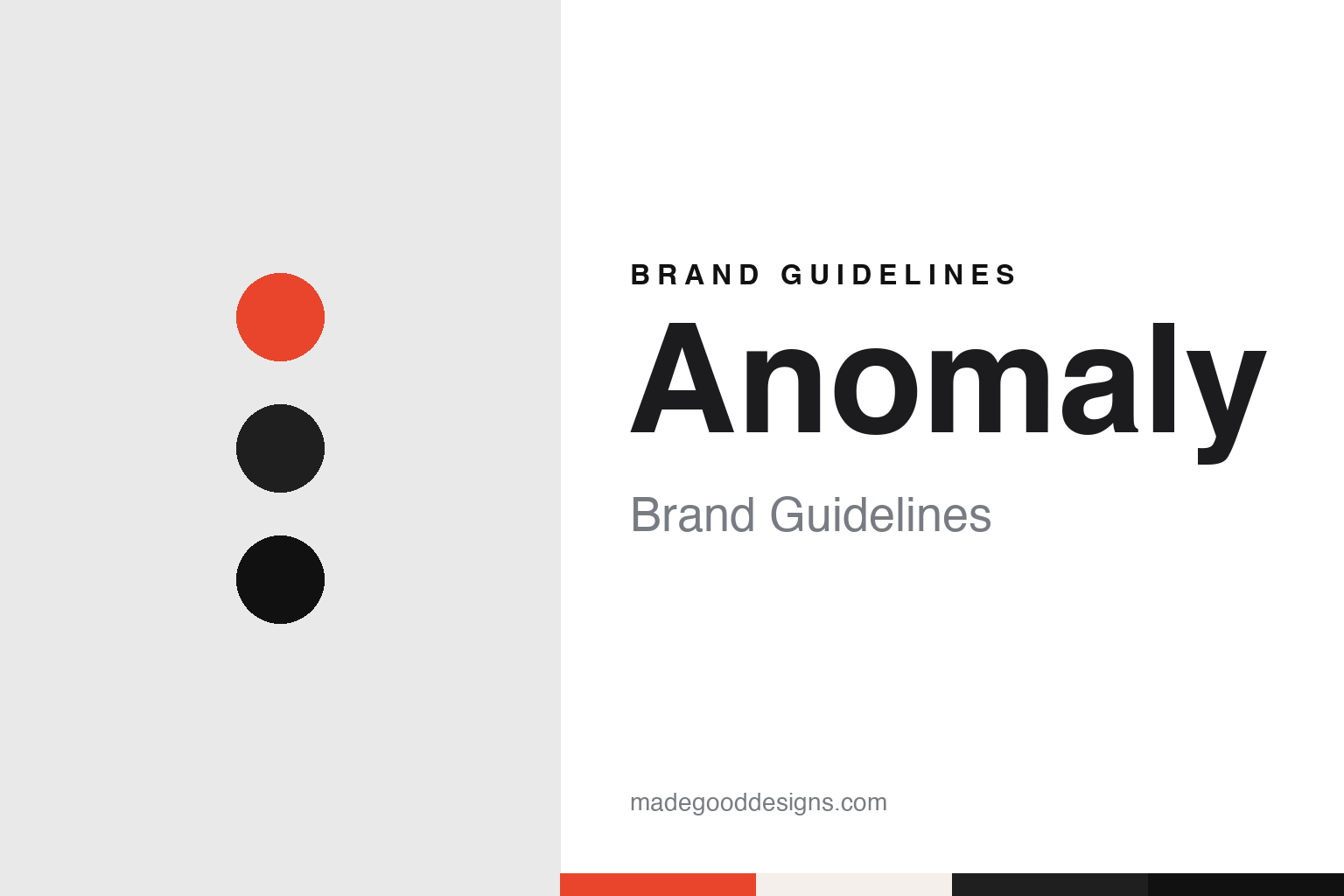
Anomaly Brand Guidelines
A single word that promises to be the exception.
Aa
Two constants: a signal red, graphite and ink palette and a heavy grotesque register. Abstract homage — not an Anomaly asset or mark; no logo, icon or wordmark is reproduced.
A name chosen as a promise
New York, 2004.
Anomaly is an agency named after a word rather than after its founders. Wikipedia says it was founded in New York in 2004 by Jason DeLand, Carl Johnson and several partners, among them Mike Byrne, Justin Barocas and Johnny Vulkan, with the aim of using advertising more widely across different media. The Canadian trade title Marketing, in a profile by Jeromy Lloyd dated 28 February 2012, gives the same year and the same city, and describes Johnson as one of the people who helped found the shop.
Johnson arrived with a history in London. Marketing wrote in 2012 that he had founded Simons Palmer Clemmow Johnson in 1988, an agency that was later sold to Omnicom and merged with TBWA. Anomaly was his second start-up, and this time the partners chose a name that did not list anyone.
The name has been treated as a brief the agency sets for itself. In the 2012 profile Johnson told Marketing: “You can overthink differentiation. We created a company called Anomaly; it’s essential that we be an anomaly and that we’ve thought through what that really means.” The word means something that departs from the usual pattern, and the founder’s quote turns it into a test the company has to pass rather than a description of what it does.
That framing shaped how the shop presented itself. Marketing placed Anomaly in 2012 among agencies that describe themselves as “not just” advertising businesses, and wrote that it had an entire division devoted to developing new intellectual properties. It said the agency was at that point launching cosmetic lines it had helped create, naming Eos, alongside its client work for Budweiser, for which Marketing described it as the global brand agency.
An agency that owns part of what it makes needs an identity that can sit next to a client’s logo and next to its own products. A single, ordinary English word does that job: it is short, it can be set in any typeface, and it carries no surnames that might later leave the company.
Colour
Fuelled, not controlled.
For its early years Anomaly was independent. That changed in February 2011. Marketing reported on 9 February 2011, in a news story by Chris Powell, that MDC Partners had acquired a majority stake in Anomaly, which it described as a multi-discipline agency with offices in New York and London, established in 2004. Financial terms were not disclosed.
The same report listed the clients the agency counted at the time: Umbro, Budweiser, Sony, P&G, Pepsi and Nike’s Converse. It also set the deal inside a larger roster. MDC had invested in the Los Angeles agency 72andSunny two months earlier, and its creative agencies already included Crispin Porter + Bogusky. Anomaly kept its own name inside that group, as the other agencies did.
Johnson described the arrangement in a short phrase. He told Marketing in 2011 that the MDC investment would let Anomaly be “fueled,” but not “controlled,” by a major holding company. The release cited in the report said the money would go into talent, global expansion and work at what it called the intersection of technology, media and brands, and the agency’s growth plan named Brazil, China and mainland Europe as markets for new offices.
The offices followed. Marketing wrote in February 2012 that Anomaly, founded in New York, already had offices in the United Kingdom and the Netherlands, having expanded to Amsterdam about five months earlier, and that Johnson was in Toronto looking for premises for a Toronto office. Johnson told the magazine that the choice of city was partly personal. “We do what we want to do,” he said. “We’re driven by questions like ‘Where is there talent? Where do we think our proposition will play well in the marketplace? And where do we want to go as human beings?’”
For the identity, each new office meant the same word on a new door. Because the name contains no place and no person, it can be paired with any city without changing the word itself.
Typography
One word, many offices.
An advertising agency is in the odd position of selling identity work while needing one of its own. Many agency names are simply the founders’ surnames joined together, sometimes with an ampersand, a plus sign or a slash, and over time those strings are often shortened to initials. That shortening is itself a design decision: a run of capitals reads as a mark rather than a list of people, and it survives the departure of the partners whose names it holds.
Other agencies pick a single word, an animal or a punctuation mark as the anchor, and let the typography do the rest. Because an agency rarely has a product on a shelf, its identity lives on surfaces that are easy to overlook: the reception wall, the office building and its signage, the credentials deck, the business card, the “about” page and, above all, the website, which is often rebuilt more often than the logo. For a designer studying these brands, the useful questions are how the name is set, how the mark behaves when it is shortened or extended for a new office, and how much of the agency’s self-promotion borrows the tone of the work it makes for clients.
Aa
A heavy grotesque — after an agency name set as one plain word. (Specimen set in Archivo Black, a sans STAND-IN; NOT the Anomaly logo or any Anomaly typeface.)
Anomaly
From one agency to an alliance.
MDC Partners later became part of Stagwell, and Anomaly sits in that group today. A Stagwell press release dated 26 February 2024, distributed through PR Newswire, described the agency’s existing offices as New York, Los Angeles, Toronto, London, Berlin and Shanghai. Wikipedia lists the same six cities. The founding city in 2004 and the two cities named in 2011 had grown into a network across three continents.
The 2024 release also introduced a new name built on the old one. Stagwell said it had agreed to acquire What’s Next Partners, a French digital brand and marketing consultancy founded and led by Guy Chauvel, and that it would become the first co-branded member of the Anomaly Alliance, a partnership model meant to extend Anomaly’s reach beyond its own offices. The release called WNP the first in a planned series of acquisitions for the alliance.
In that release Carl Johnson, described as Anomaly’s founding partner and executive chairman, returned to the idea behind the name. “As we expand across continents, it’s essential our clients know our partners exemplify what it means to be an anomaly,” he said. Twelve years after his quote to Marketing, the word was again used as a standard the company says it has to meet.
The agency’s work has also reached outside advertising. Wikipedia says Anomaly made Avec Eric, a cooking series presented by the chef Eric Ripert, and created dosist, a cannabis brand. Together with the cosmetic lines that Marketing mentioned in 2012, these show an agency that puts its name to projects of its own as well as to client campaigns.
Visually, the brand rests on the name more than on a symbol. A single word can be set large on a wall, small on a business card or beside another company’s name, as in the co-branded alliance, without needing a separate mark to explain it.
For a design guide, Anomaly shows how a one-word agency name can stay the same through a change of ownership, a run of new offices and a co-branded alliance, with the founder repeating its meaning at each step. Compare Mother, another agency named with a single word, and the group identity of Publicis. For this guide we use signal red, graphite and ink with a sans, an unofficial interpretation; no product or logo is reproduced.
Explore & save
Keep Anomaly’s identity on hand — save it to a board in the Made Good inspiration library.
Anomaly identity set
Pin the Anomaly signal red, graphite and ink palette and the heavy grotesque register to your own board.


