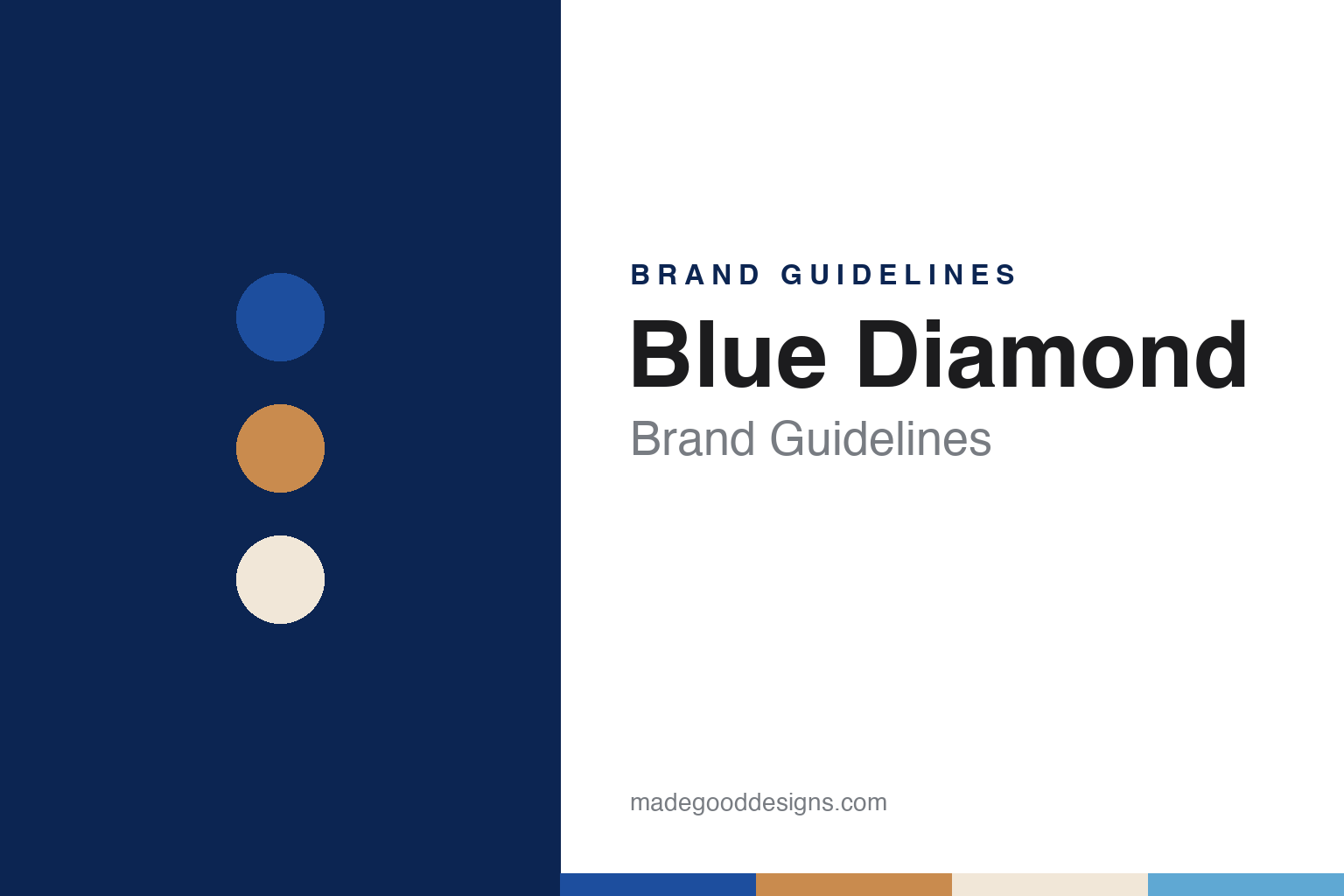
Blue Diamond Brand Guidelines
A growers’ exchange in Sacramento and a blue diamond on the label.
Aa
Two constants: a diamond blue, almond skin and kernel cream palette and a grotesque sans register. Abstract homage — not a Blue Diamond product or mark; no can, carton or logo is reproduced.
The Almond Growers Exchange
A cooperative of growers and a shelling plant by a railroad spur.
Blue Diamond is the brand of Blue Diamond Growers, an agricultural cooperative and marketing organisation for California almonds with its headquarters in Sacramento. English Wikipedia says the organisation was founded in 1910 as the California Almond Growers’ Exchange, and a Sacramento Public Library postcard record, published on the Calisphere archive, dates the founding more precisely to May 1910. Wikipedia describes the cooperative as privately held.
The company sets that founding inside a longer story of the crop. Its own history timeline says California pioneers planted almonds around 1850 in the soils of Sacramento, Monterey and Los Angeles, and that the Exchange, from 1910, led the development of the state’s almond industry from a minor domestic specialty crop.
Processing came early. The Sacramento Public Library record says that in 1914, to help boost sales of shelled almonds, an almond shelling plant was built at Eighteenth and C streets in Sacramento, along a railroad spur. Blue Diamond’s timeline likewise dates a new receiving and packaging plant to 1914. California State Parks, in its listing of the site as a California Historical Landmark, registered on 1 October 1985, dates the original structure on the property to 1915 and says it was designed to mechanize almond processing; the landmark description credits the Exchange with pioneering work in almond production, mechanization and marketing.
Blue Diamond’s timeline says that in 1931 the Exchange introduced mechanical test grading for quality, alongside changes to its grading and shelling processes. The company says the cooperative officially took the name Blue Diamond Growers in 1980, seventy years after the Exchange was formed.
Colour
A label symbol, a smoked almond and an almond drink.
The name came from a label before it belonged to the cooperative. Blue Diamond says the Exchange adopted the blue diamond as the symbol on its label in 1915, to represent quality and to distinguish its almonds from Spanish and Italian imports.
The product range has grown from shelled nuts into snacks and drinks. Wikipedia says the cooperative produces almonds and almond-derived products in various forms, including roasted almonds, almond milk and crackers. Blue Diamond says the six-ounce can of Smokehouse almonds was introduced in 1949, and that it officially introduced Almond Breeze, its almond-milk line, in 1998. The Packer, reporting on the company’s 2025 brand refresh, named Nut-Thins crackers and Almond Breeze among the product lines due to carry the new look after the snack almonds.
The cooperative has used its own members in its advertising. Blue Diamond says that in 1986 it launched the “A Can A Week” campaign, in which real almond growers made the pitch “A can a week, that’s all we ask.”
Wikipedia says that besides its Sacramento headquarters, Blue Diamond has manufacturing plants in Salida and Turlock, California. The company says it opened the Turlock plant in 2013, together with an Almond Innovation Center that it says was built to advance almond product innovation.
Typography
Design and documentation.
The brands in this group are nut and rice names: snack nuts sold in cans, jars and bags, and rice and grain mixes sold in boxes and pouches. In this part of the grocery aisle the package often does as much of the brand’s work as the name, because the food inside can look much the same from one label to the next.
A nut or rice brand’s identity is usually carried by a container, a colour, a character or a line of copy that a shopper can find quickly on a crowded shelf. Many of these names have also changed hands over the years, passing from founders and families to cooperatives, food groups or larger companies, while the pack on the shelf has kept some of its older look. That makes the plain questions behind each name worth asking: who started it, who owns it now, and where its food is grown, packed or made.
Each guide separates what independent, dated sources record from what the company says about itself — its founding story, its owners over time, its packaging and its advertising — and marks plainly what rests only on the company’s own word.
Aa
A sturdy grotesque sans — the clean-cut lettering register of a modern grocery pack. (Specimen set in Archivo, a sans STAND-IN; NOT the Blue Diamond logo or its signature typeface.)
A diamond, redrawn
Turner Duckworth, an edit and a refresh that kept the shape.
The blue diamond has lately been redrawn. The Packer reported on 11 September 2025 that Blue Diamond Almonds was unveiling a new logo and brand identity created with the design agency Turner Duckworth, and that the brand’s look had not been changed since 2004. According to the report, the refresh kept the Blue Diamond shape as a nod to the brand’s heritage while introducing crisp lines and bolder colours and fonts. Graphic Design USA reported on 16 September 2025 that the revamped logo retains the blue diamond shape while modernising its execution with crisper lines and custom typography.
The company described the work in its release, as quoted by The Packer. The key features it listed included an evolved logo that preserves the brand’s diamond shape and colour for continuity with fans, “crisp, clean-cut lettering,” a signature typeface, and a new brand world of bold colourways and “heroic typesetting.” Maya Erwin, Blue Diamond’s vice president of marketing and innovation, said: “This is a refresh, not a revolution.” Blue Diamond’s own timeline records the 2025 change as a refresh of its logo with a cleaner, more modern look.
The agency framed the job as subtraction. “A redesign like this is really about getting two things right,” Miles Marshall, executive creative director at Turner Duckworth, told The Packer. “First, the edit — chipping away at the elements until what’s left are the features that can only be the brand.” In this case, he said, that edit led to the blue diamond itself. The second part, Marshall said, was narrative: the idea of the brand as a champion of the almond, which shaped the graphics, language and colours. Graphic Design USA said the new system was meant to work from motion design to in-store signage.
The rollout was phased. The Packer said the new identity would begin with the snack almond range and spread across product lines from that autumn, eventually reaching Nut-Thins and Almond Breeze, with timing varying by line.
For a design guide, Blue Diamond shows how a symbol chosen for a 1915 label can outlast changes of name, product and packaging, and how a later redesign can work by editing toward that symbol rather than replacing it. Compare it with Ocean Spray and Planters. For this guide we use diamond blue, deep cobalt, almond skin and kernel cream with a grotesque sans, an unofficial interpretation; no product or logo is reproduced.
Explore & save
Keep Blue Diamond’s identity on hand — save it to a board in the Made Good inspiration library.
Blue Diamond identity set
Pin the Blue Diamond diamond blue, almond skin and kernel cream palette and the grotesque sans register to your own board.


