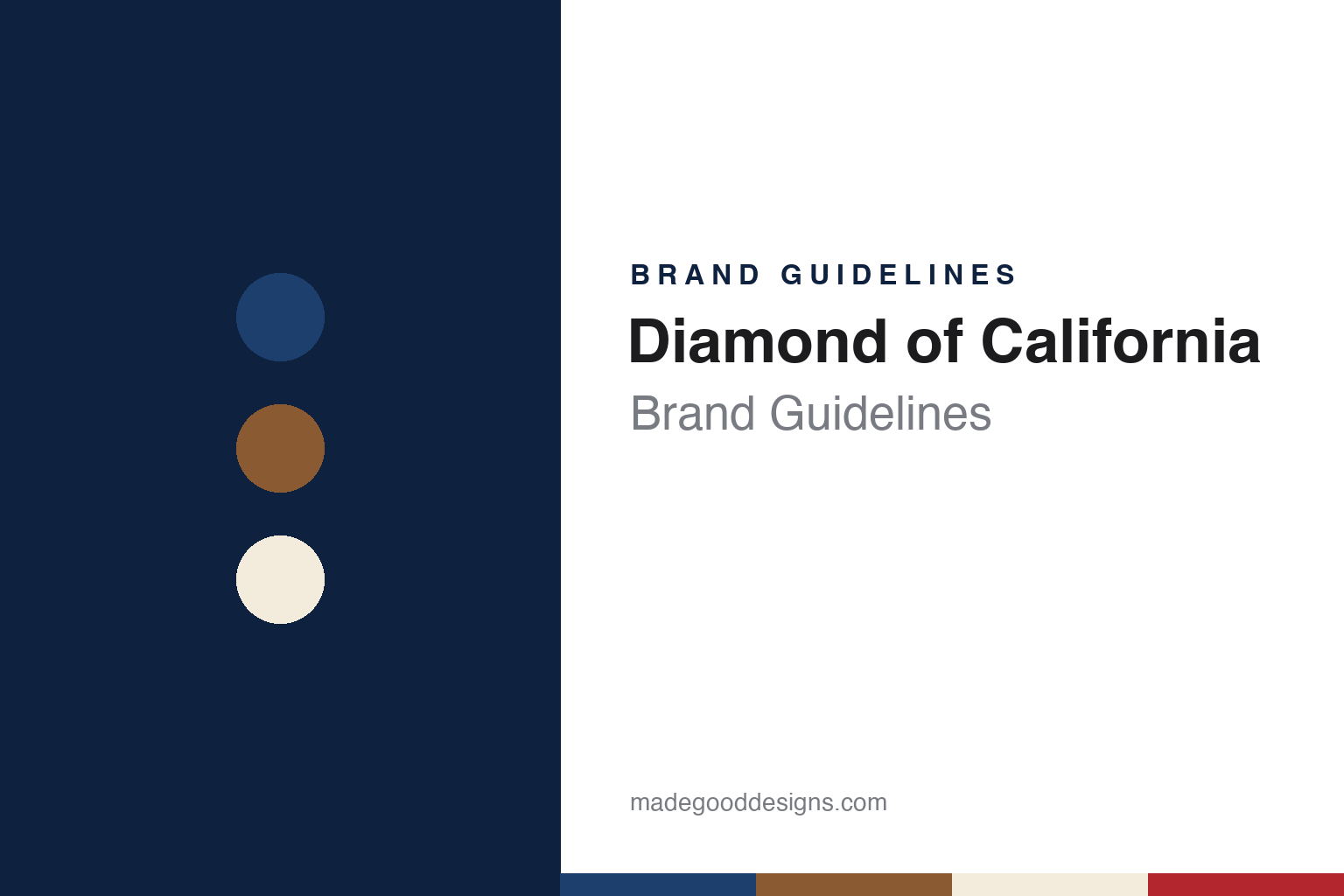
Diamond of California Brand Guidelines
A walnut growers’ co-op, a Stockton base and nuts made for homemade.
Aa
Two constants: a Diamond blue, walnut brown and baking cream palette and a Didone serif register. Abstract homage — not a Diamond of California product or mark; no bag, label or logo is reproduced.
A walnut growers’ co-op
Farmers who pooled their walnuts, and a base in Stockton.
Diamond of California began as a farmers’ business. English Wikipedia says it was founded in 1912 as Diamond Walnut Growers, a member-owned agricultural cooperative of California walnut growers, and the company’s own site tells the same story: it was started that year by a group of California walnut farmers who wanted to bring the crop of the Central Valley to American tables.
Wikipedia’s timeline gives the co-op’s early milestones. It began selling its nuts abroad in 1930, and in 1956 it centralised its operations in Stockton, California, the city that remains the brand’s base. In 1999 the business changed its name to Diamond of California. Reuters, in a long report on the company published on 19 March 2012, also described Diamond as a cooperative through the 1980s.
The brand’s product is the culinary nut: raw, unflavoured nuts bought for cooking and baking. Wikipedia separates the two ways the brand reaches shoppers. In-shell nuts are typically sold in grocery produce sections during the winter holiday season, while shelled culinary nuts are sold in the baking aisle of grocery, mass and club retailers. The company’s site lists shelled and in-shell walnuts, pecans, almonds, black walnuts, macadamias, pine nuts and hazelnuts, as well as nut pie crusts and roasted or glazed toppings.
The company’s careers page says that, more than a century after the growers started it, Diamond still brings a wider range of nuts from its growers and farms to tables worldwide, guided by the line that Diamond Nuts are “Made for Homemade.”
Colour
A share listing, a run of snack deals, and a sale back to a single brand.
The cooperative did not stay one. English Wikipedia says that in July 2005 Diamond Walnut Growers converted to a Delaware corporation and offered stock to the public as Diamond Foods, and Reuters (2012) dates the company’s public listing to the same month. As a listed company it moved beyond culinary nuts. Wikipedia records the launch of the Emerald snack nut line in 2004, and Reuters reported that Diamond bought Pop Secret popcorn in 2008 and Kettle potato chips in 2010.
A larger deal did not happen. Reuters reported in March 2012 that an agreement to buy Pringles from Procter & Gamble was postponed when the board began an accounting inquiry, and that the deal ultimately fell apart.
Diamond Foods was then bought by Snyder’s-Lance. Global AgInvesting reported on 30 November 2016 that Snyder’s-Lance, having acquired Diamond Foods in February of that year, had agreed to sell the Diamond of California nut brand, which it described as producing walnuts, almonds, cashews and pistachios, to Blue Road Capital. Snyder’s-Lance kept the snack brands, including Pop Secret and Kettle. The same report described Blue Road as an agricultural-focused private equity fund that takes control positions in businesses along the agricultural supply chain in the Americas. English Wikipedia dates the completed sale to 2017, and notes that from 2018 Campbell’s owned the former Diamond Foods snack brands, which came with Snyder’s-Lance.
Blue Road Capital has owned the nut brand since that sale. The company’s careers page says Diamond of California is part of Diamond Foods, LLC, headquartered in Stockton, alongside a sister company, National Pecan, and that Diamond Foods is owned by Blue Road Capital, a private equity firm based in New York that focuses on agricultural holdings.
Typography
Design and documentation.
The brands in this group are nut and rice names: snack nuts sold in cans, jars and bags, and rice and grain mixes sold in boxes and pouches. In this part of the grocery aisle the package often does as much of the brand’s work as the name, because the food inside can look much the same from one label to the next.
A nut or rice brand’s identity is usually carried by a container, a colour, a character or a line of copy that a shopper can find quickly on a crowded shelf. Many of these names have also changed hands over the years, passing from founders and families to cooperatives, food groups or larger companies, while the pack on the shelf has kept some of its older look. That makes the plain questions behind each name worth asking: who started it, who owns it now, and where its food is grown, packed or made.
Each guide separates what independent, dated sources record from what the company says about itself — its founding story, its owners over time, its packaging and its advertising — and marks plainly what rests only on the company’s own word.
Aa
A high-contrast Didone serif — the recipe-card, holiday-baking register of a culinary nut. (Specimen set in Playfair Display, a Didone serif STAND-IN; NOT the Diamond of California logo.)
Made for homemade
A baking-aisle brand, a holiday bag and a renovation under a new owner.
Diamond of California’s identity is built around use rather than snacking. The brand’s own line, “Made for Homemade,” appears on its about and careers pages, and the about page frames the nuts as ingredients for “treasured and new family recipes,” sold whole, chopped, sliced or slivered, both in and out of their shells. The website is organised around products, recipes and a store finder, and the company says it shares recipes, storage tips and preparation guides on its social channels.
The calendar matters to the brand. English Wikipedia notes that its in-shell nuts are typically sold in grocery produce sections during the winter holiday season, while the shelled range sits in the baking aisle year-round. The company’s site lists both kinds, from in-shell walnuts to shelled pecans and almonds.
The owner describes the current identity as a work in progress. The company’s careers page says that, with the support of Blue Road Capital, Diamond of California is in the midst of a major transformation and in the early stages of a complete brand renovation covering product, packaging, pricing, placement, marketing and new product development. It also says the brand works with food bloggers and chefs on recipes and content, a programme the company calls a culinary influencer programme.
The brand’s news page collects coverage of its newer products, among them nut pie crusts, snack walnuts and seasonal pecan and pumpkin items. Those products sit alongside the walnut range on which the growers’ cooperative was founded in 1912.
For a design guide, Diamond of California shows how a farmers’ cooperative name can survive a listing, a run of acquisitions and a private-equity sale while keeping its place in the home kitchen. Compare the Blue Diamond guide, a California almond growers’ cooperative, and the Kettle Chips guide, a former Diamond Foods sibling. For this guide we use Diamond blue, walnut brown and baking cream with a Didone serif, an unofficial interpretation; no product or logo is reproduced.
Explore & save
Keep Diamond of California’s identity on hand — save it to a board in the Made Good inspiration library.
Diamond of California identity set
Pin the Diamond of California blue, walnut brown and baking cream palette and the Didone serif register to your own board.


