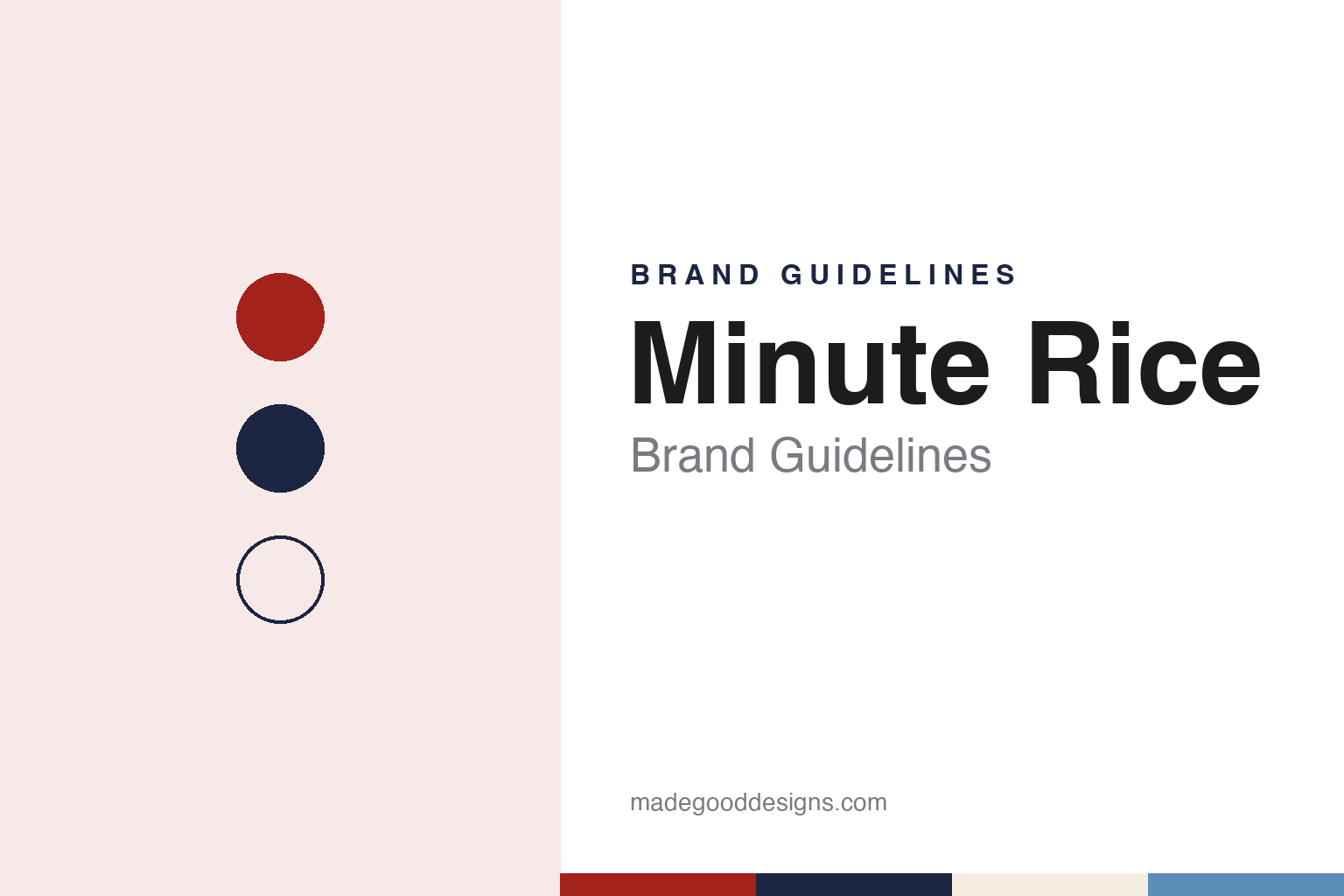
Minute Rice Brand Guidelines
A drying process, a wartime ration and a brand name that is a unit of time.
Aa
Two constants: a kitchen red, deep navy and grain cream palette and a sturdy sans register. Abstract homage — not a Minute Rice product or mark; no box, cup or logo is reproduced.
Rice in a minute
A drying process, a 1941 sale and a wartime ration.
Minute is an American brand of instant rice owned today by Riviana Foods, the Houston rice company that has been part of the Spanish group Ebro Foods since 2004. English Wikipedia describes the product plainly: the rice is parboiled and then dried before it is packed, so that it cooks quickly at home. The brand name and the product promise are the same idea, and the identity has been built around time saved in the kitchen.
The process came before the brand. Wikipedia says Ataullah K. Ozai-Durrani, an Afghan inventor, devised a way in the late 1930s to pre-cook rice and then dry it, so that the grains could be rehydrated simply by boiling them briefly. Wikipedia’s article on instant rice, citing a New York Times notice of 5 May 1964 headlined “A. K. Ozai-Durrani, Made ‘Minute Rice’”, dates the process to 1939. Ozai-Durrani sold his method to General Foods in 1941, Wikipedia says.
The early customer was the military. Wikipedia says General Foods first supplied the quick-cooking rice to the US Army, citing a Harvard Business School study of product innovation in food processing, and the brand’s own timeline says the US Armed Forces used Minute Rice in special GI rations in 1942 and 1943, for troops in Europe and the South Pacific during the Second World War.
The date of the civilian launch depends on the source. Wikipedia, citing The Oxford Companion to American Food and Drink, says General Foods released Minute Rice commercially in 1946, and its article on instant rice says General Foods mass-marketed the product from that year. The brand’s website dates its start to 1941, when, it says, “sixty second rice” was introduced to the market. Wikipedia’s article on Ebro Foods gives 1946 for the introduction to the wider public and 1949 for broader distribution.
The product was refined after the launch. Wikipedia says an improved version was released several years later, and the brand’s timeline places a newly developed, quicker Minute White Rice in 1957. Wikipedia’s article on Ebro Foods says Minute Rice today sells boxed instant rice and rice cups in many rice varieties, as well as quinoa.
Colour
General Foods, Kraft, Ebro and Riviana.
Minute Rice stayed with General Foods and its successors until 2006. Wikipedia says the brand was heavily marketed through the 1950s in magazines including Life and Better Homes and Gardens, and the brand’s timeline says a national advertising campaign began in 1949. The same timeline records a “tuck-tight top” introduced in 1966, which it says made the box easier to open and less likely to spill in storage.
General Foods was later combined with Kraft. Wikipedia says that General Foods merged with Kraft to form Kraft General Foods, which became Kraft Foods in 1995. Around that time, Wikipedia says, citing an Advertising Age report of January 1998, sales of the product began to slip; industry executives attributed this to complications from the merger, the rise of store brands and a shift by some consumers from rice toward potatoes and pasta. Kraft answered with a new round of advertising that included a recipe hotline, 1-800-Minute-1, Wikipedia says.
The brand’s timeline lists product additions across those decades: Minute Premium Rice, a precooked parboiled rice it describes as less sticky and light golden in colour, in 1989; Minute Instant Brown Rice in 1990; and flavoured One-Dish meals in 2003. Wikipedia’s article on Ebro Foods also dates the move into brown rice to 1990.
The sale came in 2006. In a release dated 27 July 2006 in Madrid, Ebro Puleva, now Ebro Foods, announced that it had reached an agreement with Kraft Foods Global to buy the Minute Rice business in the United States and Canada, with completion subject to approval from the US antitrust authorities. Ebro said the purchase opened the Canadian rice market to the group, and it expected the brand to work alongside Riviana, New World Pasta and Panzani in commercial, industrial, marketing and advertising areas. Riviana’s own history says it acquired the Minute brand and business from Kraft Foods Global that year.
Wikipedia adds that in Canada the business went to Ronzoni Foods Canada Corporation, which was renamed Catelli Food Corporation. Riviana Foods has owned Minute Rice since 2006, and the brand’s website now carries a Riviana Foods copyright.
Typography
Design and documentation.
The brands in this group are nut and rice names: snack nuts sold in cans, jars and bags, and rice and grain mixes sold in boxes and pouches. In this part of the grocery aisle the package often does as much of the brand’s work as the name, because the food inside can look much the same from one label to the next.
A nut or rice brand’s identity is usually carried by a container, a colour, a character or a line of copy that a shopper can find quickly on a crowded shelf. Many of these names have also changed hands over the years, passing from founders and families to cooperatives, food groups or larger companies, while the pack on the shelf has kept some of its older look. That makes the plain questions behind each name worth asking: who started it, who owns it now, and where its food is grown, packed or made.
Each guide separates what independent, dated sources record from what the company says about itself — its founding story, its owners over time, its packaging and its advertising — and marks plainly what rests only on the company’s own word.
Aa
A heavy, compact sans — the plain, quick-reading register of a grocery-shelf box. (Specimen set in Archivo Black, a sans STAND-IN; NOT the Minute Rice logo.)
From box to cup
Rice cups, new grains and a Louisiana-rooted owner.
Under Riviana the brand moved beyond the box. Riviana’s history says that in 2006 it introduced, under the Minute name, microwavable ready-to-serve single-serve rice cups that cook in one minute, and the brand’s timeline says Minute rice cups reached stores in 2008, the year Wikipedia’s article on Ebro Foods also gives for the launch. The timeline lists a Multi-Grain Medley in 2013 combining brown, red and wild rice with quinoa, and later Jasmine and Basmati rice cups.
The owner has its own long history. Riviana traces itself to 1911, when a consortium led by Frank A. Godchaux Sr. bought rice mills in southwest Louisiana to form the Louisiana State Rice Milling Company; that company merged with River Brand Rice Mills in 1965 to become Riviana Foods Inc., and Ebro Foods acquired Riviana in 2004. Riviana’s headquarters is in Houston, Texas, and its locations page lists rice plants in Texas, Arkansas, Louisiana, Tennessee, California and Minnesota, along with two sites in Canada.
That puts Minute alongside older rice names on the same shelf. Its stablemates include Mahatma, which Riviana’s predecessor introduced in 1932, and Success boil-in-bag rice, which Riviana says it began test-marketing in 1971. The brand’s website organises its recipes under headings such as “Epic Rice Bowls” and has a section titled “Minute Bowl Heads”.
For a design guide, Minute Rice shows how a single product promise can carry a whole identity: a brand name that is a unit of time, a wartime ration story, and a pack format that moved from the box to the microwavable cup. Compare it with Ben’s Original, another American rice brand with a Houston history, and with its stablemate Mahatma. For this guide we use kitchen red, deep navy and grain cream with a sturdy sans, an unofficial interpretation; no product or logo is reproduced.
Explore & save
Keep Minute Rice’s identity on hand — save it to a board in the Made Good inspiration library.
Minute Rice identity set
Pin the Minute Rice kitchen red, deep navy and grain cream palette and the sturdy sans register to your own board.


