Bostitch Brand Guidelines
The Boston wire stitcher that gave a country its word for stapling.
Aa
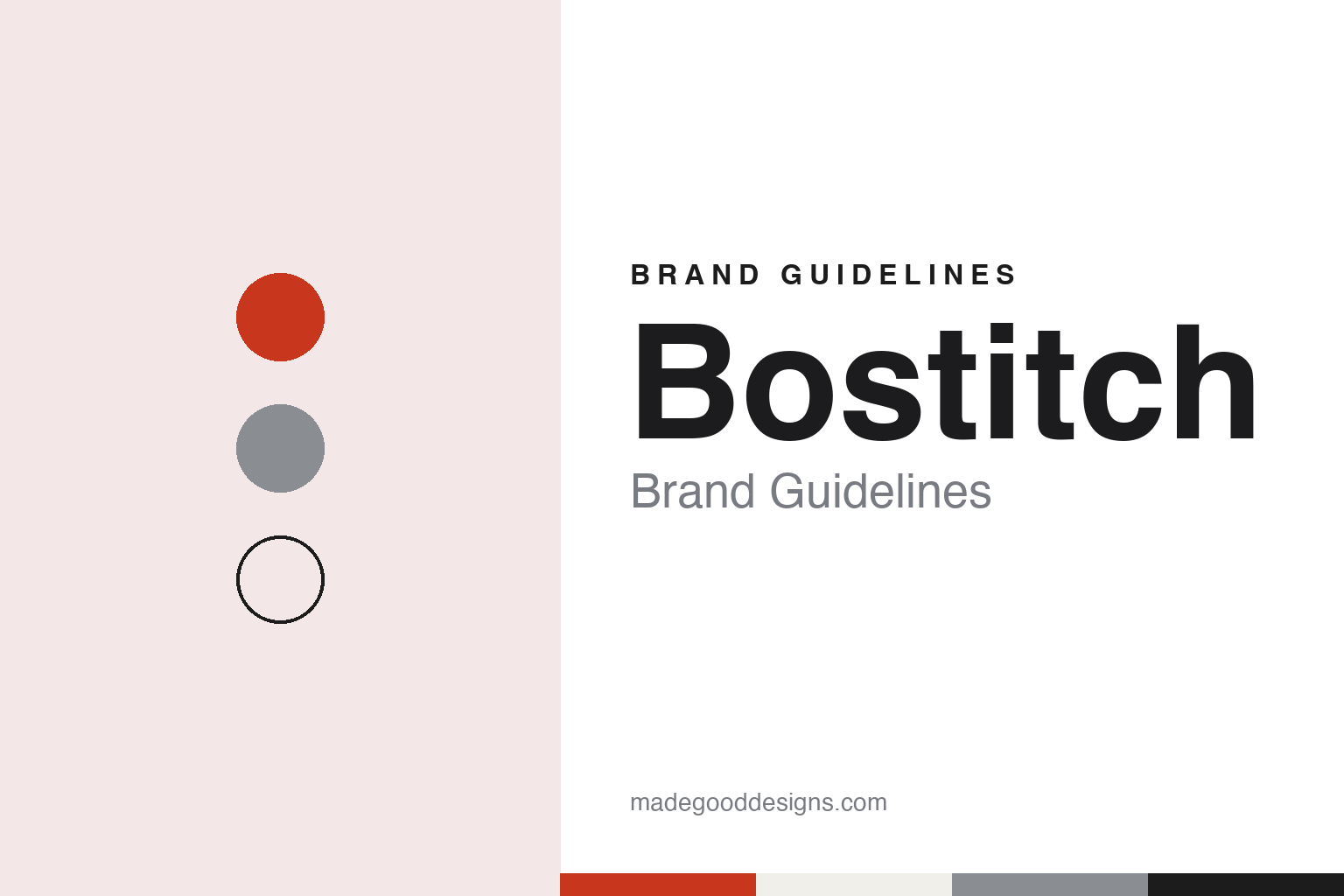
Two constants: a Bostitch red, steel and black palette and an industrial condensed sans register. Abstract homage — not a Bostitch product or mark; no stapler, logo or nameplate is reproduced.
Boston, 1896
A wire-stitching machine for books.
Bostitch began with bookbinding. English Wikipedia says Thomas Briggs founded the company in Arlington, Massachusetts, in 1896 as the Boston Wire Stitcher Company, after inventing a machine that stitched books from a coil of wire; Stanley’s British Bostitch website gives the name as the Boston Wire Stitch Company. The British site describes the early products as treadle-operated wire-stitching machines for fastening books, calendars and hat boxes. The first machines used pre-formed staples that had to be fed one by one along a track; staples collated first with paper and then with glue followed, the same site says.
The company concentrated on commercial stitching machines and made other kinds of industrial staplers, English Wikipedia says. Its move toward the office came in 1914 with the Model AO, a “portable stapling-machine” patented in the name of the inventor Arthur H. Maynard and assigned to the Boston Wire Stitcher Company; English Wikipedia, citing the magazine American Heritage, describes it as an ancestor of the modern desk stapler.
Maynard’s name is on the next patent too. In 1924 the company introduced the Bostitch No. 1, a stapler that used strips of staples joined together — the cohered strip that desk staplers still load — according to English Wikipedia, which cites the patent published on 26 August 1924 and Bostitch’s own company history.
During the Second World War the company joined five other firms to form the New England Small Arms Corporation, which made Browning Automatic Rifles, English Wikipedia says, citing American Rifleman.
Colour
Boston plus stitch.
The brand name is a contraction. In 1948 the company officially changed its name to BOSTITCH, a blend of “Boston” and “stitch,” English Wikipedia says; Stanley’s British site connects the change to the growing range of industrial stapling machines.
The business left Massachusetts long ago. English Wikipedia records that in 1957 the company moved from Westerly, Rhode Island, to East Greenwich, Rhode Island, which it describes as its current location.
Bostitch has always sold more than office staplers. Stanley’s British site says the purchase of the Calwire Company in 1961, a maker of staplers and a T-nailer, took Bostitch into wood fastening, followed by coil nailers for pallet making and a roofing coil nailer for construction. English Wikipedia lists the range today as fastening tools — staplers, staple guns, nailers, riveters and glue guns — and fasteners such as nails, screws and staples, for home, office, construction and industrial use.
The industrial side remains large in the brand’s own description of itself. Stanley’s British Bostitch site lists manual and pneumatic tools and fasteners for construction, furniture, packaging, pallet and crate making, automotive work and gardening, alongside a complete range of office fastening products. It traces today’s collated nails, brads, staples, rings and clips back to the paper- and glue-collated staples of the early stitching machines. The same page says Stanley has manufacturing plants, offices, distribution centres and service sites around the world.
In one country the brand became a word. English Wikipedia, citing the 2004 Variantenwörterbuch des Deutschen, says that in German-speaking Switzerland “Bostitch” is used as a common noun for a stapler, and the verb “bostitchen” means to staple — used, the article notes, even in an official form from the Zurich social-insurance office.
Typography
Design and documentation.
The seven brands in this group are all office-supply names: Leitz, Rexel, Fellowes, Swingline, Esselte, Bostitch and ACCO. Office-supply brands in general sit at many different points in the trade, from family companies that still carry a founder’s name to labels that now belong to much larger groups, and a single brand can be sold everywhere from a stationery shop to an office-furniture catalogue.
An office-supply brand’s identity is usually carried less by a single stapler or file than by a name, a colour and the products people recognise on a desk, because the company behind the name may have changed hands, moved its factories or grown far beyond the place where it started. That makes the questions behind each name worth asking plainly: who started it, who owns it now, and where its products are actually made.
Each guide separates what independent sources record from what the company says about itself — its founding story, its owners over time, where its products are made and how its identity has changed — and marks plainly what rests only on the company’s own word.
Aa
A condensed industrial sans — the register of tool boxes and staple packs. (Specimen set in Oswald, a sans STAND-IN; NOT the Bostitch logo.)
Bostitch
From Textron to Stanley.
Bostitch has belonged to larger groups since 1966. English Wikipedia says the conglomerate Textron bought the company in 1966. The sale was trailed months earlier: English Wikipedia cites a Providence Journal report of 30 August 1985 that Textron planned to sell Bostitch and two other units in a debt-cutting move. On 28 January 1986 the Los Angeles Times reported that Textron had agreed to sell its Bostitch division to Stanley Works, as part of a plan to reduce debt after Textron’s purchase of Avco Corp. the previous year; English Wikipedia dates the acquisition to January 1986, while Stanley’s British Bostitch site gives 1987. Stanley has owned Bostitch since then, and the company is now Stanley Black & Decker.
The British site says the purchase gave birth to the STANLEY BOSTITCH brand, and that later acquisitions brought Atro, a European tool and fastening maker, and Spenax, a supplier to the bedding and automotive industries, under the Bostitch name. English Wikipedia uses “Stanley Bostitch” as the company’s formal name and notes that it is still more commonly called simply Bostitch.
The brand has kept widening. In August 2013, English Wikipedia says, citing the tool-news site ToolGuyd, Stanley Black & Decker began selling power tools, mechanics’ hand tools and air tools under the Bostitch name through Walmart stores and online distributors. English Wikipedia also lists a separate official website for BOSTITCH Office Products.
For a design guide, Bostitch shows how a company name built from a city and a process can end up as the everyday word for the product. Compare Swingline, another American stapler name, and Fellowes, another American office-products name. For this guide we use a stapler red, a wire steel grey and black with a sans, an unofficial interpretation; no product or logo is reproduced.
Explore & save
Keep Bostitch’s identity on hand — save it to a board in the Made Good inspiration library.
Bostitch identity set
Pin the Bostitch red, steel and black palette and the industrial condensed sans register to your own board.