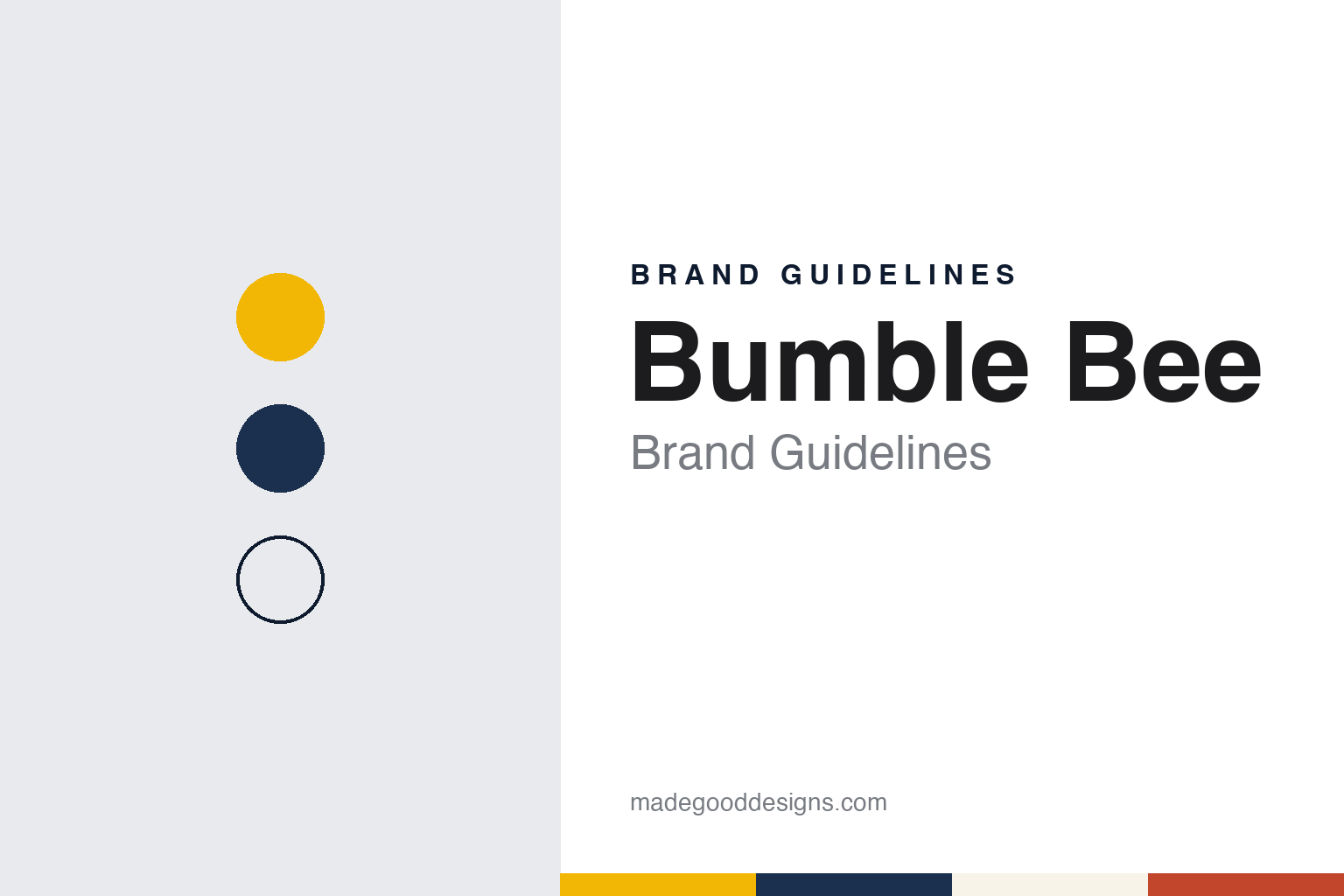
Bumble Bee Brand Guidelines
The Astoria salmon packers’ name that swapped a bee for a lighthouse.
Aa
Two constants: a Bumble Bee yellow and navy palette and a Bold grotesque sans register. Abstract homage — not a Bumble Bee product or mark; no can, label, logo or mascot is reproduced.
Columbia River Packers
Seven salmon canners in Astoria, Oregon.
Bumble Bee began on the Columbia River. In 1899 seven salmon canners in Astoria, Oregon, joined to form the Columbia River Packers Association, led by Andrew B. Hammond, English Wikipedia says, citing the company and The Oregon Encyclopedia. The company dates the Bumble Bee brand to 1910. The association was incorporated in 1924, and in 1946 Transamerica took a controlling interest in it. In 1959 the association went into partnership with the Wards Cove Packing Company, English Wikipedia says.
In 1961 the packers merged with Castle & Cooke, and the business was renamed Bumble Bee Seafoods after its best-known brand, English Wikipedia says. The company’s old Astoria plant, the Samuel Elmore Cannery, burned down in 1993; today Bumble Bee operates canneries in Santa Fe Springs, California, according to the same article.
Colour
Many owners, one name.
English Wikipedia sets out a long chain of owners after Castle & Cooke: a management buyout in 1985; Pillsbury in 1988; the Thai company Unicord in 1989, a sale the New York Times reported that August, after Grand Metropolitan had taken over Pillsbury in a hostile bid; bankruptcy and a sale to International Home Foods in 1997; ConAgra in 2000, when it bought International Home Foods; the private-equity firm Centre Partners in 2003; a 2004 merger with Canada’s Connors Bros.; Centre Partners again in 2008; and the London investment firm Lion Capital in 2010. The business took the name Bumble Bee Foods, LLC, in 2005. Within the combined company, Bumble Bee was the name used in the United States and Clover Leaf the name used in Canada, the article says.
That period ended in court. Bumble Bee was sued in August 2015, accused of colluding with Chicken of the Sea and StarKist to fix prices, and a planned merger with Chicken of the Sea was called off in December 2015 after the Justice Department raised concerns. In May 2017 Bumble Bee agreed to plead guilty to a single count of fixing canned-tuna prices, the Times of San Diego reported, adding that two of the company’s executives had agreed the previous December to plead guilty in connection with the case and that the Justice Department’s investigation was continuing. In December 2019 Bumble Bee’s former chief executive, Christopher Lischewski, who had been indicted in May 2018, was convicted of conspiring to fix the prices of canned tuna sold in the United States between November 2010 and December 2013, according to the Justice Department as cited by English Wikipedia. In November 2019 Bumble Bee’s parent company and four affiliates filed for bankruptcy in Delaware.
Typography
American tinned seafood.
The seven brands in this group are all American names in tinned seafood: StarKist, Bumble Bee, Chicken of the Sea, Safe Catch, American Tuna, Crown Prince and Season. Tinned-fish brands sit at many different points in the trade, from long-established household names on supermarket shelves to smaller companies built around a single fishery or a single product.
Several of the best-known American names now belong to groups based outside the United States. English Wikipedia records that South Korea’s Dongwon Industries bought StarKist from Del Monte Foods in 2008, that Taiwan’s FCF acquired Bumble Bee in 2020, and that Thailand’s Thai Union became the sole owner of Chicken of the Sea in 2000; Moroccan reports in 2021 recorded the purchase of Season by the Casablanca group Mutandis. A tinned-fish brand’s identity is therefore often carried less by a single factory than by a label, a name and a mascot, because the company behind the name may have changed hands and its fish may be caught and packed far from where the brand began.
That makes the questions behind each name worth asking plainly: who started it, who owns it now, and where its fish is caught and canned. Each guide separates what independent sources record from what the company says about itself — its founding story, its owners over time, where its products are made and how its labels have changed — and marks plainly what rests only on the company’s own word.
Aa
A bold grotesque sans for a brand that kept its heavy lettering. (Specimen set in Archivo Black, a sans STAND-IN; NOT the Bumble Bee logo.)
Bumble Bee
From a bee to a lighthouse.
The present owner came out of that bankruptcy. On 31 January 2020 FCF Co., Ltd., a company based in Kaohsiung, Taiwan, which describes more than forty years in the trading and marketing of tuna, announced that it had acquired Bumble Bee Foods, which its release called “a 120-year old beloved marketer of seafood and specialty protein products,” in a transaction covering Bumble Bee’s North American assets. FCF said it expected no changes to the headquarters in San Diego, and listed Bumble Bee, Brunswick, Clover Leaf and Snow’s among the brands. FCF has owned Bumble Bee since 2020.
The identity changed within weeks. English Wikipedia records Horatio, a bee, as the brand’s mascot, and its advertising jingle “Yum Yum Bumble Bee,” which the ska band Mephiskapheles adapted on its 1994 album. In March 2020 The Dieline reported a redesign by the agency BexBrands that retired Horatio and put a lighthouse in his place, “symbolizing Bumble Bee as a beacon for its sustainable, delicious seafood offerings.” The bold lettering stayed, adjusted to feel more modern and approachable, and the strong colours were kept close to the earlier packs with small adjustments, the magazine said. The aim, according to The Dieline, was to attract shoppers looking for sustainable seafood, bolder flavours and convenient formats without losing the brand’s regular canned-tuna buyers.
Today the company’s website presents a family of brands — Bumble Bee, Snow’s, Clover Leaf, Beach Cliff, Brunswick and Anova — under the line “Help People Thrive – For Life,” with a “Trace My Catch” tool and the phrase “Bee Well For Life.” The site says the family covers “a full range of quality seafoods from wild-caught salmon to shelf-stable tuna, from oysters and sardines to fresh-frozen albacore.” It calls Snow’s “the authentic New England classic” and dates it to 1920, and dates Brunswick, a sardine brand, to 1893. Beyond tuna, English Wikipedia lists salmon, other seafood and chicken among the company’s products, and the Wild Selections label among its brands.
For a design guide, Bumble Bee shows how a 1910 brand name can outlast a long run of owners while its symbol changes. Compare Clover Leaf, its Canadian sister brand, and StarKist, another American tuna name. For this guide we use a honey yellow, ocean navy and lighthouse white with a bold sans, an unofficial interpretation; no product or logo is reproduced.
Explore & save
Keep Bumble Bee’s identity on hand — save it to a board in the Made Good inspiration library.
Bumble Bee identity set
Pin the Bumble Bee yellow and navy palette and the Bold grotesque sans register to your own board.


