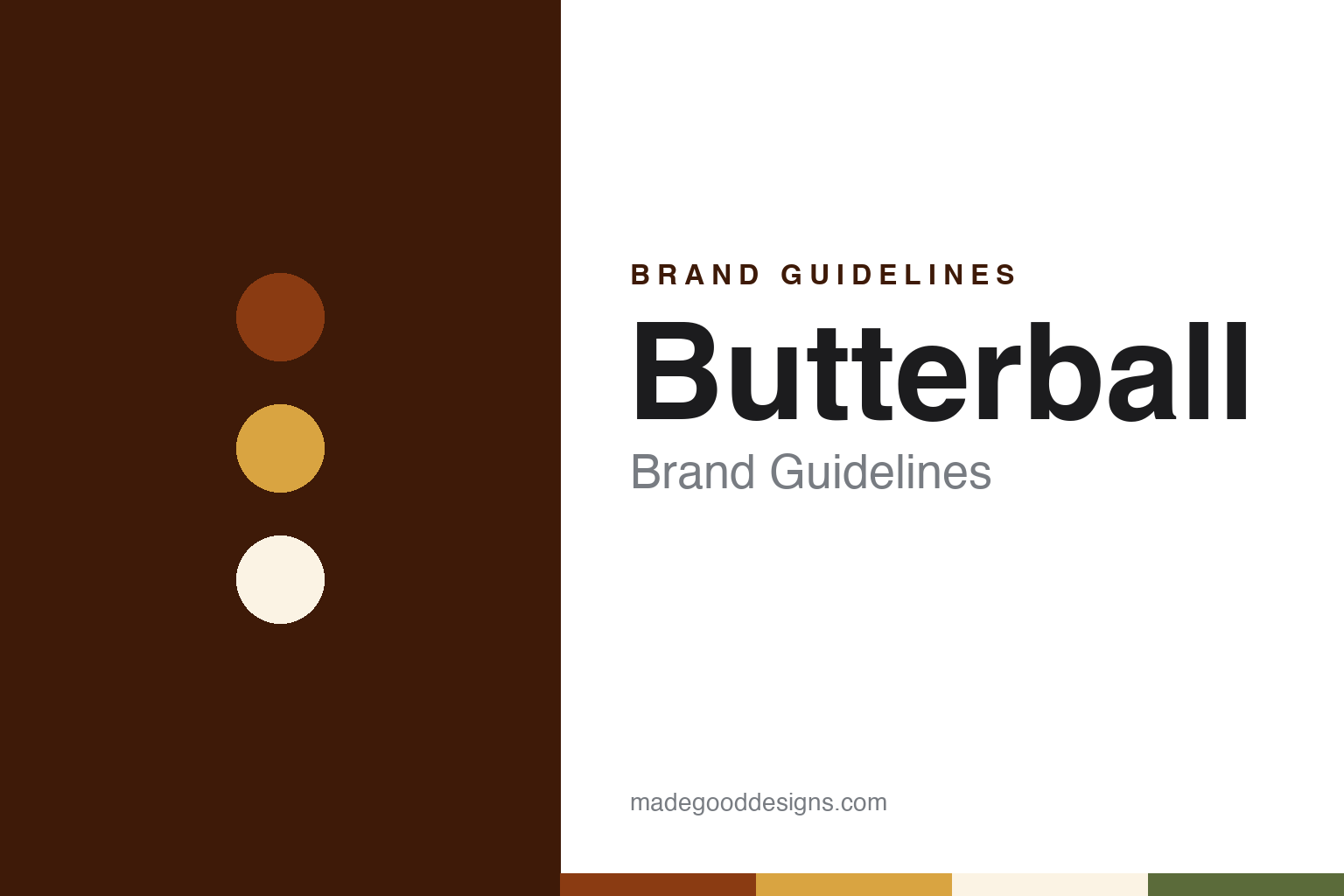
Butterball Brand Guidelines
An Ohio trademark, a Chicago meat packer and a turkey company in North Carolina.
Aa
Two constants: a roast brown, golden skin and gravy cream palette and a soft display serif register. Abstract homage — not a Butterball product or mark; no package, bird or logo is reproduced.
A name before a bird
A trademark from Ohio, a buyer from Chicago and a frozen turkey.
Butterball is an American brand of whole turkeys and turkey products, made today by Butterball, LLC of Garner, North Carolina. The name is older than the Swift turkey. In a November 2017 post for the law firm Foley Hoag, republished by Mondaq, the firm’s trademark writers traced the first application to register BUTTERBALL to Ada Walker of Wyoming, Ohio. Her application, for live and dressed poultry as well as sandwiches, eggs and fresh vegetables, was filed on 5 September 1939, and she claimed to have used the mark since 1938.
The mark then changed hands. Foley Hoag says that in 1951 Leo Peters bought the trademark from Walker and, while he decided what to do with it, licensed it to the Chicago meat packer Swift & Co. The first Butterball turkey was reportedly sold by Swift in 1954, the post says, and trademark assignment records show Peters formally licensing or assigning the registration to Swift in 1956. The Associated Press, in a report carried by USA Today on 21 November 2006, likewise said Butterball sold its first turkey in 1954.
Peters kept part of the name. Foley Hoag says he retained the non-poultry rights to BUTTERBALL and, in the late 1950s or early 1960s, founded Butterball Farms, Inc., a butter company in Grand Rapids, Michigan. Butterball Farms says on its own website that Peters made sure to retain the rights to the name when he sold the turkey patents, and it still makes shaped and flavoured butter under the Butterball Farms name.
The turkey company has its own account of the name. Its corporate-information page, as archived in October 2021, says Butterball received its name from the broad breast and plump, round shape of the turkey. Foley Hoag, for its part, asks where Ada Walker found the word and describes the origin of the mark as a bit shrouded in mystery.
Through the following decades the brand moved with Swift. Foley Hoag says the Swift business and the BUTTERBALL turkey mark went through a series of mergers and spin-offs, sharing corporate homes at various times with companies including Beatrice Foods and ConAgra. By the mid-2000s the Butterball turkey business belonged to ConAgra Foods of Omaha, according to the Associated Press report of November 2006.
Colour
ConAgra, Carolina Turkeys, Smithfield, Maxwell Farms and Seaboard.
The modern company was built from a North Carolina turkey business. Refrigerated Transporter reported on 4 October 2006 that Carolina Turkeys of Mount Olive, North Carolina, had finalised its purchase of Butterball Turkey from ConAgra Foods, and that Carolina Turkeys had changed its company name to Butterball LLC with effect from 2 October 2006. The trade paper said Carolina Turkeys was established in 1986 as a joint venture of Smithfield Foods and Maxwell Farms, an affiliate of the Goldsboro Milling Co., and that the deal brought it processing plants in Arkansas, Missouri and Colorado.
Smithfield’s own press release of 2 October 2006 described Butterball, LLC, formerly known as Carolina Turkeys, as a joint venture between Smithfield and Maxwell Farms in which Smithfield owned 49 percent. It named Keith Shoemaker, formerly of Carolina Turkeys, as chief executive of the new company. The Triangle Business Journal profiled him in November 2007 and said the Mount Olive company had been renamed Butterball LLC after the deal.
The partnership changed four years later. The News & Observer of Raleigh reported on 10 September 2010 that Maxwell Farms, which owned 51 percent of Butterball, was partnering with Seaboard Corp. of Kansas to buy the minority shares held by Murphy-Brown, a Smithfield subsidiary. The paper described Butterball as based in Garner, and said Maxwell Farms had begun in 1916 as a feed mill selling bagged feed across eastern North Carolina and turned to turkeys in 1958. Meatpoultry.com reported the same day that Seaboard had agreed to buy a 50 percent interest, with the Maxwell Farms group holding the other half.
The purchase closed at the end of the year. Refrigerated & Frozen Foods reported on 7 December 2010 that Maxwell Farms, LLC, of Goldsboro, North Carolina, and Seaboard Corporation, of Merriam, Kansas, had finalised the purchase and were now equal partners in Butterball, LLC. Maxwell Farms and Seaboard Corporation have owned Butterball since that deal. Seaboard’s website in 2026 lists Butterball among its business units and says the company is headquartered in Garner and operates processing plants in North Carolina, Arkansas and Missouri.
The plant network has shifted since then. Poultry Producer reported on 6 December 2024 that Butterball planned to close its processing facility in Jonesboro, Arkansas, one of the plants that came with the 2006 purchase. Outside the United States the name follows a different arrangement: the Financial Post reported on 5 June 2014 that the Quebec co-operative Exceldor was taking over P&H Foods and with it the rights to produce and sell Butterball-branded turkey in Canada, under a licensing agreement with Butterball LLC.
Typography
Design and documentation.
The brands in this group are all meat and poultry names, sold from the chiller cabinet, the deli counter and the freezer. Meat and poultry brands in general sit at many different points in the trade, from family packing houses that still carry a founder’s name or a home town to labels that now belong to much larger food groups, and a single name can appear on bacon, ham, sausages, sliced deli meat and frozen dinners alike.
A meat brand’s identity is usually carried less by one package than by a name, a colour and a promise printed on a label, because the company behind the name may have changed hands, moved its production or grown far beyond the place where it started. That makes the questions behind each name worth asking plainly: who started it, who owns it now, and where its products are actually processed and packed.
Each guide separates what independent sources record from what the company says about itself — its founding story, its owners over time, its products and how its labels and advertising have changed — and marks plainly what rests only on the company’s own word.
Aa
A soft, warm display serif — the kitchen-table register of a holiday turkey. (Specimen set in Fraunces, a display serif STAND-IN; NOT the Butterball logo.)
A logo, a phone line and a holiday
A turkey logo registered in the 1980s and a help line that opened in 1981.
The Butterball mark itself has a documented history at the trademark office. Foley Hoag’s 2017 post says Ada Walker’s original registration was allowed to expire in 2001, but that by then it had been replaced by many others, including the BUTTERBALL logo for turkey that shoppers recognise. That logo, the post says, was registered in the 1980s and claims a first use date of 1962, when the brand still belonged to Swift.
The brand’s other long-running signature is a service rather than a symbol. The Turkey Talk-Line, a telephone line for cooks preparing a holiday bird, opened in November 1981, according to Seaboard’s description of Butterball, which says its first staff were home economists. The Associated Press reported in November 2006 that the line was answered from Naperville, Illinois, by Thanksgiving dinner experts trained at what the company called “Butterball University,” and that the new owners intended to keep it the same after the sale. Keith Shoemaker told the AP that callers were used to a Midwestern accent and that he wanted the change of ownership to be seamless for customers over the holidays.
The line has changed with its callers. Butterball’s corporate page, as archived in 2021, says the Talk-Line introduced texting in 2016, and Seaboard says the line can answer questions in English or Spanish. The phone number spells out the brand name, 1-800-BUTTERBALL, which the AP printed alongside its 2006 report.
The range has also widened beyond the whole bird. The AP report of 2006 said ConAgra had focused on whole turkeys and that other Butterball products, including turkey burgers, turkey sausage and turkey bacon, had been lost among ConAgra’s wider range; Shoemaker said the new company would build a sales and marketing staff selling only turkey. Butterball’s 2021 corporate page says the company launched its Farm to Family brand in 2016, and lists deli meat, ground turkey and turkey bacon among its everyday products alongside the holiday bird.
For a design guide, Butterball shows how a single word can carry a brand through several owners: the name was first filed in 1939, the turkey logo dates its first use to 1962, and the company that holds it today traded as Carolina Turkeys until 2006. Compare it with Jennie-O, another American turkey name, and Banquet, a frozen-food brand that, like Butterball before 2006, belonged to ConAgra. For this guide we use roast brown, golden skin and gravy cream with a soft serif, an unofficial interpretation; no product or logo is reproduced.
Explore & save
Keep Butterball’s identity on hand — save it to a board in the Made Good inspiration library.
Butterball identity set
Pin the Butterball roast brown, golden skin and gravy cream palette and the soft display serif register to your own board.


