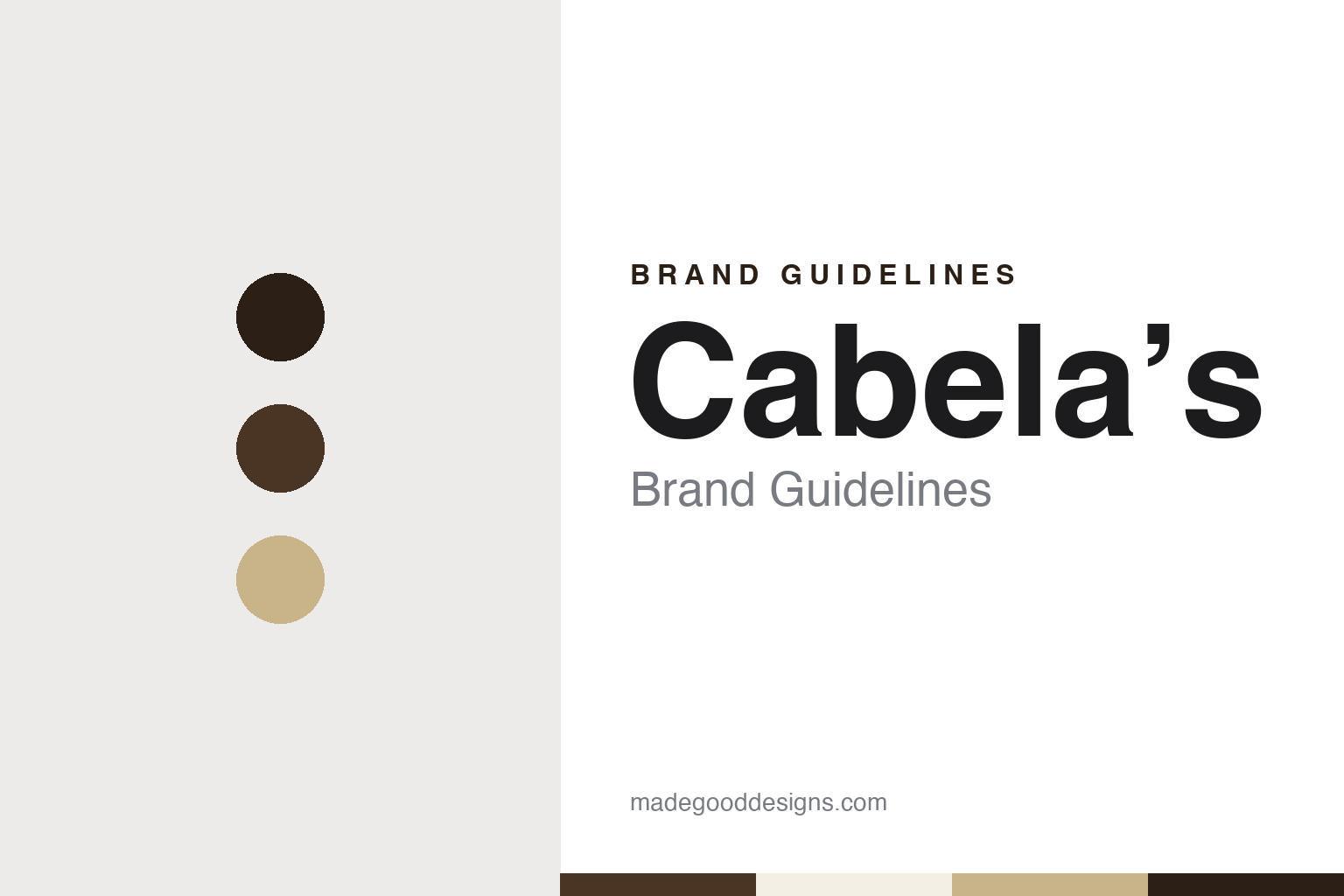
Cabela’s Brand Guidelines
A family hardware store, a box of flies and a catalogue that became a chain of lodges.
Aa
Two constants: a lodge brown, prairie tan and canvas palette and an outfitter slab serif register. Abstract homage — not a Cabela’s asset; no sign, logo, catalogue or product is reproduced.
Flies by mail
A buying trip, an advert and a kitchen table.
Cabela’s began with a purchase that did not sell. The Los Angeles Times, in an obituary of Dick Cabela published in February 2014, said he bought a large batch of hand-tied fishing flies while on a buying trip to Chicago with his father for the family’s hardware and furniture store in Chappell, Nebraska. The flies did not sell in the store, and a newspaper advert in Casper, Wyoming, brought a single order. Then, following a Cabela’s company history, the paper said he placed an advert in Sports Afield offering a few free flies for a small postage charge, and orders began to arrive.
The business that followed was run from home. The Los Angeles Times said it started at a kitchen table in Chappell in 1961, with Dick and his wife, Mary Cabela, assembling the packages and sending them out. An Associated Press report published by The Denver Post on 17 February 2014 said he sold the flies through the mail with his wife and his brother, Jim Cabela, and that this led to the Cabela’s catalogue. English Wikipedia dates the start to December 1961, says the couple kept a record of every name and address that came in, and says Jim joined the company in 1963.
That list of names and addresses was the basis of a catalogue business. Wikipedia says the first mimeographed catalogue became a printed one, and that the operation moved from the basement of a family store to a former American Legion hall. In 1968 the company moved again, into a former John Deere dealership in Sidney, Nebraska, by which time it sold equipment for hunting, backpacking and other outdoor activities as well as fishing gear. Sidney remained the company’s home: the Associated Press described it in 2014 as the town where Cabela’s was based.
Dick Cabela died at his home in Sidney in February 2014, the Los Angeles Times and the Associated Press reported, citing the company. By then the Cabela name, first printed on a small fly catalogue, stood over a chain of large stores in the United States and Canada, according to Wikipedia.
Colour
From catalogue to showroom, and into Bass Pro Shops.
The move from mail order to retail began in Sidney. Wikipedia says a large retail store opened there in 1991, and that later stores were decorated with outdoor scenery, mounted animals and aquariums, with some adding shooting and archery ranges. Those interiors made the stores something more than shops: Wikipedia describes them as wildlife exhibits viewed as tourist attractions. Retail Dive, reporting in September 2017, likewise described the chain as sharing a “destination-like” shopping approach with its rival Bass Pro Shops.
The format also had a smaller version. Wikipedia says Cabela’s announced a new retail format called the Outpost store in late 2011, the first in Union Gap, Washington, and a second in Saginaw County, Michigan, with seasonally rotating merchandise, online-order kiosks and in-store pickup. The company also moved into Canada, buying a family-owned outdoor store in Winnipeg in 2007, according to Wikipedia.
The ownership change came in 2016 and 2017. Retail Dive reported that Bass Pro Shops’ agreement to acquire Cabela’s was announced in October 2016, that both companies received a request for more information from the Federal Trade Commission that December, and that the two companies announced on 26 September 2017 that the merger had been completed, with Cabela’s shares no longer listed on the New York Stock Exchange. The Associated Press, in a report carried by USA Today the same day, said the small western Nebraska town that had been home to Cabela’s was left wondering about its future. Wikipedia says the FTC approved the acquisition in July 2017 and that Cabela’s has been a subsidiary of Bass Pro Shops, based in Springfield, Missouri, since then.
Inside Bass Pro Shops the two names now run side by side. Wikipedia says that many Cabela’s stores were rebranded as Bass Pro Shops through 2024 and 2025, while a number kept the Cabela’s name.
Typography
Design and documentation.
A sporting-goods store is read from the car park before it is read from the shelf. The fascia carries the name in letters large enough to register from a moving vehicle, so retail marks in this field tend toward heavy, wide letterforms, simple outlines and a colour that survives being lit from behind at night. Inside, the job of the identity changes. Departments such as footwear, team sports, fitness, camping, fishing and hunting need hanging signs and aisle markers that work from across a large floor, and the type on them usually follows a stricter, more neutral system than the fascia, so the shopper notices the category before the brand.
Displays carry much of the mood. Product walls, mannequins in seasonal kit, trial areas for shoes or bikes and lodge-style fixtures in outdoor departments all tell a visitor what kind of trip or game the store is preparing them for. Private labels add a further layer: a retailer’s own lines of apparel, footwear or equipment often get their own names, logos and colour palettes, designed to sit beside national brands on the same rail without being mistaken for them. A guide for a store brand can cover the exterior sign, the wayfinding system, the fixtures and the house labels together.
Aa
An outfitter slab serif — the register of a catalogue cover and a lodge sign. (Specimen set in Zilla Slab, a slab-serif STAND-IN; NOT the Cabela’s logo.)
Cabela’s
A surname, a catalogue and a showroom.
The Cabela’s identity is a family name with a possessive, the same form a small-town store would use, and it has stayed that way from the first fly adverts to the large stores. The name belonged to a merchant family before it belonged to an outdoor business: the Los Angeles Times quoted Dick Cabela describing a childhood in a family of merchants, and the first flies were bought for the family’s hardware and furniture store in Chappell.
For decades the catalogue was the main carrier of that name. It began, Wikipedia says, as a mimeographed list and became a printed catalogue, and it gave the company a mailing list that the founders had built by hand from the first orders. When the stores arrived, the identity moved from paper into space. Mounted animals, aquariums and outdoor scenery, as Wikipedia describes them, turned the interior into a large part of the brand, and both Retail Dive and Wikipedia place the stores in the same “destination” category as those of Bass Pro Shops, the company that now owns the name.
The 2017 merger turned a rivalry into a pairing. Wikipedia says Cabela’s branding has appeared with Bass Pro Shops branding in NASCAR sponsorships. That pairing, rather than a single replacement, is how the older Nebraska name has been carried into the larger group, even as some of its stores have been renamed.
For a design guide, Cabela’s shows how a mail-order business can turn a catalogue name into an interior, so that the store itself does much of the work a logo would otherwise do. Compare it with Bass Pro Shops, its owner since 2017, and REI, another outdoor-gear retailer with a long history behind its name. For this guide we use lodge brown, prairie tan and canvas with a slab serif, an unofficial interpretation; no product or logo is reproduced.
Explore & save
Keep Cabela’s’s identity on hand — save it to a board in the Made Good inspiration library.
Cabela’s identity set
Pin the Cabela’s lodge brown, prairie tan and canvas palette and the outfitter slab serif register to your own board.