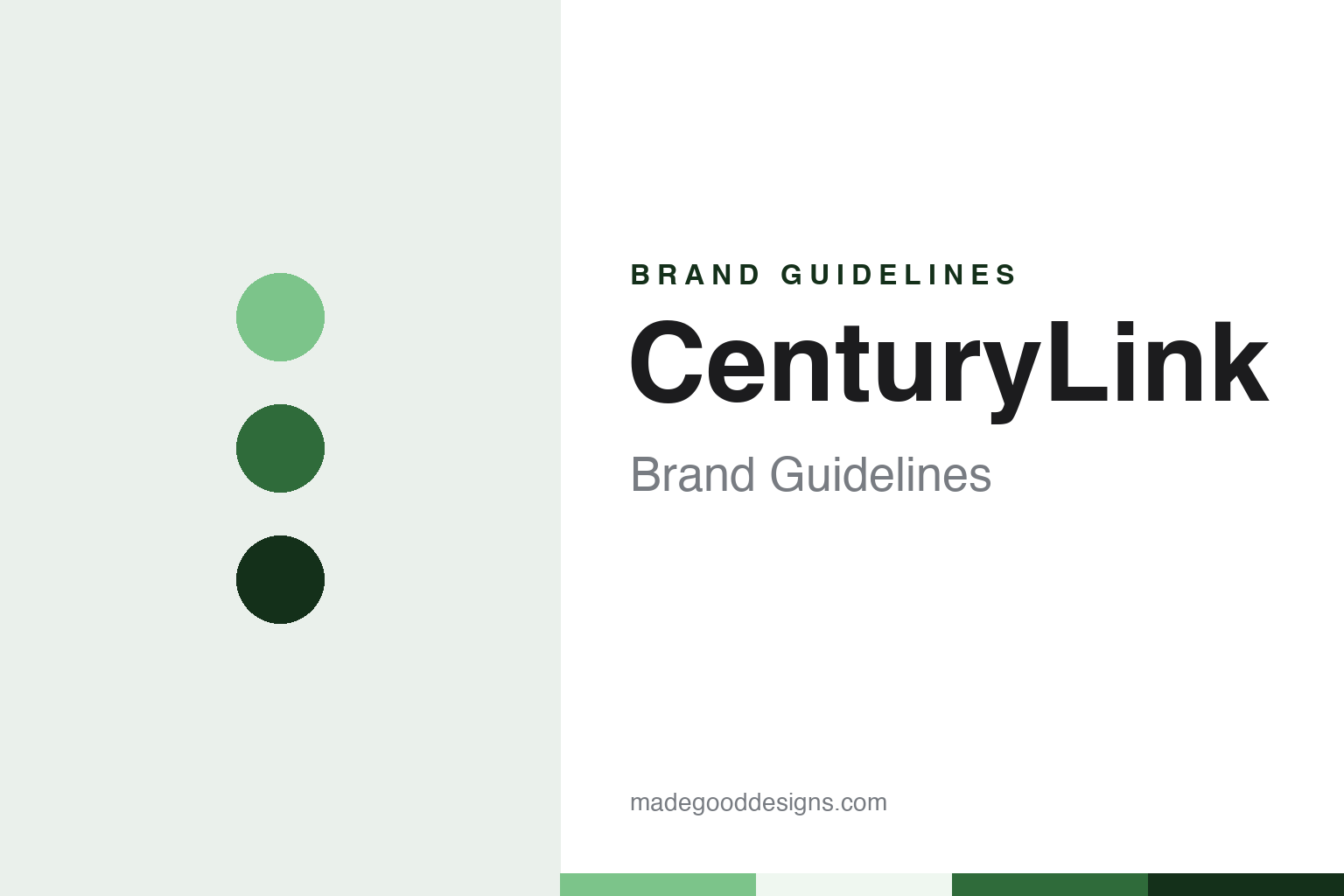
CenturyLink Brand Guidelines
A wedding gift, a century and a link — then light.
Aa
Two constants: a leaf, fern and forest palette and a Neo-grotesque sans register. Abstract homage — not a CenturyLink or Lumen asset or mark; no logo, icon or wordmark is reproduced.
A small-town telephone company
Oak Ridge and Marion, Louisiana.
CenturyLink grew out of a family telephone business in northern Louisiana. Wikipedia traces the company’s roots to the Oak Ridge Telephone Company in Oak Ridge, Louisiana, which F. E. Hogan Sr. sold in 1930 to William Clarke and Marie Williams. In 1946, Wikipedia says, their son Clarke McRae Williams received the family’s telephone company as a wedding gift.
Clarke Williams then bought the Marion Telephone Company and made Marion his base as he grew the business through acquisitions, according to Wikipedia. The company stayed a family-run operation until it was incorporated in the late 1960s, under the name Central Telephone and Electronics, with Clarke M. Williams as president and chairman. In 1971 it was renamed Century Telephone Enterprises, Wikipedia says, and the word “Century” entered the name.
The renamed company kept buying. Wikipedia says Century Telephone acquired the La Crosse Telephone Corporation of Wisconsin in 1972, the start of decades of acquisitions, and went public on the New York Stock Exchange in 1978. Over the following years the company used the shorter name CenturyTel, and it stayed headquartered in Monroe, Louisiana, which remains the home of its successor company today, Wikipedia says.
In those years the company’s name appeared on the monthly bill, in the telephone directory and on the side of the service truck. Wikipedia says that by the early 2000s CenturyTel was adding fibre assets, buying Digital Teleport in 2003, and that it began offering satellite television in 2005. The “Century” name carried through each of those steps, and through a long run of local acquisitions, until a much larger merger led the company to choose a new word to sit beside it.
Colour
CenturyTel, Embarq and a link.
That merger was with Embarq. Wikipedia says Embarq announced on 27 October 2008 that it would be acquired by CenturyTel in an all-stock deal, with CenturyTel’s chief executive Glen Post staying on to lead the merged company, a role he held until 2018; Wikipedia describes Embarq as the former landline business of Sprint. Two names had to become one, and the company chose a new word for the combination rather than keeping either.
The name was CenturyLink. On 19 October 2009, Wikipedia says, the CenturyTel and Embarq brands were retired and the business began trading under the CenturyLink banner, although the new corporate name, CenturyLink, Inc., did not become official until May 2010, and the shares kept trading on the New York Stock Exchange under the old CenturyTel ticker, CTL. The new word kept “Century” from the Louisiana company and added “Link”, a plain description of what a telephone and internet network does.
CenturyLink then grew by merger again. Wikipedia says that on 22 April 2010 CenturyLink, still legally CenturyTel at that point, announced it would acquire Qwest, which brought it the former Bell company US West, and that on 1 November 2017 it closed the acquisition of Level 3 Communications. In between, in July 2011, it bought Savvis, a provider of cloud infrastructure and hosted IT services. Each deal added networks, customers and old brand names, and in each case the CenturyLink name took their place on bills and vans.
The CenturyLink name worked on two layers at once. It was the corporate name on the stock listing and the consumer name on the household bill, the van and the router. That arrangement lasted about a decade, until the company decided that its corporate and consumer layers should carry different words, and that its newest service should carry a third.
Typography
Parents, consumer names and the van.
Cable and broadband identities usually run on two levels at once. There is the corporate parent name, the one that appears on stock listings, regulatory filings and press releases, and there is the consumer brand name that a household actually sees. The two are often different words, and a parent can introduce, retire or merge consumer names while its own name stays the same. For a designer, the useful habit is to ask which layer a mark belongs to before borrowing anything from it.
The consumer layer travels on physical surfaces as much as on screens. Service trucks and vans carry the mark through neighbourhoods every day, so livery has to read at a distance, at speed and in bad light, usually with a short name, a strong single colour and a lot of white or dark ground. Technician uniforms, door hangers and installation boxes repeat the same few elements.
Inside the home, the brand lives on quieter surfaces: the boot screen of a set-top box, the on-screen programme guide, the router label, the remote control and the monthly bill. These are read up close and often, so typography, spacing and a restrained palette tend to matter more there than any large logo.
Aa
A neo-grotesque sans — after a name built from two plain words. (Specimen set in Inter, a sans STAND-IN; NOT the CenturyLink or Lumen logo or any company typeface.)
CenturyLink
Lumen above, CenturyLink and Quantum Fiber below.
The split came in 2020. Light Reading published the company’s announcement on 14 September 2020 that CenturyLink had a new name, Lumen Technologies, or simply Lumen, for the parent company. The same announcement said CenturyLink would remain as the brand for residential and small business customers on traditional networks, and introduced Quantum Fiber, a digital platform for fibre-based services to homes and small businesses. The stock ticker changed with the opening of trading on 18 September 2020, it said.
Three names now did three jobs. Lumen, a word for a unit of light, named the corporate parent and its business networks; CenturyLink named the older copper-based household service; and Quantum Fiber named the newer fibre service. For a designer, the arrangement is a clear case of a company using names to separate its newer products from its older ones, rather than relying on a single master brand.
The consumer side has since been sold off in pieces. Wikipedia says Lumen agreed in August 2021 to sell its local telephone operations in a group of states to Apollo Global Management, describes the consumer business as divested to AT&T and Brightspeed, and says the sale of Quantum Fiber to AT&T closed on 2 February 2026, after which the service was rebranded “Quantum Fiber from AT&T”. The CenturyLink name, born in 2009 from a Louisiana company and Sprint’s former landline business, now covers a narrower part of the business than it once did.
Lumen Technologies remains headquartered in Monroe, Louisiana, near the towns where the Williams family ran its telephone company.
For a design guide, CenturyLink shows how a corporate name can become a consumer brand when its parent takes a new name, and how a third brand can be set beside it for a newer product. Compare Frontier Communications, another telephone company that grew by buying local networks, and Sprint, whose landline business became Embarq. For this guide we use leaf, fern and forest with a sans, an unofficial interpretation; no product or logo is reproduced.
Explore & save
Keep CenturyLink’s identity on hand — save it to a board in the Made Good inspiration library.
CenturyLink identity set
Pin the CenturyLink leaf, fern and forest palette and the Neo-grotesque sans register to your own board.