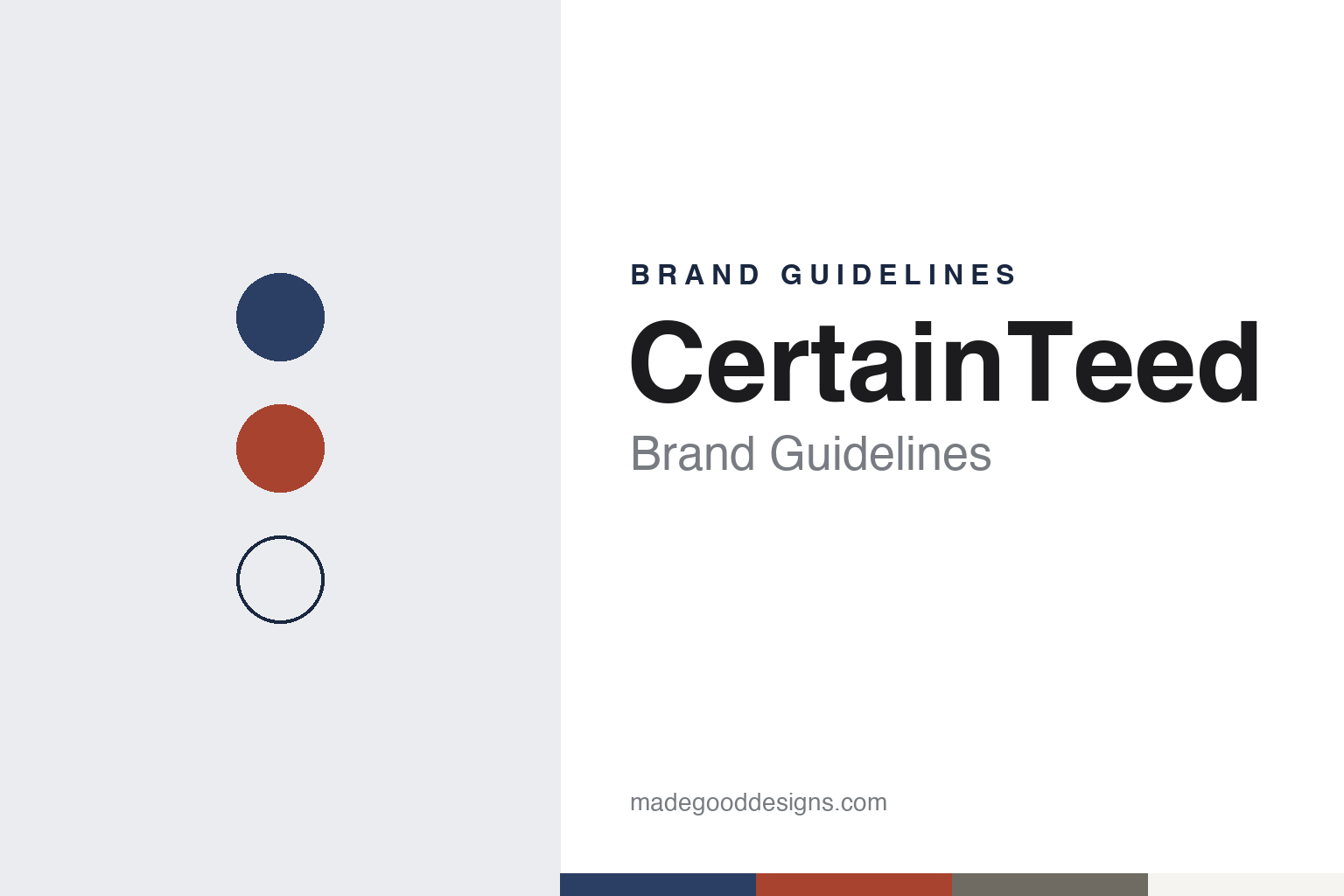
CertainTeed Brand Guidelines
A roofing maker with a military-minded founder, and a company name built from a sales slogan.
Aa
Two constants: a slate blue, clay red and weathered grey palette and an American gothic grotesque register. Abstract homage — not a CertainTeed product or mark; no shingle, wrapper or logo is reproduced.
General Roofing, 1904
A founder with a military background and a slogan.
CertainTeed is a North American maker of building products, from roofing and siding to insulation, drywall and ceilings, and a subsidiary of the French group Saint-Gobain. Its company history page dates it to 1904, when George M. Brown founded the General Roofing Manufacturing Company.
A fuller account appears in the International Directory of Company Histories (St. James Press, volume 35, 2001), reproduced online by FundingUniverse. It places Brown in East St. Louis, Illinois, and says that he had a military background, which he chose to reflect in the name General Roofing. He gave his early roofing materials military-sounding names such as Major, Sergeant and Guard, names he hoped would suggest quality and strength. His first products were two kinds of asphalt roofing, a smooth roll and a grit-surfaced type, made in a small roofing plant with a small dry felt mill.
Growth came from paper. According to the same history, Brown bought paper mills in Marseilles, Illinois, and York, Pennsylvania, converted them into felt mills and built roofing plants beside them. The directory dates the start of asphalt shingle production to 1913; the company’s own timeline marks 1912 as the year individually cut asphalt shingles were introduced. By 1914, the directory says, the headquarters had moved across the river from East St. Louis to St. Louis, Missouri, and the company went on to add paints and varnishes to its roofing and insulating papers.
The name arrived in 1917. Both the company’s timeline and the directory say General Roofing became the Certain-teed Products Corporation that year, and the directory explains that the name was formed from the motto “Quality made CERTAIN … Satisfaction GuaranTEED.” The company quotes the same slogan as Brown’s own: “Quality Made Certain, Satisfaction Guaranteed.” In 1918, the directory says, the company began trading on the New York Stock Exchange.
Colour
From St. Louis to New York, Valley Forge and Malvern.
The directory traces a long list of additions after the First World War. It says Certain-teed began making floor coverings from its roofing felt around 1920 and gypsum wallboard in 1923, at about the time it moved its headquarters again, from St. Louis to New York City. George Brown retired as president in 1935. In 1938, according to the same history, the company developed the WOODTEX shingle, a heavy asphalt shingle with a texture like wood, and that year the Celotex Corporation of Chicago gained control by buying a majority of its stock. A group of investors led by Rawson G. Lizars later won back control through a proxy contest.
After the Second World War the company moved into fibreglass. The directory says it opened its first research and development centre in Paoli, Pennsylvania, in 1952, bought the Pall Corporation’s fibreglass plant at Mountaintop, Pennsylvania, in 1964 and merged with the fibreglass maker Gustin-Bacon in 1966. The company’s own timeline adds that it began producing solid vinyl siding in 1969.
The French connection began in 1967. According to the directory, Certain-teed formed a partnership that year with Compagnie de Saint-Gobain, creating the Certain-teed Saint-Gobain Insulation Corporation, and in 1971 it bought Saint-Gobain’s American, Canadian and Mexican patents for fibreglass and foam. In 1976 it shortened its name to CertainTeed Corporation, closing up the hyphen and capitalising the T. In 1980 Michael Besson, who had run Saint-Gobain’s paper and packaging division, became president and chief executive. In 1988, the directory says, Saint-Gobain acquired all the remaining shares, and CertainTeed left the New York Stock Exchange to become a subsidiary; the company’s timeline also gives 1988 as the year it became part of the Saint-Gobain family. Saint-Gobain has owned it outright since then.
The directory cites a company anniversary book, 75th Anniversary: CertainTeed 1904–1979, published from Valley Forge, Pennsylvania. Today the company names its headquarters as Malvern, Pennsylvania, next to the Malvern Innovation Center, which it describes as the research and development hub for its roofing, insulation and ceilings businesses. On making, the company says it runs manufacturing facilities in the United States and Canada.
Typography
Design and documentation.
The brands in this group make the outside of a house: the shingles and membranes on its roof, the boards and panels on its walls and the decking and railings around it. Roofing, siding and decking names sit at many different points in the building trade, from businesses that grew out of a single product or family firm to names that now belong to much larger groups selling a whole range of exterior materials.
Most homeowners meet these brands only a few times, and often through someone else: a contractor, a dealer, a sample board or a colour card. A brand’s identity is therefore carried less by a single product than by its name, its product families, its colour ranges and the programmes it runs for the people who install its materials. Ownership can change several times while the name on the bundle stays the same.
Each guide separates what independent sources record from what the company says about itself — its founding, its owners over time, where its products are made and how its names and product lines have changed — and marks plainly what rests only on the company’s own word.
Aa
An American gothic grotesque — a trade-catalogue register. (Specimen set in Libre Franklin, a sans-serif STAND-IN; NOT the CertainTeed logo.)
CertainTeed
A slogan that became a company.
CertainTeed’s name is its most distinctive design asset, because it is a slogan compressed into a word. The directory’s account of the 1917 renaming, building “Certain-teed” from “Quality made CERTAIN … Satisfaction GuaranTEED”, explains the odd spelling, and the 1976 change to CertainTeed, with its capital T in the middle, turned the hyphenated trade name into a single compound word. The company still tells the story on its own history page, where Brown’s slogan opens the timeline.
Its product names tell a similar story of naming as identity. Brown’s first roofing lines, the directory says, took military ranks such as Major and Sergeant to match the General in the company name. Later names leaned towards architecture and estate: the company’s timeline lists Grand Manor®, introduced in 1990, and the Landmark Solaris® solar-reflective shingles unveiled by CertainTeed Roofing in 2008. The directory adds the 1938 WOODTEX shingle, named for its wood-like texture, and notes that in 1959 the company developed a fully automatic shingle-packaging machine.
The parent company is part of the presentation. CertainTeed’s about page calls itself a subsidiary of Saint-Gobain and points to its parent’s long history, saying the group “has been going strong since 1665”. During the energy crisis of the 1970s, the directory says, CertainTeed became known as “The Energy Saving Company”, a phrase tied to its insulation, siding and piping products. Its current home page, built around the line “Let’s Build for Tomorrow. Today”, describes a house “that science built” and organises the range into residential and commercial solutions, from roofing and siding to drywall.
For a design guide, CertainTeed shows how a slogan can harden into a company name and then into a single word, and how product names can carry a house style from military ranks to estate names. Compare it with GAF and Owens Corning, two other American names in roofing and insulation. For this guide we use slate blue, clay red and weathered grey with a sans, an unofficial interpretation; no product or logo is reproduced.
Explore & save
Keep CertainTeed’s identity on hand — save it to a board in the Made Good inspiration library.
CertainTeed identity set
Pin the CertainTeed slate blue, clay red and grey palette and the American gothic grotesque register to your own board.