Charles Alston worked across almost every visual format of mid-century America: hospital murals, prints made for a government art programme, easel paintings that moved towards abstraction, and sculpture. The Met records him as American, born in Charlotte, North Carolina, in 1907 and active in New York, where he died in 1977.
What makes Charles Alston useful to designers is range with discipline. His lithographs are small, quiet studies in value; his murals are public storytelling at architectural scale. Both depend on the same habits: a clear silhouette, a controlled tonal ladder and a composition that leads the eye. Four of his lithographs made for the New York City WPA Art Project are flagged public domain by the Met, and they illustrate this guide. His later paintings remain in copyright, so they are described here in text only. For more public-domain material, browse the MGD museum inspiration collection.
Who was Charles Alston?
The Met’s collection records give his dates as 1907–1977 and his birthplace as Charlotte, North Carolina.
His public career took shape under the New Deal. The Studio Museum in Harlem describes him as the first Black supervisor for the Federal Art Project, a role he took up in 1935, and Britannica likewise identifies him as a supervisor on the Works Progress Administration’s Harlem Hospital mural project. That position made him both an artist and an organiser, directing a team of painters rather than working alone in a studio.
Later he turned to easel painting and taught. The Met bought his oil Painting (1950) in 1951 through its Arthur Hoppock Hearn Fund, and in 2021 acquired his earlier canvas Girl in a Red Dress (1934). In 1963 he joined Romare Bearden and Hale Woodruff in founding Spiral, a group of Black artists who met in New York to discuss the role of art in the civil rights era.
The Harlem Hospital murals: a story in two panels
Alston’s major public commission is a pair of murals for Harlem Hospital, Magic in Medicine and Modern Medicine. Britannica dates the commission to 1936. Columbia University’s project on the hospital’s WPA murals explains that white hospital officials initially objected to the designs as containing too much Black subject matter; Alston kept to his plans, and final approval came in 1940.
The two panels work as a diptych. According to Columbia’s mural project, Magic in Medicine imagines the history of healing in Africa, while Modern Medicine turns to Western medicine and the question of racial integration in the hospital itself. For designers, that is a lesson in paired layout: two panels that share a scale, a horizon and a palette, but carry contrasting content, so the viewer reads them as “then and now” without a caption.
The murals have needed repeated care. Columbia’s project documents conservation of five Harlem Hospital murals, including both Alston panels, beginning in 2005, and Hyperallergic later reported on their restoration. Alston also painted murals with Hale Woodruff for the Golden State Mutual Life Insurance building in Los Angeles.
The murals are not on any museum open-access list, so they appear here in text only. For the wider context of Harlem artists in this period, see our guides to Augusta Savage and Jacob Lawrence.
What to look at in a Charles Alston lithograph
The four Met impressions shown here were a gift of the New York City WPA in 1943. The museum dates Stud Poker to about 1938 and Barn and Tree, Barn and Broken Down Silo and Deserted House to 1935–43. The Met holds separate impressions of related images dated 1934 (Barn and Trees) and about 1938 (Deserted House), which are not public domain.
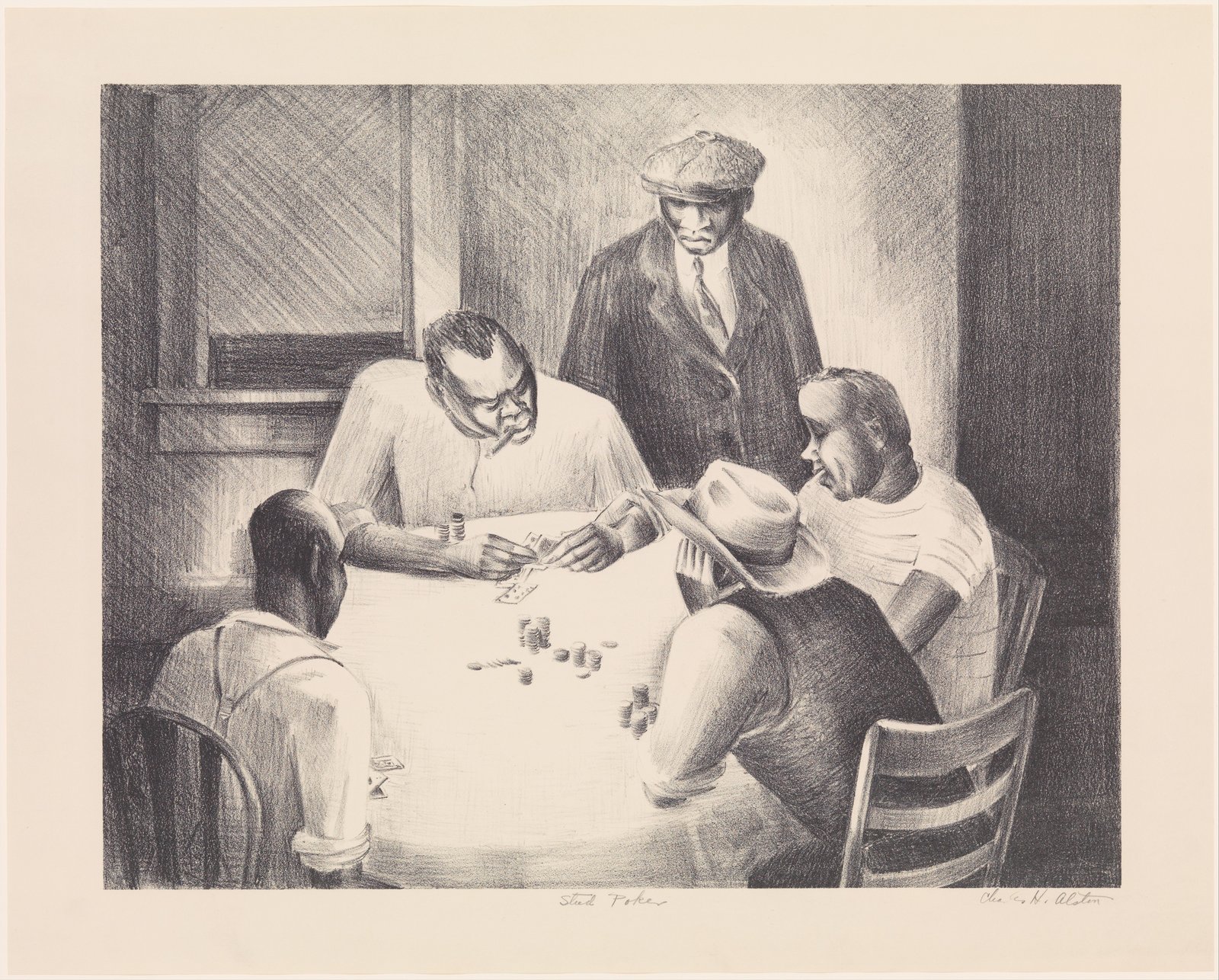
A pool of light at the centre. In Stud Poker, the tablecloth is the brightest shape in the image. Every figure leans towards it, the standing man frames it from behind, and the chips and cards sit on it like type on a page. The room drops into hatched grey around it.
Tone built from crayon strokes. Lithography lets an artist draw on stone with a greasy crayon, and Alston used the crayon as a hatching tool. Look at the walls of the card room: diagonal strokes cross to make a mid-grey without any outline. The same strokes turn into wood grain on the barns.
Four values, not fifty. Measured from the museum’s scan of this impression of Stud Poker, the image sorts into four main tones: paper #ECDFD0, light grey #C5BAAF, mid grey #8E8480 and dark #5C5454. The warmth in those greys comes from the scan of the aged sheet, not from coloured ink, but the structure is clear: a tight ladder of values that keeps every shape legible.

Rural buildings as graphic shapes
The three barn and house prints show another side of Alston’s draughtsmanship. Here the subject is architecture, and the buildings become strong geometric blocks set against soft, swirling skies.
In Barn and Tree, a curving dry-stone wall pulls the eye in from the lower left and loops around the barn, while a bare, forked tree on the right balances the gable. The ground is simplified into rounded mounds.
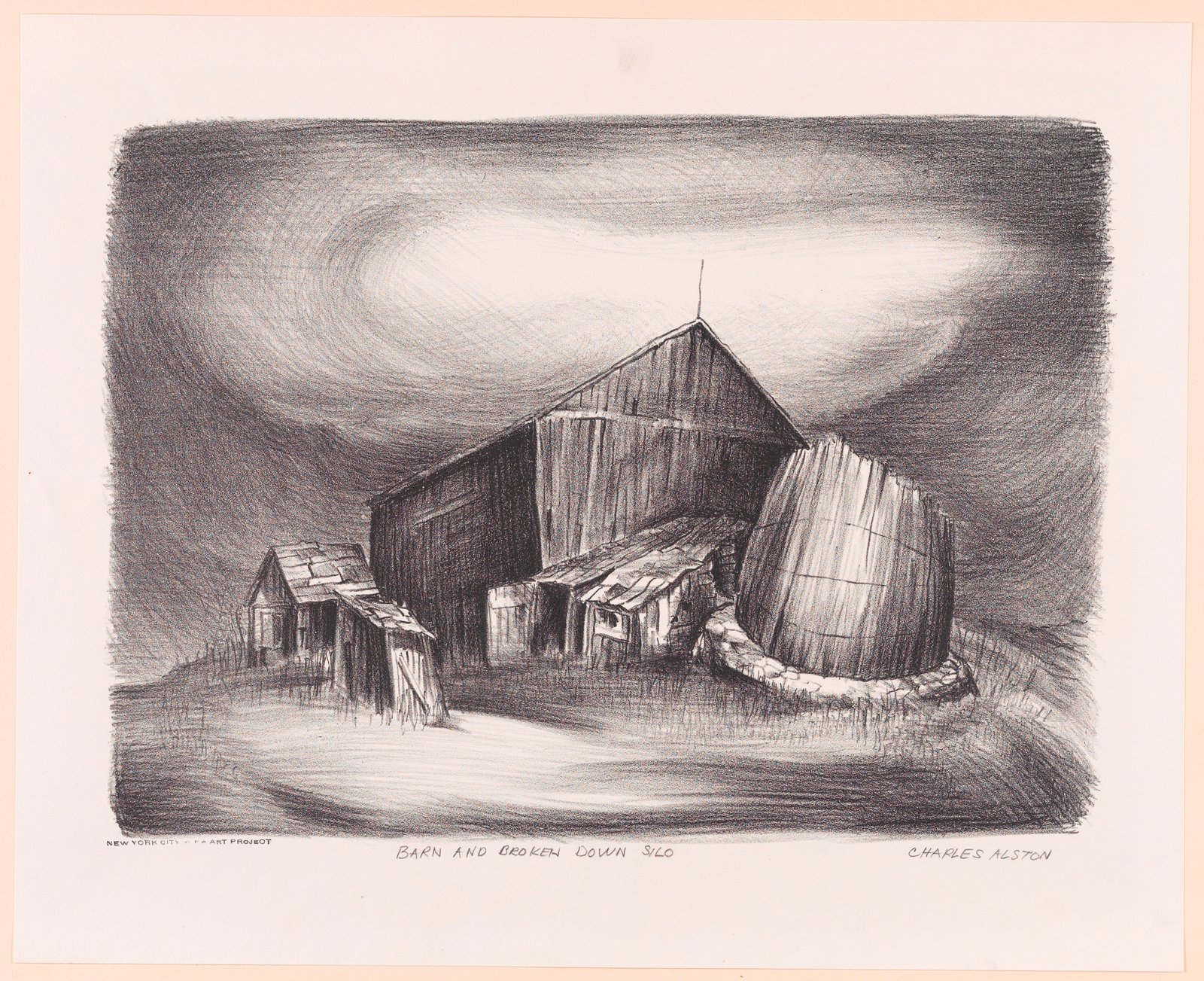
In Barn and Broken Down Silo, the silo has collapsed into a leaning barrel of staves, and an oval of pale light opens in a dark sky directly above the roof. The light shape is a frame within the frame: it isolates the buildings like a vignette on a book cover.
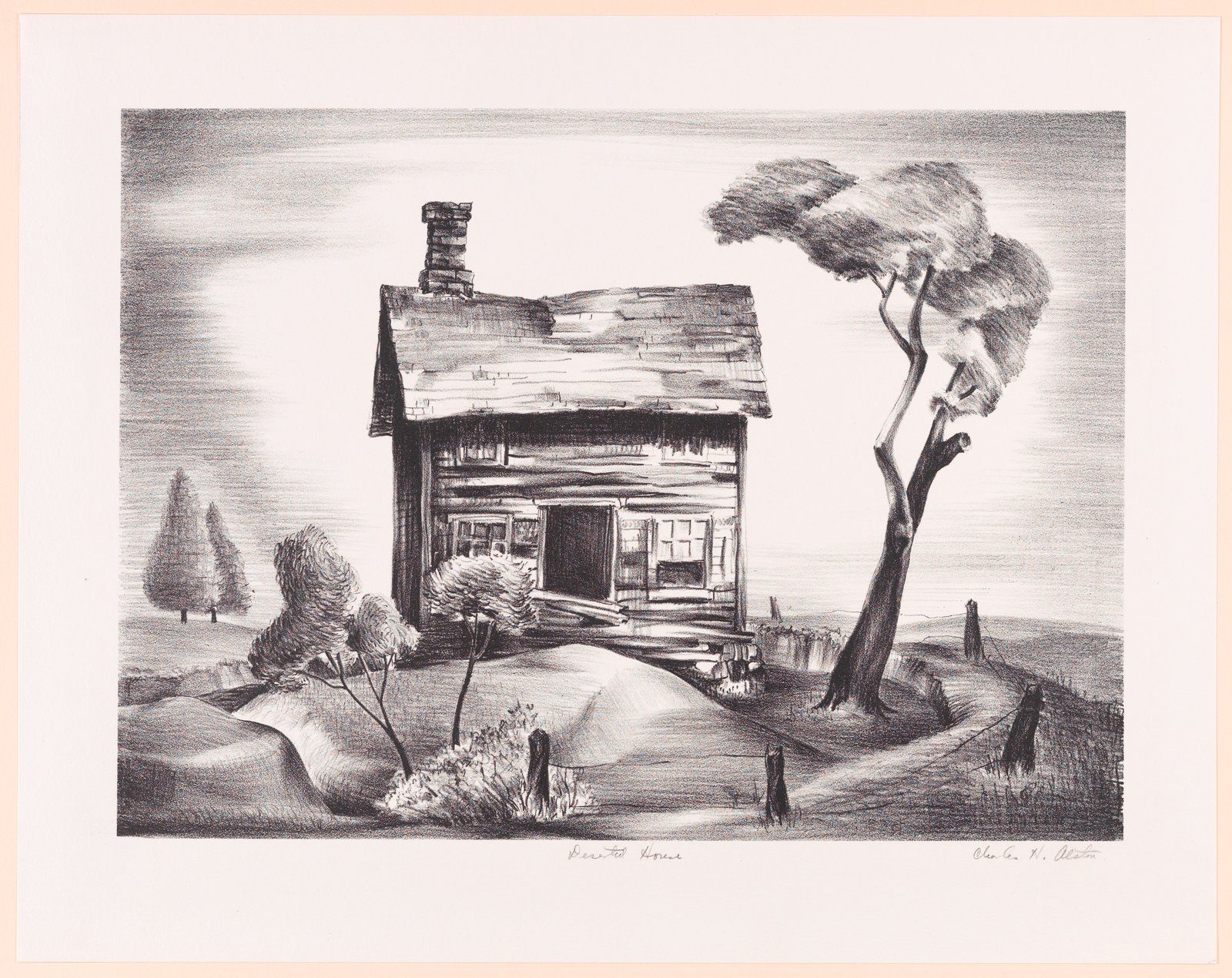
Deserted House reverses the scheme. A small wooden house sits in bright, open light, its windows and door dark, with a wind-bent tree leaning over it. The empty paper of the sky does as much work as the drawn areas.
Lettering, signature and the WPA mark
Look at the margins. On Barn and Tree and Barn and Broken Down Silo, small capitals at the lower left read “New York City WPA Art Project”, while Alston’s title and signature sit in pencil below the image. On Barn and Broken Down Silo the title and the name “Charles Alston” are written in neat, spaced capitals; on Stud Poker and Deserted House they appear in a looser hand.
That three-part margin, with programme credit at left, title in the centre and signature at right, is a tidy piece of information design. It records sponsor, title and maker without touching the image.
Later work: from figure to abstraction
Alston’s postwar paintings moved between figuration and abstraction. The Met’s 1950 canvas is titled simply Painting. His Walking (1958), an oil in the collection of the Smithsonian’s National Museum of African American History and Culture, shows a group of women and a young girl striding forward ahead of a long line of others. The museum notes that he painted it two years after the Montgomery Bus Boycott and quotes Alston saying the idea of a march was already in the air.
The figures in Walking are simplified into planes of colour with little facial detail, so the painting reads as one collective movement rather than a set of portraits. The Smithsonian lists the work as copyright of the Charles Alston Estate. The museum has also acquired a portrait bust of Martin Luther King Jr. by Alston, as reported by Smithsonian Magazine and The Art Newspaper.
How designers can borrow the ideas
- Design in four values. Before you add colour, block the layout in paper, light, mid and dark. If it reads at thumbnail size, it will read at poster size. Sample the greys from a public-domain scan with the MGD image colour picker.
- Make the brightest shape the subject. Like the card table in Stud Poker, put the lightest value where you want the eye to land, and let everything else step down.
- Use hatching as texture. Directional strokes give flat vector illustration a hand-made surface. Change the angle of the strokes to separate wall from floor, sky from ground.
- Pair panels with a shared structure. For a diptych, a two-page spread or a before-and-after layout, keep the horizon, scale and palette consistent so the contrast in content does the work.
- Treat the margin as a credit line. A short, aligned line of small capitals for the publisher, a title and a signature can give a print, poster or packaging label an archival finish. Our guide to lithography explains the process behind these prints.
Frequently asked questions
Who was Charles Alston?
Charles Alston (1907–1977) was an American painter, muralist, printmaker and teacher, born in Charlotte, North Carolina, and active in Harlem, New York. He supervised the WPA murals at Harlem Hospital and co-founded the Spiral group in 1963.
What are Charles Alston’s Harlem Hospital murals?
They are two paired murals, Magic in Medicine and Modern Medicine, painted for Harlem Hospital under the WPA Federal Art Project. The commission dates to 1936, and final approval came in 1940. One panel imagines healing in Africa, the other modern Western medicine.
Are Charles Alston’s works public domain?
Some are. The Met flags four lithographs from the New York City WPA Art Project, including Stud Poker, as public domain. His paintings, such as Walking (1958), remain in copyright with the Charles Alston Estate.
What technique did Charles Alston use in his prints?
His WPA prints are lithographs, drawn with crayon so that hatched strokes build up graded tones. He used a narrow range of values and a bright central shape to organise each composition.