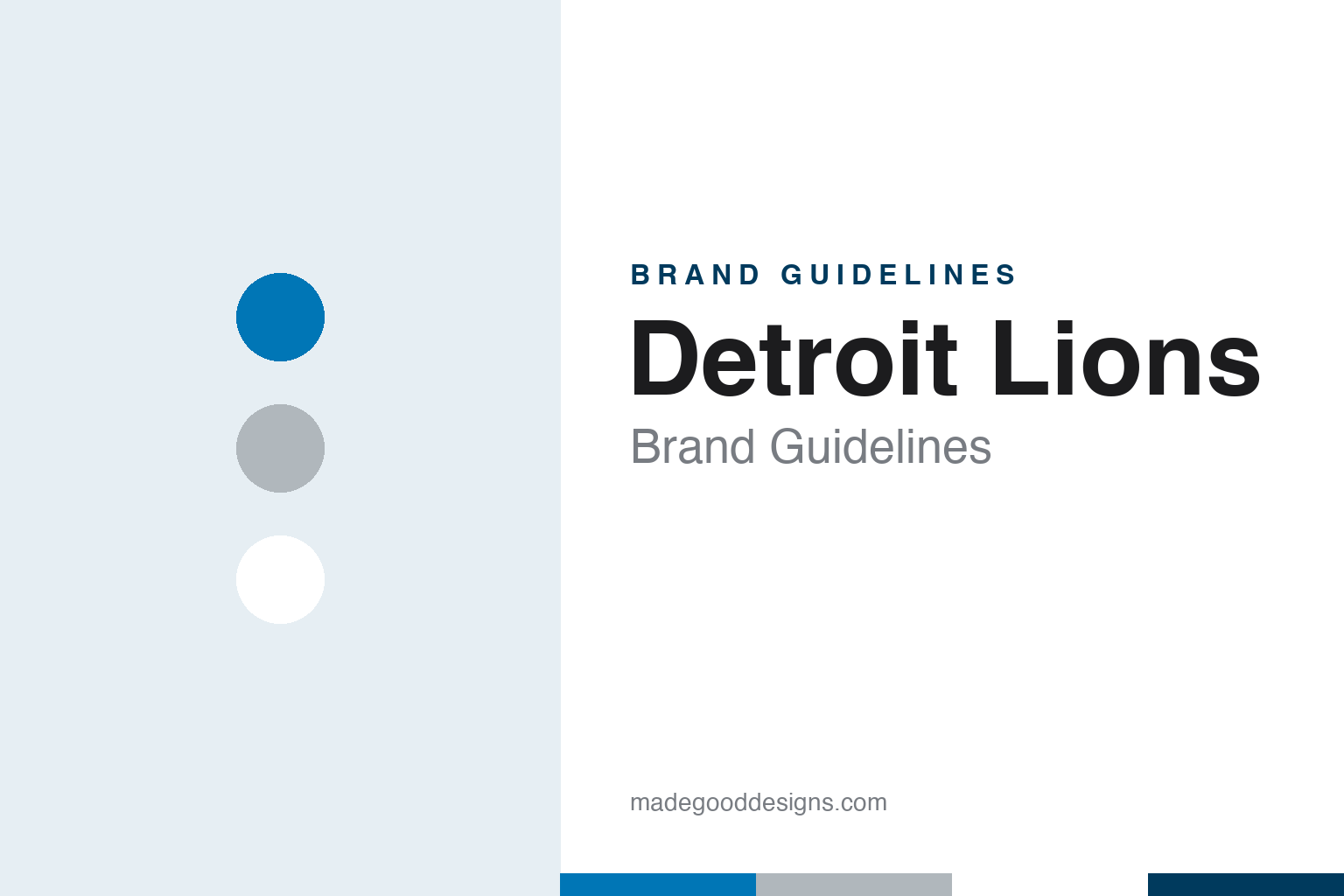
Detroit Lions Brand Guidelines
From the Portsmouth Spartans to Honolulu blue, silver and a leaping lion.
Aa
Two constants: a Honolulu blue and silver palette and a condensed athletic sans register. Abstract homage — not a Detroit Lions product or mark; no helmet, uniform or logo is reproduced.
Portsmouth to Detroit
An Ohio club, a baseball neighbour and a colour chosen by a player’s family.
The Detroit Lions started in a small Ohio river town. The Detroit Historical Society, in its Encyclopedia of Detroit, says the team formed in 1929 as the Portsmouth Spartans of Portsmouth, Ohio, and English Wikipedia says the Spartans joined the NFL on 12 July 1930. Wikipedia adds that, amid financial struggles, the franchise was relocated to Detroit in 1934.
The new name borrowed from a neighbour. Wikipedia says the club was renamed the Lions in reference to the city’s baseball team, the Detroit Tigers. The owner who brought the team to Detroit was George A. Richards, who also owned the Detroit radio station WJR. The Detroit Historical Society and Wikipedia both credit Richards with the club’s Thanksgiving Day game, which has been played in Detroit since 1934; Wikipedia says he negotiated with NBC to carry the game live across the network, and that the only break came from 1939 to 1944.
The colours were picked by a player and his wife. Wikipedia says Glenn Presnell, a member of the 1934 team, recalled that Richards asked him and his wife to choose between combinations that included red and white, orange and black, and blue and silver. The Presnells preferred blue and silver, and Richards chose it. The blue is officially called “Honolulu blue”, which Wikipedia says was inspired by the colour of the waves off the coast of Hawaii. The Detroit Historical Society says the colours have been Honolulu blue and silver since the move.
The team has had several homes. The Detroit Historical Society lists the University of Detroit Stadium, Tiger Stadium, the Pontiac Silverdome and Ford Field, which opened in downtown Detroit in 2002.
Colour
Silver helmets, a black interlude and two rebrands in eight years.
The uniform has changed slowly. Wikipedia says that apart from a switch to scarlet and black from 1948 to 1950, introduced by the head coach Bo McMillin after his years at Indiana, the Lions have worn silver helmets, silver pants and blue or white jerseys since 1934. Small changes followed over the decades: television numbers on the sleeves in 1956, white trim on the logo in 1970, outlined numerals in 1972, and blue facemasks in place of silver in 1984.
Black arrived in 2003. Wikipedia says the club added black trim to its logo and jerseys that year and switched the facemasks to black, then added a black alternate jersey in 2005. The Detroit Free Press reported on 1 February 2017 that black had come in two years after Matt Millen became team president, and an ESPN Uni Watch column by Paul Lukas in April 2017 said it was added reportedly at Millen’s instigation. On 20 April 2009 the Lions unveiled a new logo and uniforms; Wikipedia says the lion gained a flowing mane and fangs and the typeface became more modern.
The black went again in 2017. The Detroit Free Press reported on 1 February 2017 that the club was going through a full rebranding of logo, font and uniforms, the second in less than a decade. The paper quoted a team statement saying the rebrand included the removal of black from the identity and would emphasise Honolulu blue and silver, and it described the new logo as replacing the black outline around the lion with a silver one and sharpening the image. New uniforms followed on 13 April 2017; ESPN noted a chrome facemask on the silver shell and a leaping lion without the black outline. The set also added the initials “WCF” to the left sleeve for William Clay Ford, who had owned the team since 1963.
The next set arrived on 18 April 2024. Wikipedia says the home jersey, called “One Pride”, uses a redefined Honolulu blue with white block numbers trimmed in silver; the road white jersey, “the 313”, carries a Honolulu blue “Detroit” wordmark on the front; and a black alternate called “Motor City Muscle” brought the colour back with a “Lions” wordmark, worn with a Honolulu blue helmet bearing the leaping lion in black. A WCF memorial decal sits on the back of the helmets.
Typography
Design and documentation.
A professional football identity is built from a small set of parts that have to work together at very different sizes. The helmet decal is a compressed version of the identity: a mark that sits on a curved shell, is seen from the side at a distance and has to read in a single colour against a painted surface. Many clubs keep the helmet mark separate from the primary logo used on print and screens, and the two are often redrawn on different schedules.
Colour names are part of the system. Clubs and their uniform suppliers give their tones proper names, and those names travel from style guides onto merchandise labels and broadcast graphics, which helps keep a shade consistent across fabric, paint and pixels.
Throwback uniforms let a club revisit an earlier set without retiring the current one, so an older wordmark, numeral style or helmet colour can return for a single season or a few games. Stadium naming adds another layer: when naming rights change, the building’s signage, tickets and wayfinding are rebranded while the team’s own marks stay the same.
Aa
A condensed athletic sans — the register of a stadium wordmark and a sideline banner. (Specimen set in Oswald, a sans STAND-IN; NOT the Detroit Lions logo, wordmark or numerals.)
Honolulu blue
A family ownership and a colour that keeps returning.
The Ford family has owned the Lions since 1963. Wikipedia says William Clay Ford owned the team from that year, that his wife Martha Firestone Ford took over the club in 2014, and that their daughter Sheila Ford Hamp, vice chair since 2014, succeeded her mother as principal owner and chair on 23 June 2020.
The club has used throwbacks to revisit its past. Wikipedia says that in 1994 the Lions wore jerseys modelled on the 1935 season, with solid silver helmets and pants, Honolulu blue jerseys with silver numbers and no helmet logo, and that from 2001 to 2004 they wore 1950s-style jerseys on Thanksgiving Day. A throwback for the franchise’s 75th anniversary in 2008 became the permanent alternate in 2009. For the 90th season in 2023 the club issued a commemorative logo and patch based on its 1961 to 1969 logo, and on 21 June 2023 it introduced an alternate blue helmet carrying the 1960s lion, the club’s first blue helmet since 1955.
The newest uniform goes back to silver. Wikipedia says that on 25 August 2026 the Lions unveiled a “Defend the Den” Rivalries jersey in silver with black italic numbers, carbon-fibre decals, Honolulu blue and black shoulder stripes and a “Detroit” wordmark on the front.
For a design guide, the Detroit Lions show how a colour with a story, picked by a player’s family in 1934, can anchor an identity through a scarlet interlude, a black decade and two rebrands. Compare the baseball club that inspired the name in our Detroit Tigers brand guidelines, the city’s basketball team in our Detroit Pistons brand guidelines and the league itself in our NFL brand guidelines. For this guide we use Honolulu blue, silver and white with a condensed sans, an unofficial interpretation; no product or logo is reproduced.
Explore & save
Keep Detroit Lions’s identity on hand — save it to a board in the Made Good inspiration library.
Detroit Lions identity set
Pin the Detroit Lions Honolulu blue, silver and white palette and the condensed athletic sans register to your own board.