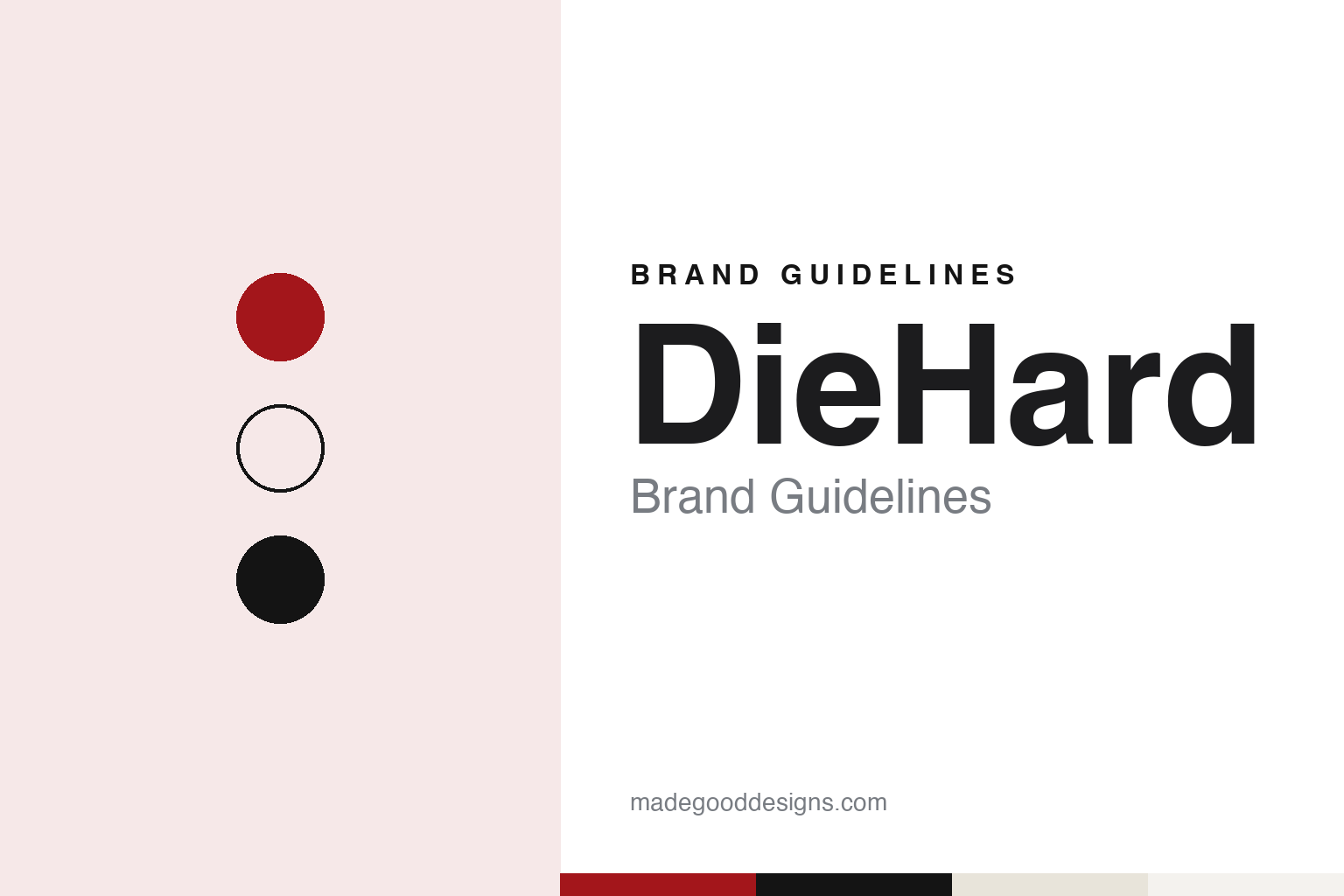
DieHard Brand Guidelines
A department-store battery whose name outlived the store’s hold on it.
Aa
Two constants: a red, black and pale case palette and a heavy grotesque register. Abstract homage — not a DieHard product or mark; no battery, label or logo is reproduced.
A Sears battery with a stubborn name
A store brand built for the starter motor.
DieHard began as a store brand. English Wikipedia says the brand dates to 1967 and was developed for Sears by Globe-Union Battery. On its own heritage page, “The DieHard Legacy”, the brand tells the same story from the retailer’s side: it says Sears introduced the DieHard in 1967 after a long research programme, and presents the battery as something Sears had designed and tested before it went on sale in its stores.
The case was the visible difference. The company says the original DieHard used a thin-walled, translucent polypropylene case in place of the black, rubber-type enclosures common at the time, and that the slimmer walls left room inside for bigger plates and more acid. It describes the tooling for that clear plastic container as a major project of its own, with a large injection-moulding press and a heavy mould built for the purpose.
The name, according to the same page, came from testing. The company says “DieHard” was derived from the battery’s unfailing operation on test vehicles driven at high and low speeds, in hot and cold climates and at different altitudes. It is a name that describes a promise rather than a place or a founder, and it has stayed on the product through every change of owner since.
Sears sold the brand loudly. The company says Sears marketed DieHard through a series of advertisements that ranged from batteries frozen in ice to batteries fitted in Baja race cars, and that television comedy shows starring Garry Moore, Carol Burnett and Tim Conway featured parodies of the brand. Motor racing followed: the company says DieHard batteries were used in many of the cars entered in the 1970 Indianapolis 500, and that Richard Petty and Bobby Allison ran them during the 1973 NASCAR season.
The range widened through the 1970s and 1980s. The company lists maintenance-free, “add-no-water” batteries in 1976, a DieHard motorcycle battery in 1983, an experimental electric-vehicle battery called the XDH-1 for the brand’s twentieth anniversary, and the DieHard Gold automotive battery in 1988.
Colour
Globe-Union, Johnson Controls, Clarios and Advance.
The name on the battery and the company that made it were never the same thing. English Wikipedia says Globe-Union was later bought by Johnson Controls, which continued to manufacture DieHard batteries for Sears. It adds that for a time DieHard batteries were also made by Exide, and that manufacturing afterwards returned to Johnson Controls.
In 2019, according to the same article, Johnson Controls spun off its battery division as Clarios and sold it to Brookfield Business Partners. English Wikipedia says Clarios manufactures DieHard batteries, alongside other battery brands it makes for different sellers. The maker behind the label has therefore changed several times while the label itself stayed with the retailer.
Through the 1990s and 2000s the name spread well beyond the car battery. The company says the 1990s brought DieHard flashlights, flashlight batteries, rechargeable batteries, gel-cell batteries, work boots and marine batteries; it lists a DieHard Platinum battery in 2007, tyres and a smart charger in 2016, and wiper blades in 2018. In 2007, the company says, DieHard worked with Orange County Choppers on a custom motorcycle that was kept at DieHard’s headquarters in Hoffman Estates, Illinois.
The retail side then shifted. English Wikipedia says Sears launched a pilot DieHard Auto Center in San Antonio in 2017, a standalone version of its in-store auto centres, and later opened another in Troy, Michigan. Sears filed for Chapter 11 bankruptcy protection in 2018, according to the same article.
On 23 December 2019, English Wikipedia says, Advance Auto Parts announced that it had bought the DieHard brand from Sears; the brand’s own heritage page gives the same date. Advance Auto Parts has owned the DieHard brand since 2019, and the DieHard website now carries the line “Now at Advance Auto Parts”. Its footer says DIEHARD is a registered trademark of Advance Stores Company, Incorporated.
Typography
Design and documentation.
The brands in this group all make or sell batteries, from the small cells that go into torches, remote controls and toys to the heavy batteries that start cars, boats and trucks. Battery brands in general sit at many different points in the trade: some names belong to the company that makes the cells, some are owned by retailers or parts chains, and some are licensed to different companies in different parts of the world.
A battery brand’s identity is usually carried less by the product itself than by its packaging, its colours, its slogans and sometimes a mascot, because one sealed case looks much like another. Behind the label, the company that owns the name and the factory that builds the battery may have changed several times. That makes the plain questions worth asking: who started the brand, who owns it now, and who actually makes the batteries.
Each guide separates what independent sources record from what the company says about itself — its founding story, its owners over time, where its batteries are made and how its packaging has changed — and marks plainly what rests only on the company’s own word.
Aa
A heavy grotesque — a loud, workshop-sign register. (Specimen set in Archivo Black, a sans-serif STAND-IN; NOT the DieHard logo.)
DieHard
A name that changed shelves.
Under Advance, the brand was relaunched with a film. The company says that in October 2020 Advance Auto Parts launched a “DieHard is Back” campaign with a two-minute film that brought together the battery brand and the Die Hard films, with the character John McClane fighting off henchmen once more and a DieHard Platinum AGM battery cast as his sidekick. The campaign built its whole idea on the shared name.
The range has kept growing under the new owner. The company says DieHard added power tools in 2021 and hand tools in 2022. Its website now lists car, marine, power-sports, small-engine and heavy-duty batteries alongside tools, battery accessories, flashlights, wiper blades, footwear, floor mats and portable power stations. English Wikipedia notes that DieHard-branded goods such as tools and boots have also been sold at Sears and Kmart.
Where it is sold has changed more than what it is. The company says DieHard automotive and specialty batteries are available in Advance Auto Parts and Carquest stores, at Sears Auto Centers and through professional repair shops. A battery that began on a department-store shelf now sits in an auto-parts chain, carrying the same two-word name that Sears chose more than half a century ago.
That makes DieHard an unusual case for a design guide. It was never a factory brand: Globe-Union, Johnson Controls, Exide and Clarios each made batteries under it at different times, according to English Wikipedia, while the name itself was owned by a retailer and then sold to another one. The constant was the word, its promise of reliable starting, and a heritage page that keeps the 1967 translucent case at the centre of the story.
For a design guide, DieHard shows how a retailer’s own label, given a memorable name and a long run of advertising, can become a brand valuable enough to be sold on by itself. Compare Interstate Batteries, an American car-battery name built around its own distribution network, and Optima, a performance battery also made within the Clarios group. For this guide we use a starter red, a garage black and a pale case tone with a heavy sans-serif, an unofficial interpretation; no product or logo is reproduced.
Explore & save
Keep DieHard’s identity on hand — save it to a board in the Made Good inspiration library.
DieHard identity set
Pin the DieHard red, black and pale case palette and the heavy grotesque register to your own board.