Optima Brand Guidelines
A Denver laboratory battery that travelled through Norway before it reached the racetrack.
Aa
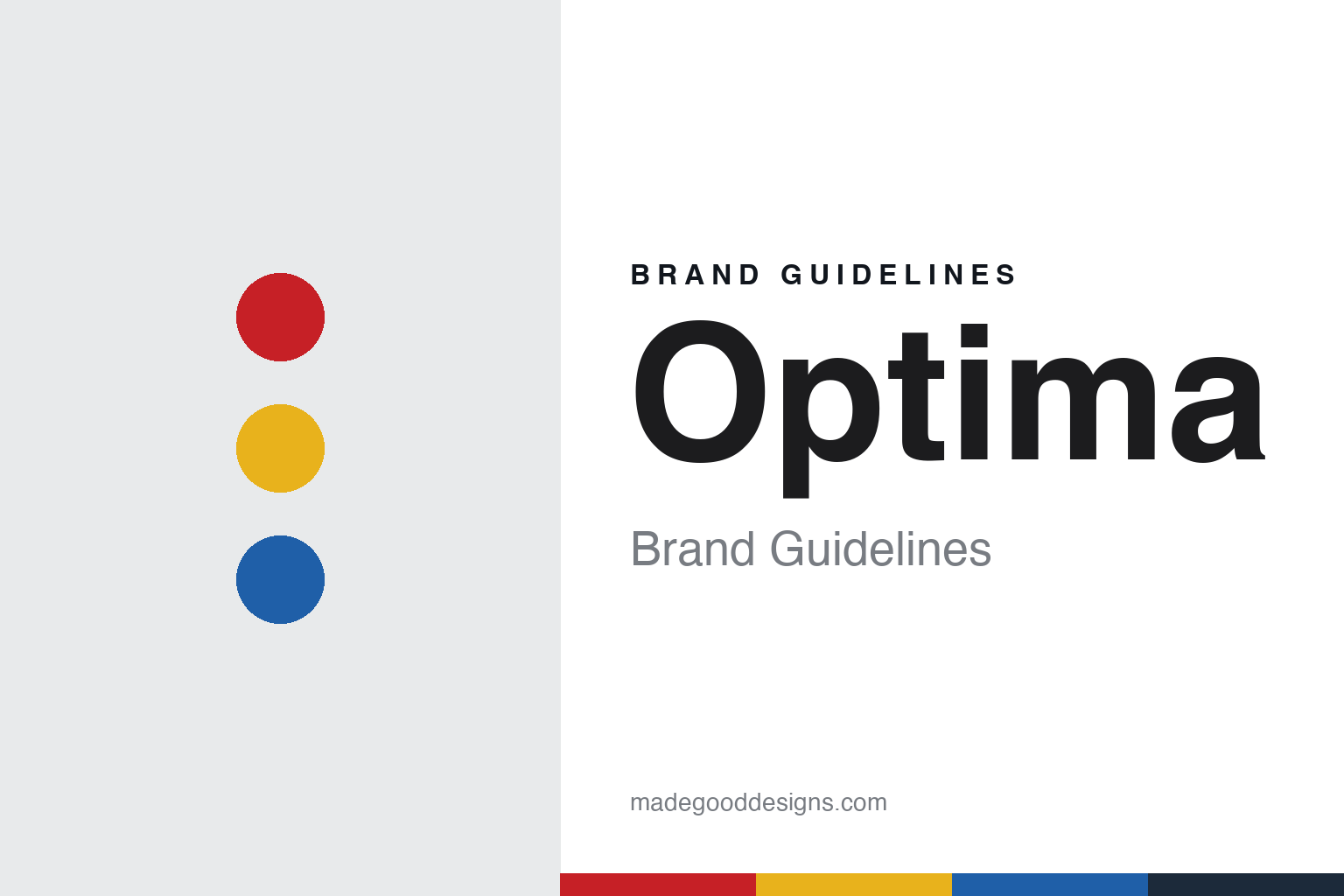
Two constants: a red, yellow and blue over slate palette and a condensed grotesque register. Abstract homage — not an Optima product or mark; no battery, label or logo is reproduced.
A battery from a rubber company
A patent, a sealed cell and a Denver laboratory.
Optima did not start as a battery company. Its own brand timeline, as published on the Optima website in 2013, begins on 30 May 1972, when Donald H. McClelland and John L. Devitt filed a patent claim for a maintenance-free lead-acid battery. The work took place at the Gates Rubber Company in Denver, Colorado, a business better known for belts and hoses than for batteries.
In 1973, according to the same timeline, Gates began developing a sealed lead-acid battery for commercial and military use, and the SPIRALCELL design was the result. The company says a patent was issued and assigned to Gates on 2 January 1975. The spiral idea gives the brand its name for its technology to this day: the company uses SPIRALCELL TECHNOLOGY with a registered-trademark sign.
The move toward cars came a decade later. The company says that in 1984 Gates set up a project team for SLI batteries, the starting, lighting and ignition batteries used in vehicles, while its main customers were still commercial and military. Success there, the timeline says, led the technology into automobiles, trucks and boats, and in 1987 Gates began limited production of batteries under the OPTIMA name.
In 1990, the company says, Gates incorporated the division as OPTIMA Batteries, Inc. The same year a Norwegian company, Gylling Teledata A/S, began importing and distributing the batteries in a limited way, and soon obtained distribution rights for the whole of Scandinavia. That Scandinavian link would shape the next decade of the brand’s ownership.
The brand’s shape became part of its identity early. The company describes the distinctive OPTIMA SIX PACK shape as the thing to look for and pairs it with the slogan THE ULTIMATE POWER SOURCE, which it uses as a trademark.
Colour
Gates, Gylling, Johnson Controls and Clarios.
Ownership moved quickly once the division was formed. The company’s timeline says Gates decided in 1991 to divest OPTIMA Batteries, Inc., and that in 1992 the Gylling Group of Scandinavia bought the business from Gates. So the brand that had begun in a Denver rubber company passed into the hands of the group behind its Norwegian distributor.
Production stayed in Colorado. The company says that in 1994 OPTIMA Batteries, Inc. broke ground on a new, larger manufacturing facility northeast of Denver, as public demand for the batteries grew in the early 1990s. The timeline describes that period as one of improved manufacturing processes and a widening distribution base.
In 2000, according to the company, Johnson Controls acquired OPTIMA Batteries, Inc. For most of the next two decades the brand was presented as a Johnson Controls company; the Optima website’s footer in 2013 and again in 2017 read “Copyright Johnson Controls, Inc.” The company’s timeline lists a new production facility groundbreaking in 2007, a direct-fit replacement 12-volt battery for the Toyota Prius in 2011, and the OPTIMA Chargers Digital 1200 battery charger and maintainer in spring 2012.
The next change came with the battery business as a whole. In 2019, English Wikipedia says, Johnson Controls spun off its battery division as Clarios and sold it to Brookfield Business Partners. Clarios has owned the Optima brand since 2019; its own website now lists OPTIMA among its brands and describes OPTIMA Batteries as a division of Clarios, which gives its headquarters address in Glendale, Wisconsin.
The range today, as Clarios describes it, covers OPTIMA AGM and lithium batteries for cars, trucks, boats, power-sports vehicles and commercial vehicles.
Typography
Design and documentation.
The brands in this group all make or sell batteries, from the small cells that go into torches, remote controls and toys to the heavy batteries that start cars, boats and trucks. Battery brands in general sit at many different points in the trade: some names belong to the company that makes the cells, some are owned by retailers or parts chains, and some are licensed to different companies in different parts of the world.
A battery brand’s identity is usually carried less by the product itself than by its packaging, its colours, its slogans and sometimes a mascot, because one sealed case looks much like another. Behind the label, the company that owns the name and the factory that builds the battery may have changed several times. That makes the plain questions worth asking: who started the brand, who owns it now, and who actually makes the batteries.
Each guide separates what independent sources record from what the company says about itself — its founding story, its owners over time, where its batteries are made and how its packaging has changed — and marks plainly what rests only on the company’s own word.
Aa
A condensed grotesque — a tall, race-paddock register. (Specimen set in Oswald, a sans-serif STAND-IN; NOT the Optima logo.)
Optima
A colour on every lid.
Optima’s product names are colours. The company’s website has long sorted the range into REDTOP, YELLOWTOP and BLUETOP, each a registered product name, alongside the OPTIMA chargers. A buyer meets the brand first through a colour word on the lid, then through the SIX PACK shape of the case and the slogan beside it.
That system makes the colour code the backbone of the identity. Red, yellow and blue stand for different lines in the range, and the company keeps them apart by name across its catalogue. The brand’s web pages and news posts use the same three words consistently, from product listings to partnership announcements.
Motorsport and car culture carry the name. The company’s 2013 timeline says OPTIMA became the original-equipment battery for the Ford GT in 2004. Clarios lists recent news that includes an OPTIMA partnership with the Mustang Challenge series alongside Ford Performance, an OPTIMA battery in the RUF Boxer 8, the brand as official battery of the Air|Water show, and a race-battery development with FAT International shown at IAA Mobility 2025. In 2013 the Optima website also listed its own OPTIMA Invitational events for enthusiast car owners.
The corporate path is unusual for a battery brand. It began inside a rubber company, became a stand-alone business under a Scandinavian owner, joined Johnson Controls, and now sits within a battery maker owned by an investment group. Through each move the same name, the same three colour words and the same spiral-cell story stayed at the front.
For a design guide, Optima shows how a simple colour code on a product lid can do the work of a whole naming system. Compare VARTA, a German battery name, and DieHard, an American car-battery brand that Clarios also manufactures. For this guide we use a top red, a top yellow and a top blue over a dark slate with a condensed sans-serif, an unofficial interpretation; no product or logo is reproduced.
Explore & save
Keep Optima’s identity on hand — save it to a board in the Made Good inspiration library.
Optima identity set
Pin the Optima red, yellow and blue over slate palette and the condensed grotesque register to your own board.