Disney Cruise Line Brand Guidelines
The “modern classic” liner look, with a black hull and yellow lifeboats.
Aa
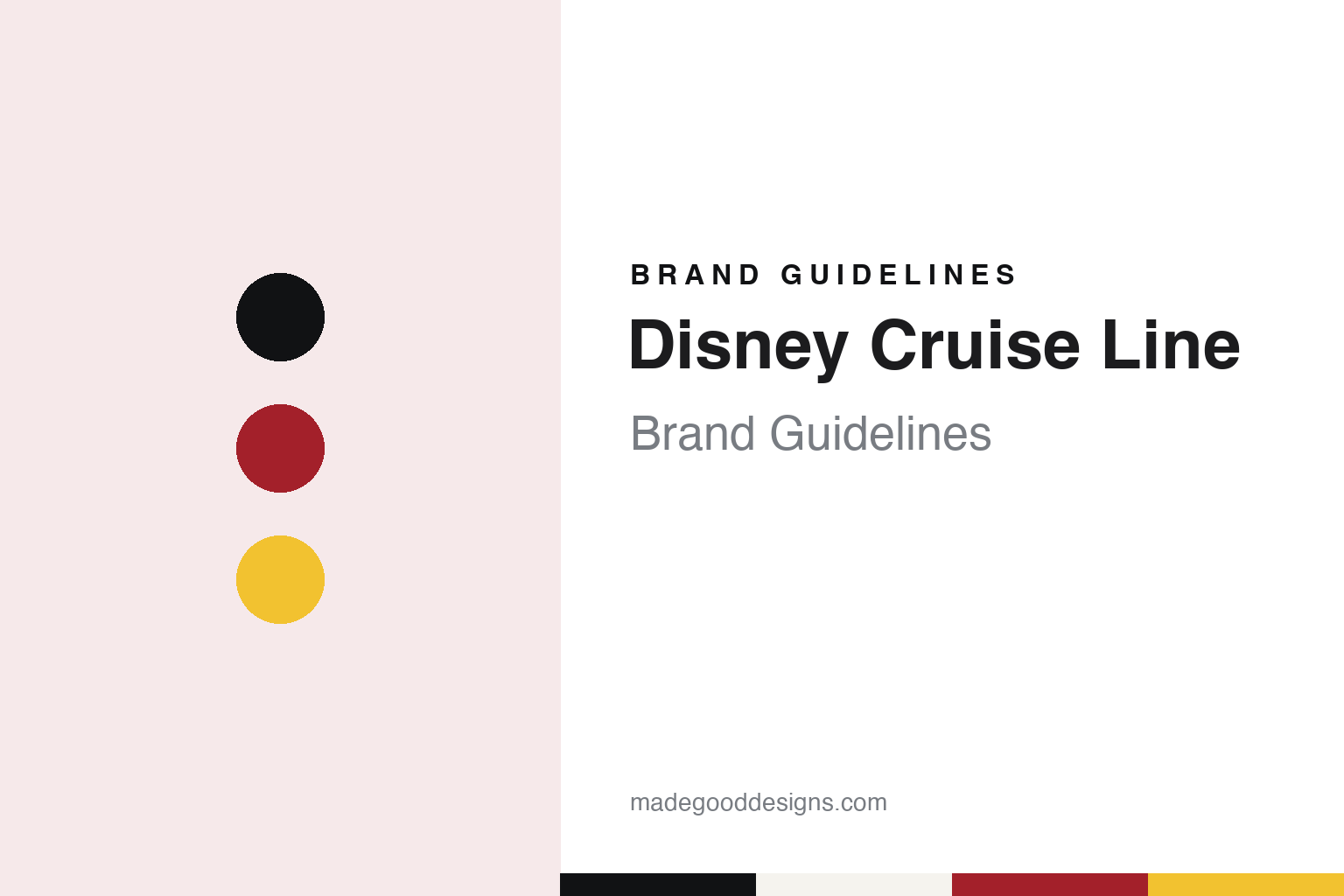
Two constants: a hull black, funnel red and lifeboat yellow palette and a liner serif register. Abstract homage — not a Disney Cruise Line product or mark; no ship, character or logo is reproduced.
Disney Vacation Cruises
From a licensed partner to a line of its own.
Disney Cruise Line is the cruise operation of The Walt Disney Company, and it grew out of an earlier licensing deal. English Wikipedia, citing USA Today, says that in 1985 Premier Cruise Line became Disney’s licensed cruise partner, so that Disney characters appeared on Premier’s ships and holidays could combine a cruise with hotel stays and theme-park visits. That arrangement ended in 1993, when Premier signed with Warner Bros. and switched to the Looney Tunes characters, and Disney then held talks with Carnival and Royal Caribbean about a new partner.
Instead, Disney chose to build its own line. Wikipedia, citing a Bloomberg News report in The New York Times of 4 May 1994, says that by early 1994 Disney had commissioned preliminary ship designs and announced plans to start a cruise operation by 1998. Arthur Rodney was named president of the venture, which initially carried the name Disney Vacation Cruises. The operating company was incorporated in the United Kingdom in February 1996 as Devonson Cruise Company and later renamed Magical Cruise Company Limited; Wikipedia gives London as its legal domicile and Celebration, Florida, as its operational headquarters, while “Disney Cruise Line” is the name it trades under.
The trade journal Maritime Reporter, in a long feature in its March 1998 issue, said the Disney Cruise Line team was formed in the early 1990s with a mission that was clear from the start: to create a “modern classic” cruise ship. Jon Rusten, the line’s director of development and newbuilding, told the magazine that Disney began actively studying the idea of becoming a ship owner and operator in the early 1990s. Wikipedia says the company ordered its ships from Fincantieri in Italy in 1995, and Maritime Reporter said the yard was chosen after a broad search, partly because it could take the order within Disney’s timetable.
The line also planned its own island stop. Wikipedia says Disney acquired Gorda Cay in the Bahamas around the same time as the ship order and redeveloped it as a private destination named Castaway Cay. Bob Shinn, a senior vice president at Walt Disney Imagineering in Florida, told Maritime Reporter in 1998 that the island was “Disney-designed, owned and operated”, and the magazine said the island plan helped shape some of the ships’ technical specifications. Disney Magic entered service in July 1998 and Disney Wonder followed in 1999, both based at Port Canaveral, Florida, under a long-term agreement with the Canaveral Port Authority, Wikipedia says, citing the Orlando Sentinel.
Colour
Norwegian architects, a design competition and a liner silhouette.
The look of the ships was settled through a contest. Maritime Reporter reported in March 1998 that the Oslo practice Yran & Storbraaten received a call from Disney around 1993 or 1994 asking whether it would help with the cruise ship. Bjørn Storbraaten then recommended bringing in the ship designers Robert Tillberg and Njål Eide, a design competition was held among them to produce “the” Disney ship, and it was Eide’s design that was selected. Storbraaten’s firm then took on the planning of the interior spaces and the general arrangement.
The same feature described how Disney widened the circle beyond naval architects. Eide, the magazine said, consulted an industrial engineer from frogdesign, a firm known mainly for product and package work, and Mike Reininger, Disney Cruise Line’s vice president of product development, said: “This is how we brought non-ship insights into the equation.” Storbraaten told the magazine that Disney treated architecture as quality rather than as an extra invoice. As an example, he said, the bow was slimmed purely for looks, at the cost of some cabins, and the anchors were left fully exposed in the manner of older ships; an exposed anchor, he said, is an important emblem for a ship to carry.
Maritime Reporter listed the features meant to recall the classic liners of the early twentieth century: a long, slender black hull with a curved line, large circular portholes, protruding bridge-wing supports, a rounded stern, funnels of which only one was working — the forward funnel housed the ESPN Sky Bar — and ornate decoration at bow and stern. The magazine added that, in keeping with the liner approach, the link between the ship’s outward image and Disney was kept deliberately light, telling readers not to expect big mouse ears on the bow. Reininger described the result as an identity “respectful of an ancestral lineage but unmistakably contemporary”, reached after studying classic vessels and testing far more radical ideas.
Inside, Disney mixed maritime suppliers with designers from outside shipping. The magazine said New York’s Rockwell Architecture, Planning and Design, which had not worked on a ship before, was asked to create a restaurant about the process of animation. The result, Animator’s Palate, was planned to look entirely black and white when guests sat down and to change gradually to full colour, with moving animation, by the end of the meal, using lighting and theatrical effects; the room had paintbrush-shaped columns with fibre-optic tips and tables resting on oversized pencils, and Rockwell’s Nancy Theil said the brief was to represent the creative process of animators.
Typography
Design and documentation.
A cruise brand is read first at a distance. The funnel is the tallest flat surface on a ship and usually carries the line’s mark or colours, so it has to work as a silhouette against sky and sea, legible from a pier, a tender or a port-city skyline. The hull livery does similar work at water level: a band of colour, a painted name and a port of registry at the stern, and often a logo near the bow, all applied at a scale where fine detail disappears and simple shapes carry the message.
Ashore, the identity moves into terminal signage: check-in hall banners, gangway graphics, luggage tags and directional boards that guide people who may not share a language. Onboard, wayfinding has to cope with long corridors, many decks and port and starboard sides; deck numbers, stair-tower colours and pictograms tend to matter more than any wordmark. Printed collateral such as brochures, daily programmes, menus and keycards then carries the typeface and palette into the hand. For a designer, the useful lesson is how one mark has to stretch from a steel funnel down to a cabin door sign.
Aa
A liner serif — the register of a stern nameboard and a printed sailing card. (Specimen set in Playfair Display, a serif STAND-IN; NOT the Disney Cruise Line logo.)
Disney Cruise Line
Mickey’s colours, painted on a liner.
The colour scheme carries the Disney link that the silhouette keeps quiet. Wikipedia, citing a New York Times article of 16 January 1997, says the line’s ships use stylistic references to early twentieth-century ocean liners — long, low profiles and black hulls with red accents — and that those colours also reflect the ones associated with Mickey Mouse. The same source says the ships carry yellow lifeboats, matching the colour of Mickey’s shoes rather than the usual safety orange, and that the choice required a waiver under international maritime rules.
That palette has followed the line through later generations of ships. Wikipedia says Disney announced the larger Dream class in 2007, built by Meyer Werft in Germany, with Disney Dream entering service in 2011 and Disney Fantasy in 2012; the Wish class followed, beginning with Disney Wish in 2022 and Disney Treasure in 2024. In 2022 Disney acquired a partly completed ship that, after a long redesign, entered service in March 2026 as Disney Adventure, homeported year-round in Singapore. Wikipedia, citing Cruise Industry News, says further ships of a new design are planned for the end of the decade.
The organisation around the ships has changed more than their colours. Wikipedia says Matt Ouimet succeeded Arthur Rodney as president in 1999, and that after a reorganisation in 2018 the cruise line was grouped with related businesses under Disney Signature Experiences, part of Disney Experiences. The Walt Disney Company has owned the line since it was set up, and Wikipedia says its ships have sailed from Port Canaveral since 1998, from Port Everglades in Fort Lauderdale since November 2023, and to the line’s own Bahamas stops at Castaway Cay and Lookout Cay at Lighthouse Point.
For a design guide, Disney Cruise Line shows how an entertainment company chose to borrow the vocabulary of the ocean liner — black hull, round portholes, funnels and an exposed anchor — and to let a handful of colours, rather than oversized characters, signal whose ship it is. Compare it with Carnival and Royal Caribbean, the lines Disney held partnership talks with in the 1990s, and with its parent, Disney. For this guide we use hull black, funnel red and lifeboat yellow with a serif, an unofficial interpretation; no product or logo is reproduced.
Explore & save
Keep Disney Cruise Line’s identity on hand — save it to a board in the Made Good inspiration library.
Disney Cruise Line identity set
Pin the Disney Cruise Line hull black, funnel red and lifeboat yellow palette and the liner serif register to your own board.