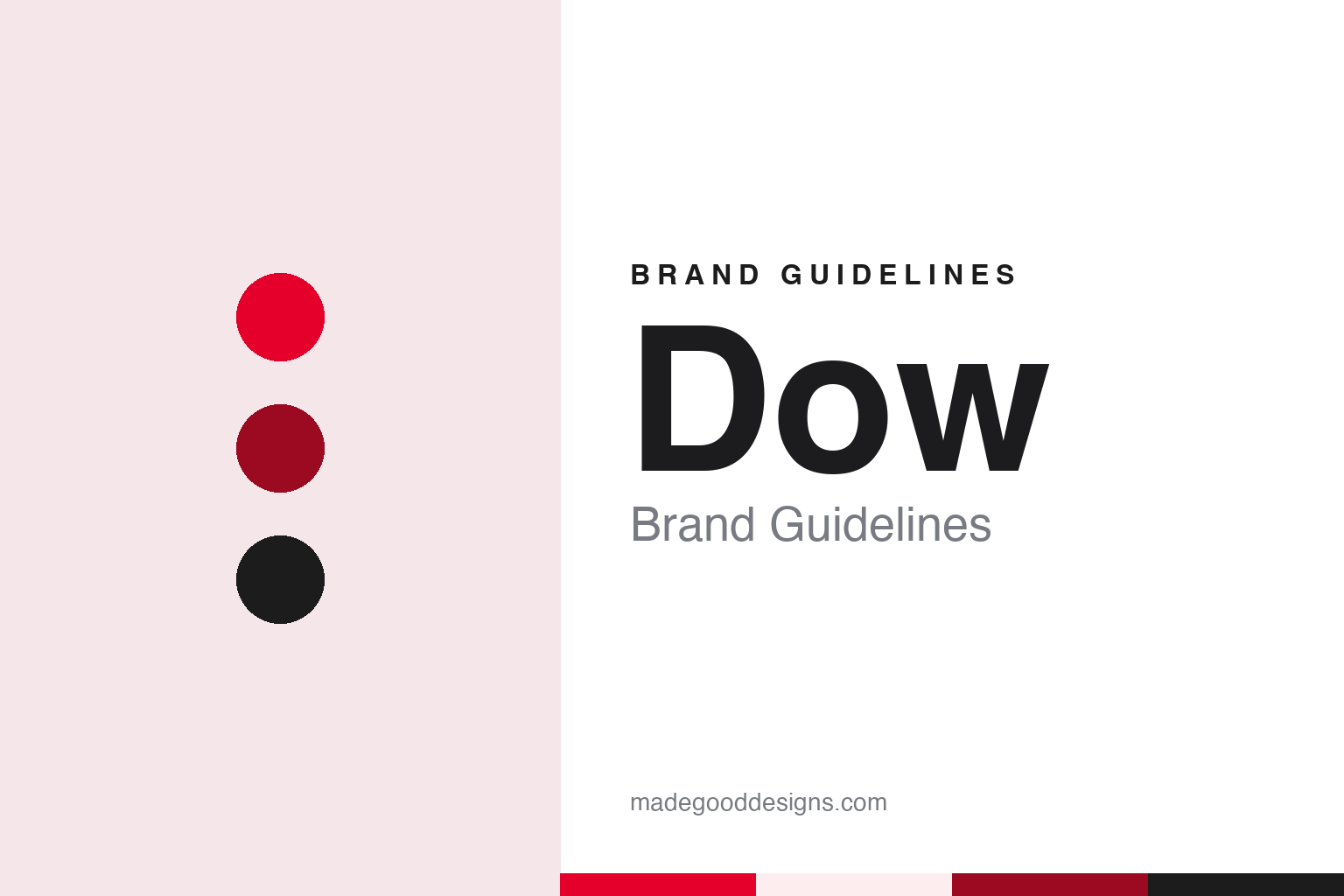
Dow Brand Guidelines
A founder’s surname, a Michigan town and a red diamond.
Aa
Two constants: a red, deep red and ink palette and a Grotesque sans register. Abstract homage — not a Dow asset or mark; no logo, symbol or wordmark is reproduced.
A name from Midland
Herbert Dow’s company, 1897.
Dow is a surname that became a corporate mark. The Dow Chemical Company was founded in 1897 by the chemist Herbert Henry Dow in Midland, Michigan, according to Wikipedia, which says the business grew out of a method he devised for extracting bromine from the brine that lay underground beneath the town. More than a century later the company still has its headquarters in Midland.
The original name followed a familiar pattern for its period: a founder’s surname joined to a plain description of the trade. Over the decades the descriptive half receded in everyday use, and the brand that appears on signs, advertising and sponsorships is the single word Dow. The legal structure has kept the long form alive. Today, Wikipedia says, the publicly traded holding company is Dow Inc., incorporated under Delaware law, and The Dow Chemical Company is its operating subsidiary.
The name has stayed in the family’s town as well as on the company. Wikipedia lists Herbert Dow as head of the company from 1897 to 1930; his son Willard Dow was named a company director in 1922 and general manager of the Midland plant in 1926, and later led the business.
That link shows up in the town’s landscape. In October 2006, Wikipedia says, Dow bought the naming rights to the stadium used by the Great Lakes Loons, a minor league baseball team based in Midland. The ballpark is called Dow Diamond, a name that shares its second word with the shape of the company’s emblem.
The archive of the brand is substantial too. The Science History Institute in Philadelphia holds a Dow Chemical Company historical collection, including print advertisements, leaflets and posters for the company’s brands taken mainly from magazines published between 1921 and 1993, according to Wikipedia’s description of the collection, alongside photographs of the Midland site.
Colour
A red diamond over Midland.
The Dow symbol is a diamond. Wikipedia dates its creation to around 1918 and describes it as the diamond logo the company still uses. In its current form the diamond is red, with the company name set across it in white.
An early public appearance is recorded in a photograph. A negative in the Science History Institute’s Dow Chemical Company Historical Image Collection, dated 12 September 1950, shows a newly installed reproduction of the company’s diamond emblem on the roof of the South Power Station at its headquarters in Midland. The catalogue record says the sign was installed in 1950 and could be seen by traffic passing the plant on US-10 and Saginaw Road, and it files the image under the subjects “Branding (Marketing)”, “Electric signs” and “Emblems”.
For much of the company’s history, subsidiaries and joint ventures carried the Dow name in their own titles, from Dow Corning to Dow AgroSciences.
Dow’s own diamond guidelines, dated June 2021, set out the rules. They describe a “One Dow” brand strategy and say the logo consists of three elements always used as a unit: the red diamond symbol, the company name in white as the logotype, and the registered trademark symbol. The logo identifies Dow as a complete enterprise, the guidelines say, and is not placed close to other words, logos or messages. They name the colour Dow Red and give its PANTONE reference as PMS 185, noting that the company had realigned the print values of Dow Red to match its screen and PANTONE values more closely.
The same document introduces a brandline, “Seek Together”, which can appear alone at Dow events or as a lockup beside the diamond. The guidelines say the pairing of the two words is meant to suggest conversation and partnership, and that the brandline’s typography is customised for Dow and should never be recreated.
Typography
Industrial names, symbols and colours.
Industrial company names tend to start as descriptions of people or processes. Many began with a founder’s surname, a pair of partners’ names joined by an ampersand, or a long legal title that listed what the firm made and where. Over time those titles were shortened in everyday use, and the short form often became the official name: a surname on its own, or a set of initials that customers and staff had been using for decades.
The marks that sit beside those names are usually simple shapes. Squares, ovals, diamonds and plain rules recur because they print cleanly on drums, sacks, vehicles, signage and paperwork, and because they hold their shape at very small and very large sizes. Many identities rely on a single corporate colour, applied across a wordmark and a few supporting elements, rather than a broad palette.
Mergers and spin-offs test these systems. When companies combine, the new group must choose whether to keep one name, join two, or invent a third; when a group later splits, each part needs a name and mark of its own. Those decisions, and the dates on which they took effect, are often the clearest record of how an industrial brand has changed.
Aa
A grotesque sans — after a red diamond and a four-letter name. (Specimen set in Archivo, a sans STAND-IN; NOT the Dow logo or any Dow typeface.)
Dow
From DowBrands to Dow Inc.
The brand’s recent history is a story of names being sorted. In October 1997, Wikipedia says, S. C. Johnson & Son announced it would buy Dow’s DowBrands consumer products division, based in Indianapolis; the sale was completed on 23 January 1998. The consumer brands in that business, including Ziploc and Saran, moved to their new owner, Wikipedia says.
The larger reorganisation came two decades later. On 11 December 2015, Wikipedia says, Dow announced that it would merge with DuPont. The two companies combined in 2017 as DowDuPont, keeping their respective headquarters in Michigan and Delaware, with a plan to split into three separate public companies within two years.
The split restored the Dow name to its own listing. On 2 April 2019, the European Rubber Journal reported that Dow Inc. had formally spun off from DowDuPont on 1 April and would begin trading on the New York Stock Exchange under the symbol DOW the next day, replacing DowDuPont in the Dow Jones Industrial Average. The journal reported that DowDuPont was breaking into Dow Inc., DuPont and Corteva Agriscience, and quoted chief executive Jim Fitterling calling the day “the beginning of a new and exciting chapter for Dow”.
The separation redrew the family of names around the diamond. Dow AgroSciences went to Corteva in June 2019, Wikipedia says, while Dow Corning became Dow Silicones Corporation, a wholly owned Dow subsidiary trading under the name DOWSIL. The new trade name keeps the parent’s three letters at its front.
For a design guide, Dow shows how a founder’s surname and one geometric shape can carry a company through mergers, divestments and a full corporate split. Compare 3M, another American industrial name reduced to a short mark, and GE, whose monogram also carries a long corporate name. For this guide we use red, a deep red and ink with a sans, an unofficial interpretation; no product or logo is reproduced.
Explore & save
Keep Dow’s identity on hand — save it to a board in the Made Good inspiration library.
Dow identity set
Pin the Dow red, deep red and ink palette and the Grotesque sans register to your own board.