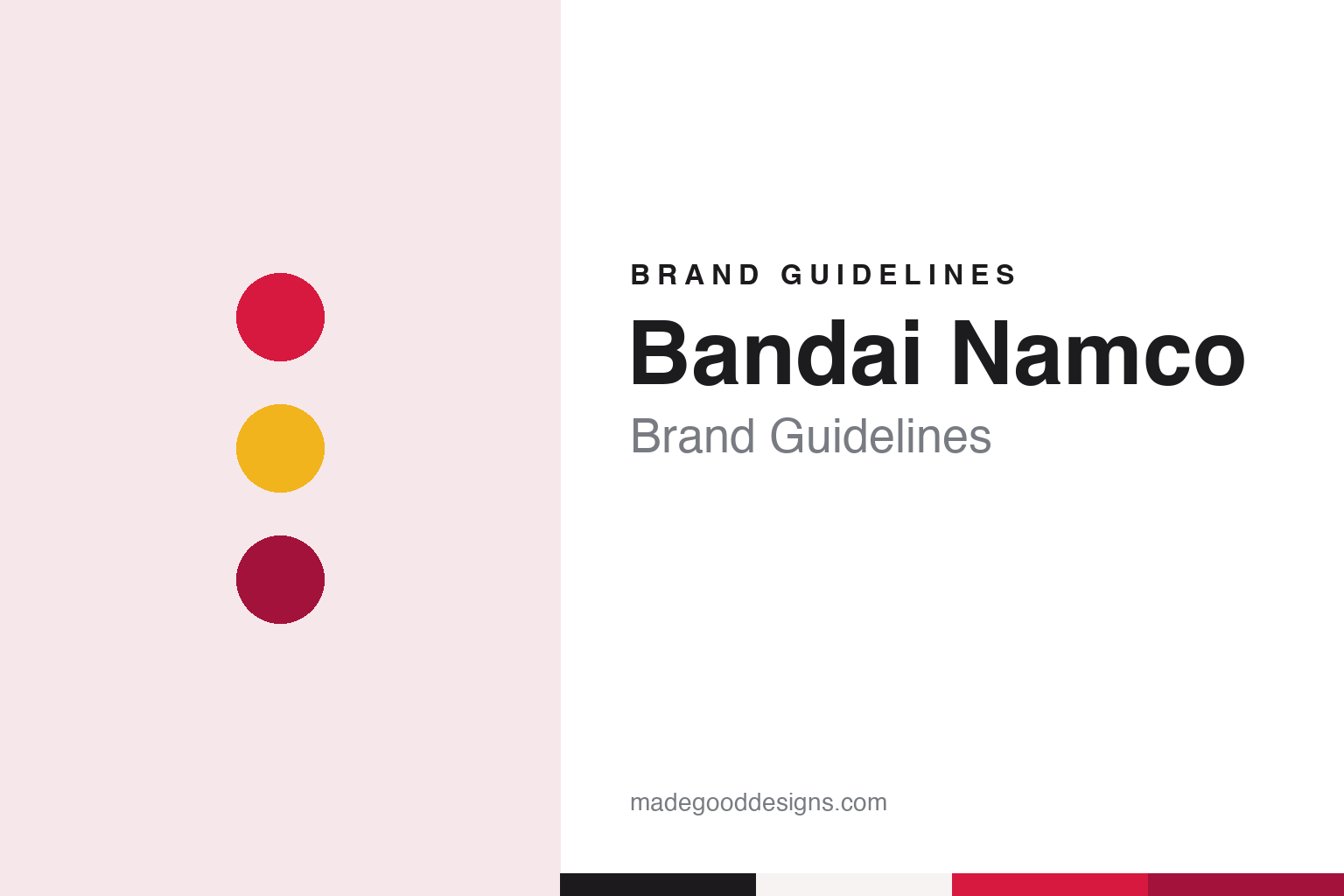
Bandai Namco Brand Guidelines
A toy maker, an arcade maker and a speech bubble.
Aa
Two constants: an ink, bubble red and deep rose palette and a Rounded sans register. Abstract homage — not a Bandai Namco asset or mark; no logo, character, game art or wordmark is reproduced.
A toy wholesaler and an amusement maker
Bandai from 1950, Namco from 1955.
Bandai Namco joins two Tokyo companies that began in very different trades. English Wikipedia says Bandai was founded on 5 July 1950 by Naoharu Yamashina as Bandai-ya, a spin-off of a textile wholesaler. The encyclopedia says the company started as a distributor of metal toys and rubber swimming rings, moved on to metal cars and model aircraft, was renamed Bandai Co., Ltd. in 1961 and found success with action figures based on the anime Astro Boy. It adds that between 1981 and 2001 Bandai also made video game consoles. Bandai’s toy and model business is covered in our Bandai guide.
The second company began with amusement rides. Wikipedia says that on 1 June 1955 the businessman Masaya Nakamura founded Nakamura Seisakusho Co., Ltd. in Ikegami, Tokyo. The encyclopedia says the name Namco comes from Nakamura Manufacturing Company, after the founder, and that in the 1960s the company built electro-mechanical arcade games such as Periscope, from 1965.
Video games followed in the 1970s. According to Wikipedia, Nakamura’s company entered the field after acquiring the Japanese division of Atari in 1974, distributing games such as Breakout in Japan, renamed itself Namco in 1977 and released its own game, Gee Bee, a year later. The encyclopedia lists Galaxian in 1979 and Pac-Man in 1980, followed by Galaga, Xevious and Pole Position, and says Namco began converting its arcade games for home systems such as the Nintendo Family Computer in 1984.
By the 1990s each company had a clear specialism. Wikipedia names Namco series such as Ridge Racer, Tekken and Taiko no Tatsujin from that decade, alongside arcades and amusement parks the company operated. Bandai, meanwhile, remained a toy and character-merchandise business, the maker of the egg-shaped virtual pet Tamagotchi and of licensed figures and model kits.
Colour
Namco Bandai in 2005, Bandai Namco from 2015.
The merger was announced in spring 2005. Nintendo World Report, in a story by Vincent Anderson dated 1 May 2005 that drew on the Nihon Keizai Shimbun and CNN, reported that Namco and Bandai planned to combine and that both had been looking for partners to face intensified competition. An update to the same report, citing Namco’s official Japanese site, said the merged company, Namco Bandai Holdings, Inc., would be established on 29 September 2005, with Namco representative director Kyushiro Takagi as chairman and Bandai president Takeo Takasu as president and representative director. The site said the official plan stressed combining Bandai’s merchandising with Namco’s software development.
The operating businesses were then rearranged. Wikipedia says that on 31 March 2006 Namco merged with Bandai’s video game operations to form Namco Bandai Games, while Namco’s arcade and amusement park divisions were spun off into a new subsidiary that kept the Namco branding. The encyclopedia’s Namco article says the standalone Namco name continues to be used for arcades and other entertainment products within the group.
The order of the two names changed a decade later. Wikipedia says the holding company was known as Namco Bandai until 2015, when it became Bandai Namco Holdings, the name now also carried by the games arm, Bandai Namco Entertainment. The encyclopedia lists the group’s main companies as Bandai for toys, Bandai Namco Entertainment for video games, Bandai Namco Experience for amusement machines and venues, Bandai Namco Filmworks, which includes the anime studio Sunrise, and Bandai Namco Music Live, which includes the label Lantis.
Wikipedia gives the headquarters as the Sumitomo Fudosan Mita Building in Minato, Tokyo, with regional offices in Irvine, California; Richmond, London; Hong Kong; and Shanghai. It says Yuji Asako became president and Masaru Kawaguchi chairman in 2025.
Typography
A name read as two companies, then as one group.
A game studio’s identity usually reaches players before the game does. The company logo appears in a short boot screen or animated ident in the seconds while software loads, then again on boxes, store pages, trailers and the credits. Because those seconds repeat every time someone starts a game, the ident tends to be brief, legible on a phone or a television, and quiet enough that it does not compete with the title that follows. Publishers add a second layer: one publishing name may sit in front of games from several development studios, each with its own look, so the publisher’s mark has to work beside very different artwork.
Much of the visible branding, though, belongs to the games rather than the company. Characters, mascots and title logos carry the recognition, and the studio name may appear underneath them in small type. Some companies let a recurring character stand in for the studio; others are known chiefly through a consistent visual style shared across their games. Ownership changes leave marks too: when a studio or its parent is bought, the new owner’s branding may appear beside the studio’s own, and when a studio becomes independent, the parent’s mark drops away. For designers, the practical point is that a studio identity is a set of placements — a boot screen, a store icon, a credit line, a website — and each needs a version of the mark that works at its size and in its moment.
Aa
Rounded sans — a stand-in for a friendly corporate wordmark set inside a speech bubble. (Specimen set in M PLUS Rounded 1c, a sans STAND-IN; NOT the Bandai Namco logo or any Bandai Namco typeface.)
Bandai Namco
A speech bubble for “Fun for All into the Future”.
The group’s current mark arrived with a new statement of purpose. Shacknews, in a report by TJ Denzer dated 1 October 2021, said Bandai Namco had announced the change in a press release on 30 September 2021: from around mid-April 2022 the company would adopt a Purpose called “Fun for All into the Future”, and with it a new logo that would retire the previous design in red, yellow and orange. The site quoted the company’s statement that “the new logo’s speech bubble motif, ‘Fukidashi’ in Japanese, expresses the potential of the brand to connect with people around the world and inspire them with amazing ideas.”
Wikipedia adds detail on the timing and colour. It says the logo and mission statement were unveiled in September 2021 for use from 1 April 2022, marking the anniversary of Bandai’s founding, and that the speech bubble represents both the worldwide reach of Japanese manga and the company’s wish to communicate with players. The encyclopedia records that on 8 February 2022, before the launch, the colour of the new logo was changed from magenta to rose red.
For designers, the mark shows a merged group choosing a single motif over its two founders’ histories. The speech bubble is drawn from comics rather than from toys or arcades, and the company tied it to communication with fans rather than to any one product. The older three-colour design, in Shacknews’ description, had appeared on games, arcade machines and business ventures alike and was set to be retired alongside the launch of the Purpose statement. Meanwhile the founding names live on at the level below: Bandai on toys and models, Namco on arcades.
For a design guide, Bandai Namco shows how a group can carry two founders’ names in one wordmark and use a single shape, a speech bubble, to stand for the whole business. Compare Square Enix, another Tokyo company formed by a merger of two names, and SEGA, another Japanese arcade and game company. For this guide we use ink, bubble red and deep rose with a rounded sans, an unofficial interpretation; no product or logo is reproduced.
Explore & save
Keep Bandai Namco’s identity on hand — save it to a board in the Made Good inspiration library.
Bandai Namco identity set
Pin the Bandai Namco ink, bubble red and deep rose palette and the Rounded sans register to your own board.