Bandai Brand Guidelines
The listed giant that makes Gunpla at home.
Aa
Two constants: a Bandai-teal palette and a gunpla-sans register. Abstract homage — not a Bandai product or mark; no model, kit or logo is reproduced.
The listed giant that makes Gunpla at home
Bandai is the Gundam-kit maker under Bandai Namco (via Bandai Spirits) whose flagship Gunpla, the world’s best-selling model kits, is still molded at its Shizuoka Hobby Center in Japan.
Bandai follows Trumpeter as the round’s listed-giant node — the one maker here that is part of a public conglomerate, and whose kits outsell the whole rest of the field. Its answer to a round about who owns the model kit is the scale one: a listed giant that still makes Gunpla at home.
Its identity is the listed giant that makes Gunpla at home. The Bandai Namco ownership, the Gunpla line and the Shizuoka plant are the story here. The giant. The listed giant that makes Gunpla at home.
(Honest notes, so the origin, the ownership, the products and the making are framed accurately. Bandai sells plastic model kits as its heroes, above all Gunpla; we report its language as the brand’s own. On origin: Bandai was established on 5 July 1950 by Naoharu Yamashina in Tokyo. On ownership: the model-kit and Gunpla business sits under Bandai Namco Holdings, the listed parent on the Tokyo Stock Exchange, formed by the Bandai and Namco merger finalized on 25 September 2005, through Bandai Co., the toy division, and Bandai Spirits, the hobby division founded on 15 February 2018. On the products: Gunpla, the Gundam plastic models, launched in 1980 after the 1979 Mobile Suit Gundam anime, in grades High Grade, Master Grade, Perfect Grade and Real Grade, snap-fit with no glue or paint needed since 1988, with more than eight hundred million cumulative units by September 2024, making it the world’s best-selling model kits, and it also held the Star Wars plastic-kit license, which we attribute. On the making: the flagship, domestic Gunpla plant is the Bandai Hobby Center in Shizuoka, Japan, though Gunpla is manufactured in Japan or China, so we say the flagship plant is in Shizuoka rather than only Japan. Its designs and the Bandai name are IP we describe but do not reproduce; there is no official brand hex; these tones are an unofficial interpretation.)
Colour
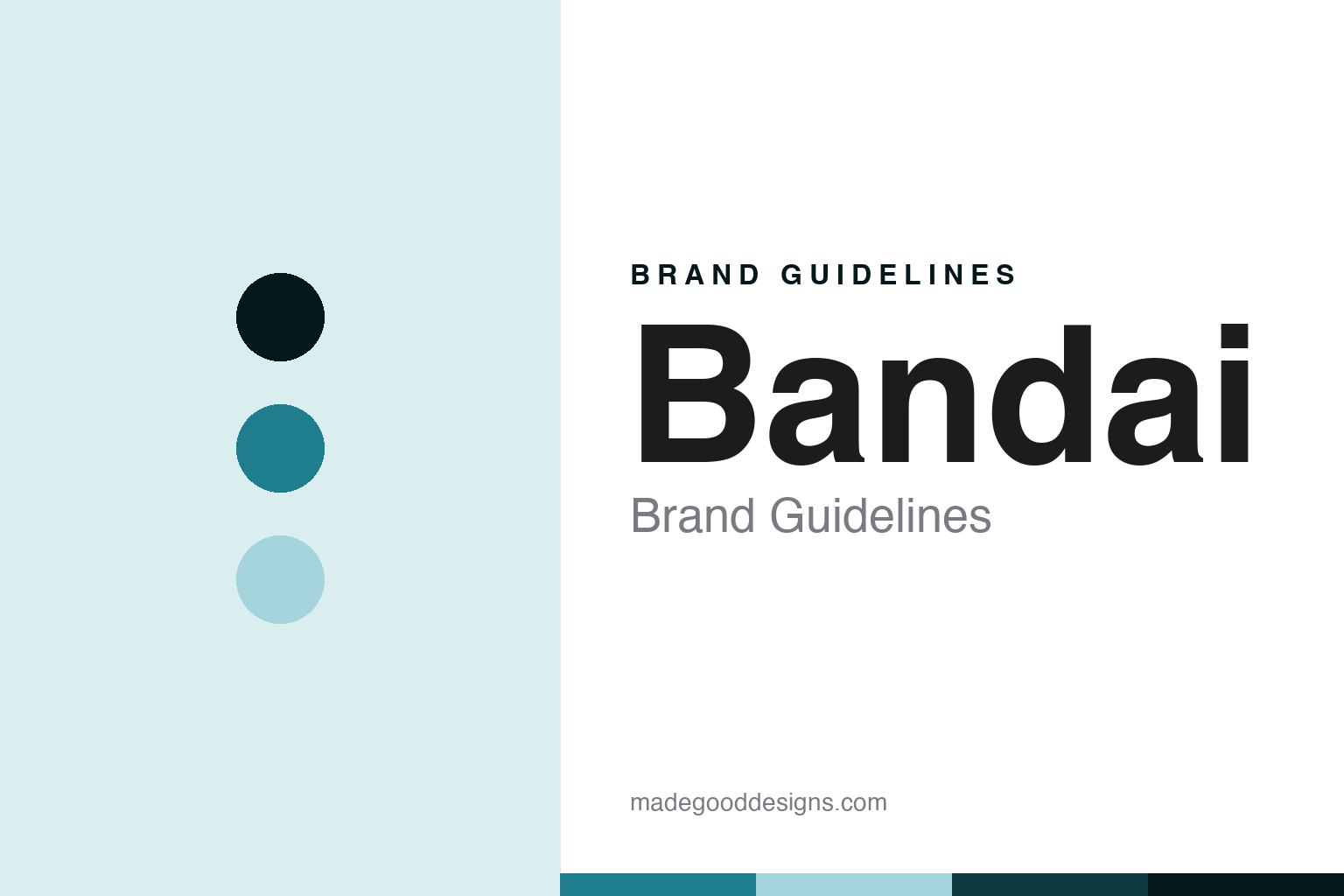
Bandai lives in a Bandai teal. Click a swatch to copy the hex.
Bandai’s identity is giant, Gunpla and home-made — a Bandai teal, an ink, a pale aqua, a deep teal, and a paper. The palette leans Bandai teal and deep teal: a clean, modern register that stands in for a listed giant rather than a loud logo colour, and we avoid the Gundam tricolor, which is a character palette, not a brand hex. It signals the listed giant that makes Gunpla at home — giant, Gunpla and home-made. The honest caveat: with no official brand hex, these values are a modern, unofficial interpretation, not first-party colours.
The lesson is a Bandai teal signals a giant, Gunpla identity. Bandai’s world is the snap-fit Gundam kit and the Shizuoka plant. For designers, it is a reminder that a clean teal and a pale aqua can carry a giant, Gunpla brand — a modern tone held as an accent, not a product shot. Because a mid hue can fail as small text, keep type dark and let the colour live in the accents, palette and band. The takeaways: name Bandai Namco and Bandai Spirits and date the merger to 2005; frame Gunpla as the best-selling kits; place the flagship plant in Shizuoka without claiming only-Japan; and keep the tricolor as a character palette.
Typography
The register is a gunpla sans — giant, Gunpla, home-made.
Bandai’s identity carries a giant, Gunpla spirit — the biggest maker in the field. A gunpla sans captures the mood: clean, precise and modern, the register of a listed giant. Set in a Bandai-teal palette, the gunpla sans feels current and dependable — exactly the personality Bandai carries. It behaves like a made, snap-fit thing rather than a loud logo, mirroring a clip-line and a cement-band. (Bandai’s real products and the name are things we describe but do not reproduce, and the exact typeface is not ours to use.) Because it is not ours to use, the honest description is “a gunpla-sans brand,” shown here in a stand-in. The type behaves like the brand: giant, Gunpla and home-made.
Aa
A gunpla-sans brand — current and dependable. (Specimen set in Outfit, a gunpla-sans STAND-IN; NOT the Bandai logo or products.)
The model-kit node
Bandai stands for the listed giant that makes Gunpla at home.
Bandai sits sixth in the round as its listed-giant node. A Bandai-teal palette, a gunpla sans and a Bandai Namco ownership make one thing — the listed giant that makes Gunpla at home — the whole identity: giant, Gunpla and home-made. The Bandai Namco ownership is the frame, the Gunpla line is the substance, and the Shizuoka plant is the pitch. The point is a listed giant whose kits outsell the field, in a round about who owns the model kit.
Put to work, the identity is the brand told straight, the parent named and the plant placed. A brand in this spirit would name Bandai Namco and Bandai Spirits and date the merger to 2005, frame Gunpla as the best-selling kits, place the flagship plant in Shizuoka without claiming only-Japan, and keep the tricolor as a character palette. A reader in this spirit would keep the facts right: Bandai makes Gunpla; the model business is under Bandai Namco via Bandai Spirits; Gunpla launched in 1980; and its flagship plant is in Shizuoka. Bandai sits after Trumpeter and before Dragon. The honest editorial moves are to name the parent, to frame the sales, to place the plant, and to keep the tricolor a character palette.
For designers and brand-builders, Bandai carries the model-kit node: the listed giant still makes its flagship at home. The lessons: a field of small makers can include one listed conglomerate, here Bandai under Bandai Namco; an origin is dated to 5 July 1950 by Naoharu Yamashina in Tokyo; an ownership is named, that the model and Gunpla business sits under Bandai Namco Holdings, the listed parent, formed by the Bandai and Namco merger finalized on 25 September 2005, through Bandai Co. and Bandai Spirits, the hobby division from 2018; products are framed, Gunpla launched in 1980 after the 1979 anime, in grades HG, MG, PG and RG, snap-fit with no glue since 1988, more than eight hundred million cumulative units by September 2024, the world’s best-selling model kits, plus the Star Wars license; and a making is placed, the flagship domestic Gunpla plant the Bandai Hobby Center in Shizuoka, though Gunpla is made in Japan or China, so not only-Japan. It is also a reminder to stay precise: Bandai is the Bandai-Namco-owned, Gunpla-making giant of the model aisle — with the palette here an unofficial interpretation, and the Gundam tricolor kept as a character palette. The hook is that scale: Bandai is the listed giant that makes Gunpla at home, the Gundam-kit maker under Bandai Namco, via Bandai Spirits, whose flagship Gunpla, the world’s best-selling model kits, is still molded at its Shizuoka Hobby Center in Japan. Read that way, Bandai is less a single kit than the listed giant that makes Gunpla at home: giant, Gunpla, home-made. The lesson for a brand is that the listed giant still makes its flagship at home, and naming the parent keeps it earned. Bandai made the-listed-giant-that-makes-Gunpla-at-home the identity — proof that a listed giant can anchor a node.
Explore & save
Keep Bandai’s identity on hand — save it to a board in the Made Good inspiration library.
Bandai identity set
Pin the Bandai-teal palette and the gunpla-sans register to your own board.