Eat’n Park Brand Guidelines
A reversed roadside sign and a Smiley Cookie from Pittsburgh.
Aa
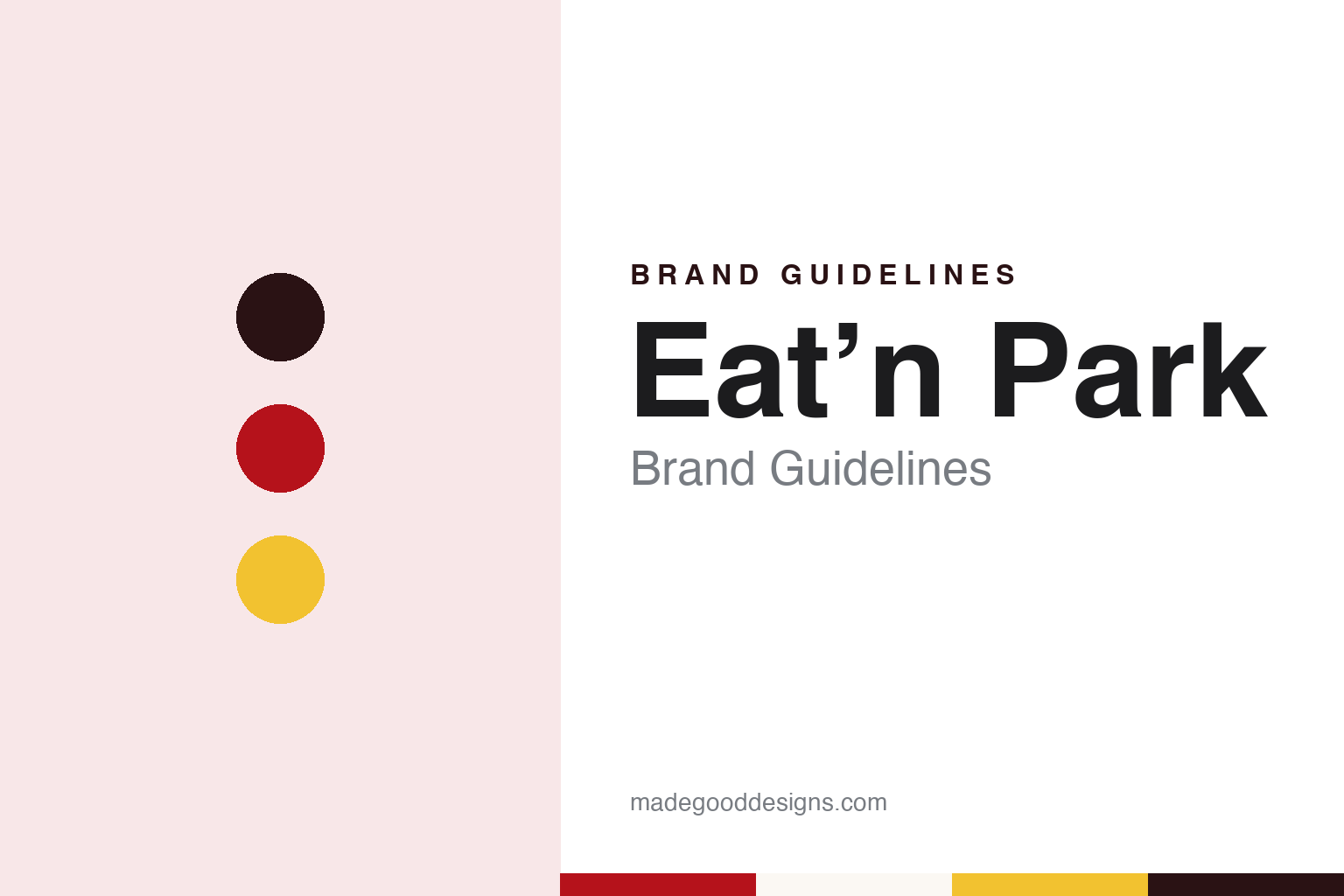
Two constants: a sign red, Smiley yellow and sign white palette and a friendly rounded sans register. Abstract homage — not an Eat’n Park product or mark; no sign, cookie or logo is reproduced.
Park and Eat
Two Isaly’s men, a Big Boy franchise and a name turned around.
Eat’n Park was started by two men from Isaly’s, the Pittsburgh dairy-and-restaurant company. The Pittsburgh Post-Gazette, writing about William D. (Bill) Peters in August 2000, said that in 1949 he left a supervisory job at Isaly’s to join another Isaly’s executive, Larry Hatch, in bringing drive-in service and a hamburger called the Big Boy to Pittsburgh. Peters’ son told the paper that Hatch had been in Ohio checking on Isaly’s stores and had seen how well the new Big Boy franchise was doing there; English Wikipedia places that visit at a Frisch’s Big Boy drive-in in Cincinnati.
The name came from the roadside. According to the Post-Gazette, “Park and Eat” was a common sign along Pennsylvania roads at the time, and the founders doubted they could protect it as their own. So they reversed the verbs, and Eat’n Park was born.
Hatch and Peters reached a deal with Big Boy’s founder, Bob Wian, to use the Big Boy name for 25 years, the Post-Gazette and Wikipedia say. Hatch stayed at Isaly’s for several years while financing the venture; Peters left at once to run the restaurants day to day, his son told the paper, and became the company’s president.
The restaurant opened on 5 June 1949 on Saw Mill Run Boulevard in Pittsburgh’s South Hills, Wikipedia says, citing a Pittsburgh Press advertisement of the day before. The company’s own history describes it as a tiny, two-tone yellow drive-in served by carhops under the line “Come as you are, eat in your car,” and says it drew so much traffic on its opening day that it had to close and regroup within hours. English Wikipedia, citing a Pittsburgh Press advertisement of 4 June 1949, places that opening drive-in on Saw Mill Run Boulevard in the Overbrook neighbourhood of Pittsburgh.
Colour
From carhops to dining rooms, and a family-owned group.
The drive-in format did not last. Eat’n Park says it opened a front dining room in 1955 for customers who preferred to eat inside, began moving to dine-in service in 1967 as interest in carhops faded, and introduced a children’s menu and hostess service in 1973. The Post-Gazette summarised the change in 2000: by the time the Big Boy agreement ran out in 1974, Eat’n Park had turned from drive-ins where people ate in their cars into sit-down restaurants with hostesses, table service and a menu running from breakfast to dessert.
When the agreement ended, the Big Boy name came off the burger. The Post-Gazette and the company both say the hamburger became the Superburger in 1974. Wikipedia says leaving Big Boy let Eat’n Park expand into territory that had been licensed to other Big Boy franchisees, and the chain moved into Northeast Ohio and West Virginia; it records a period from the mid-1990s to 2010 when the chain also served the Harrisburg, Lancaster and York markets in Pennsylvania.
The company stayed private. Eat’n Park describes itself as a family-owned restaurant chain since 1949 serving Pennsylvania, Ohio and West Virginia, and its parent, Eat’n Park Hospitality Group, gives its headquarters as Homestead, Pennsylvania. The group says it grew from a single carhop restaurant into a portfolio of regional foodservice businesses; Wikipedia lists among them the campus and corporate caterer Parkhurst Dining and the fast-casual Hello Bistro.
The company also keeps its own record of the brand. Its history dates its Christmas Star television commercial to 1982 and notes the commercial’s 40th anniversary in 2022, a book about the company, The Story Behind the Smile, published in 2023, the demolition of its Bridgeville restaurant in 2024 to make way for a new building, and the group’s 75th anniversary that same year.
Typography
Design and documentation.
The family-restaurant brands in this part of the group grew up beside the road. Their names were made to be read from a moving car, so the sign out front — a tall pylon, a lit cabinet, a roofline shape or a wordmark across the building — often did more work than any printed advertisement. A traveller who recognised the sign knew roughly what kind of room, menu and welcome waited inside before parking.
Inside, the identity carries on in ordinary objects: a laminated or folded menu with the name across its cover, a pie case or bakery counter near the entrance, booths and counter stools, printed placemats, coffee mugs and the uniforms of the staff. Many of these chains also changed hands more than once, so the wordmark, colours and building style can shift with each new owner while the name stays the same.
Each guide in this part sets out who started the brand and where, who has owned it since, and how its sign, logo and dining room are documented — separating what independent sources record from what the company says about itself.
Aa
A friendly rounded sans — the register of a cookie box and a pylon sign. (Specimen set in Nunito, a rounded-sans STAND-IN; NOT the Eat’n Park logo.)
Eat’n Park
Red-and-white signs and a face on a cookie.
Colour on the roadside is one part of the Eat’n Park identity: the Pittsburgh Post-Gazette wrote in 2000 that the chain, “with its red-and-white signs and signature ‘Smiley’ cookie,” had become firmly established in western Pennsylvania. Wikipedia illustrates the chain with a marquee pylon sign, and with a set of the chain’s historic logos from its Big Boy years, which it dates from 1950 to 1971 using newspaper advertisements of the period.
The other is the Smiley Cookie. The company says it opened its bakery in 1985 and introduced the Smiley Cookie for children visiting the restaurants in 1986; Wikipedia says the cookie launched alongside the bakery. The company’s timeline records a Smiley Cookie hot-air balloon in 1994, a Team Smiley and a Smiley’s Cookie Cruiser in 2004, and SmileyCookie.com in 2006, which let the cookie be sent anywhere in the United States. Wikipedia says the chain adopted the motto “the place for smiles.”
The buildings have changed as well. The company records a LEED-certified Eat’n Park restaurant at the Waterworks shopping center in Pittsburgh in 2010, a new Banksville restaurant in 2014 and a new Butler restaurant in 2021, and Wikipedia’s lead photograph shows a restaurant on Banksville Road. The company also says Eat’n Park appeared in a Pittsburgh edition of the Monopoly board game in 2022.
For a design guide, Eat’n Park shows how a regional family chain can build an identity from a reversed piece of roadside language and a single drawn face. Compare Friendly’s, another family-restaurant name built around a mood, and Perkins, a family-dining chain whose name has changed many times. For this guide we use sign red, Smiley yellow and sign white with a rounded sans, an unofficial interpretation; no product or logo is reproduced.
Explore & save
Keep Eat’n Park’s identity on hand — save it to a board in the Made Good inspiration library.
Eat’n Park identity set
Pin the Eat’n Park sign red, Smiley yellow and sign white palette and the friendly rounded sans register to your own board.