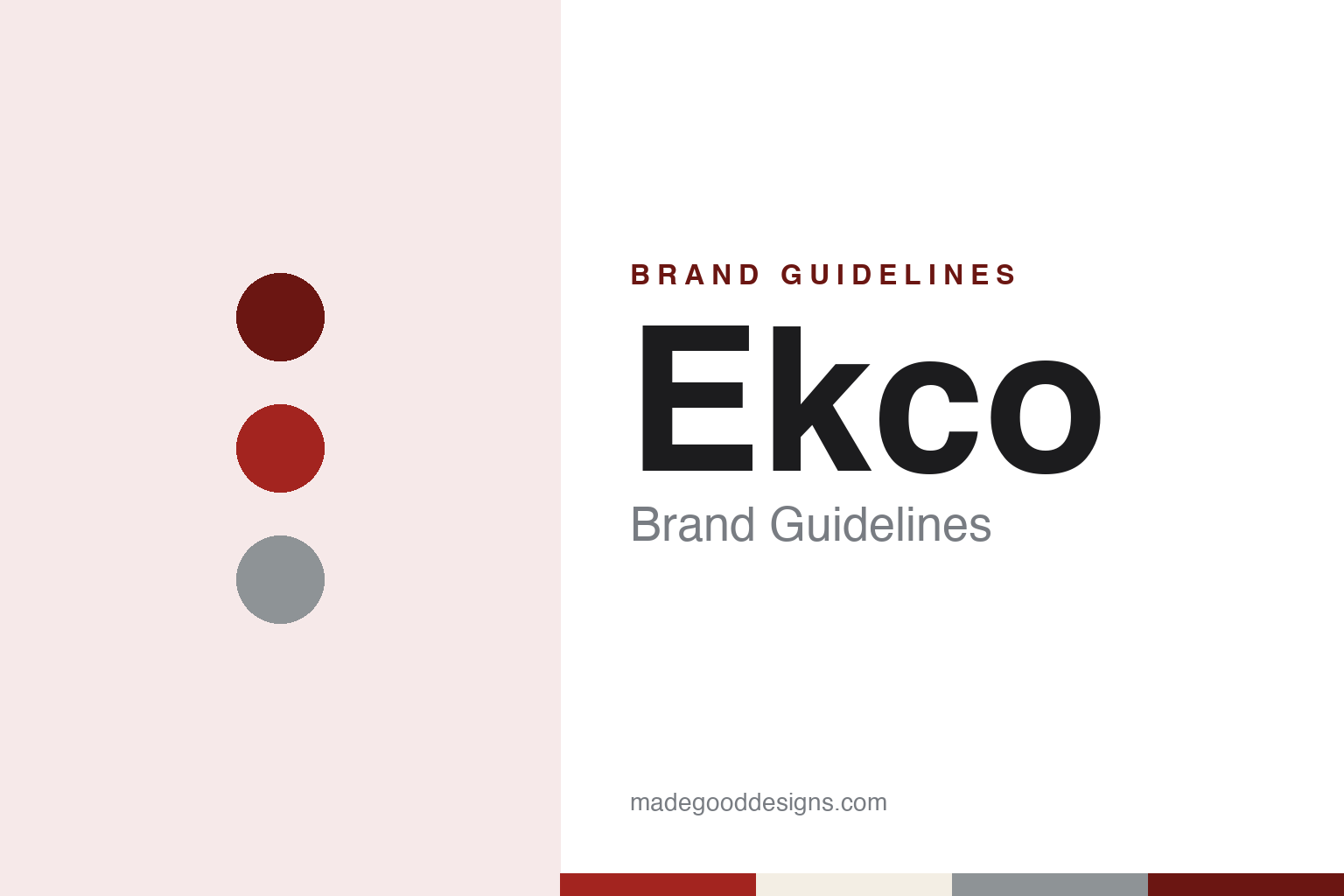
Ekco Brand Guidelines
A Chicago tinsmith’s initials, stamped on pans and kitchen tools.
Aa
Two constants: an enamel red, pan steel and kitchen cream palette and a utility housewares sans register. Abstract homage — not an Ekco product or mark; no pan, tool or logo is reproduced.
Edward Katzinger Co.
A tinsmith, a Chicago shop and pans for bakers.
Ekco began in Chicago with a tinsmith. The International Directory of Company Histories, in its profile of Ekco Group, says Edward Katzinger, a journeyman tinsmith from Austria, arrived in New York City in 1881, worked as a master mechanic in a tinsmith shop there, and opened his own business in Chicago in 1888. The Edward Katzinger Co. made tin pans for commercial bakeries, and by 1899, the directory says, its range also covered equipment for confectioners and ice cream makers. The directory gives 1903 as the year the company was incorporated under that name.
The Made-in-Chicago Museum, in a history titled “Ekco Products Co., est. 1888” published in May 2019, adds detail. It says Katzinger worked in Kansas City before settling in Chicago, that his early shop and family home were on South Halsted Street on the Near West Side, and that the “EKCO” shorthand came into use about a year after the 1903 incorporation. In 1909, the museum says, the company moved to a five-storey building on North Peoria Street, and by 1914 an expanded plant was being planned on the same block, at Washington and Sangamon streets.
The work was standardisation. The museum says that when Katzinger started, bakery pans were generally made to order, and that by the early 1920s his factory was producing pans in stock sizes for the trade; it quotes a 1921 profile in the Northwestern Miller that held the Washington Street works up as an example of modern pan production. A line of baking pans for home kitchens, the museum says, prepared the ground for the company’s later move into housewares.
Edward’s son Arthur Katzinger, an engineering graduate of the Armour Institute, joined the company as plant manager and was soon running it, by the directory’s account; he became president in 1939. In 1923, the directory says, the family built a new factory on Chicago’s Northwest Side, which the museum places at Cicero and Armitage avenues. The museum also says Arthur designed many of the firm’s pans and utensils himself.
Colour
Acquisitions, a new name and a run of corporate owners.
Growth came by acquisition. The directory lists the purchase of the August Maag Co., a Baltimore bakeware maker, in 1927, and of the A & J Manufacturing Co. of Binghamton, New York, a kitchen-tool maker, in 1929, which took the company into kitchenware. Geneva Cutlery of Geneva, New York, followed in 1934, and in 1937 an English subsidiary, Platers and Stampers, was formed to make housewares in Britain; it was renamed the Prestige Group in 1956. In 1945 the company went public as Ekco Products Co., a name built from the founder’s initials, and by then Arthur had changed his surname to Keating, the directory says. The museum dates the change of corporate name from Edward Katzinger Co. to the same period.
By 1960, according to the directory, Ekco made commercial baking pans, builders’ hardware and industrial food-handling equipment as well as housewares, and its trade names included Ekco Eterna, Ekcoloy, Flint and Geneva Forge. With Alcoa it formed Ekco-Alcoa Containers in 1955 to supply rigid aluminium-foil containers, and it bought out its partner in 1962. Subsidiaries had plants in Canada, Mexico, England, Germany and Australia, the directory says.
In 1965 Ekco agreed to be bought by American Home Products; the museum says the company became a division of the conglomerate in September 1965. By 1972 the business had been divided into Ekco Products, Ekco Housewares and the Prestige Group. American Home Products sold its housewares operations in 1984: Ekco Housewares, then based in Franklin Park, Illinois, went to a group led by the investment firm Gibbons, Green, Van Amerongen, and its Chicago plant closed in 1986, the directory says.
In 1987 Ekco Housewares was sold to Centronics Corp. of Nashua, New Hampshire, a former printer maker, which renamed itself Ekco Group, Inc. in 1988. Through the early 1990s Ekco Group added plastic storage, brush and pest-control businesses, according to the directory. English Wikipedia says Corning Consumer Products bought Ekco, together with General Housewares, in 1999; that company was renamed World Kitchen in 2000 and Corelle Brands in 2018.
Typography
Design and documentation.
Cookware reaches most people through a shop shelf before it reaches a stove, so a pan’s identity is carried first by its packaging. A box or sleeve usually shows the piece from above or at an angle, names the range and the collection, and gives the brand a fixed corner where the logo sits from one product to the next. Colour on the box often signals the range rather than the company, which lets one maker run several lines side by side without each one looking like the others.
Smaller printed pieces carry the name once the box is gone. Hang-tags and card wraps travel with pans sold loose on a rail, while the underside of a pan or the end of a handle may carry a stamped or cast mark that stays with the piece for as long as it is used. Those small marks are where a name is most often seen at home.
Each guide in this group sets out who started the brand, who owns it now and how its name has been presented, and separates what independent sources record from what the company says about itself.
Aa
A utility housewares sans — the register of a stamped pan and a blister card. (Specimen set in Archivo, a sans-serif STAND-IN; NOT the Ekco logo.)
Ekco
Initials, a can opener and a family of sub-brands.
The Ekco name is a compression of its founder’s company: E and K for Edward Katzinger, and Co for company. The museum dates the shorthand to the years just after the 1903 incorporation, and the directory records it becoming the corporate name in 1945. From then on the initials worked as a prefix as well as a name, in trade names such as Ekco Eterna and Ekcoloy and, later, Ekco Pro.
The museum gives particular attention to the Miracle Can Opener, a geared opener with long handles that it credits to the company designer Myron J. Zimmer and dates to a 1938 patent. It quotes a 1965 Ekco magazine advertisement for the opener, run in titles such as Better Homes and Gardens, with the line “We taught your mother a new way to open chicken soup.” The museum reads that campaign as a message of continuity at the moment Ekco was passing to American Home Products.
The museum also quotes Arthur Keating telling Fortune in 1949 that the company talked about “what the consumer will pay,” and describes an approach of offering the same tool at several price points and in many handle colours. Colour returned under later owners: the directory cites a 1985 HFD report on a Nova line of European-styled kitchen tools in bright primary colours, introduced while Finn Schjorring ran Ekco Housewares and said he wanted kitchen utensils good enough to hang on a wall.
The bakeware side carried its own name. The directory describes Baker’s Secret as Ekco Housewares’ bakeware brand by 1988, and English Wikipedia says Corelle Brands discontinued Baker’s Secret in 2018.
For a design guide, Ekco shows a housewares identity built on an abbreviation: a founder’s initials, stamped on pans and tools, then extended into a family of sub-brands. Compare Corelle, whose parent group Ekco joined in 1999, and Revere Ware, its metal-cookware stablemate there. For this guide we use enamel red, oxblood, pan steel and kitchen cream with a sans-serif, an unofficial interpretation; no product or logo is reproduced.
Explore & save
Keep Ekco’s identity on hand — save it to a board in the Made Good inspiration library.
Ekco identity set
Pin the Ekco enamel red, pan steel and kitchen cream palette and the utility housewares sans register to your own board.