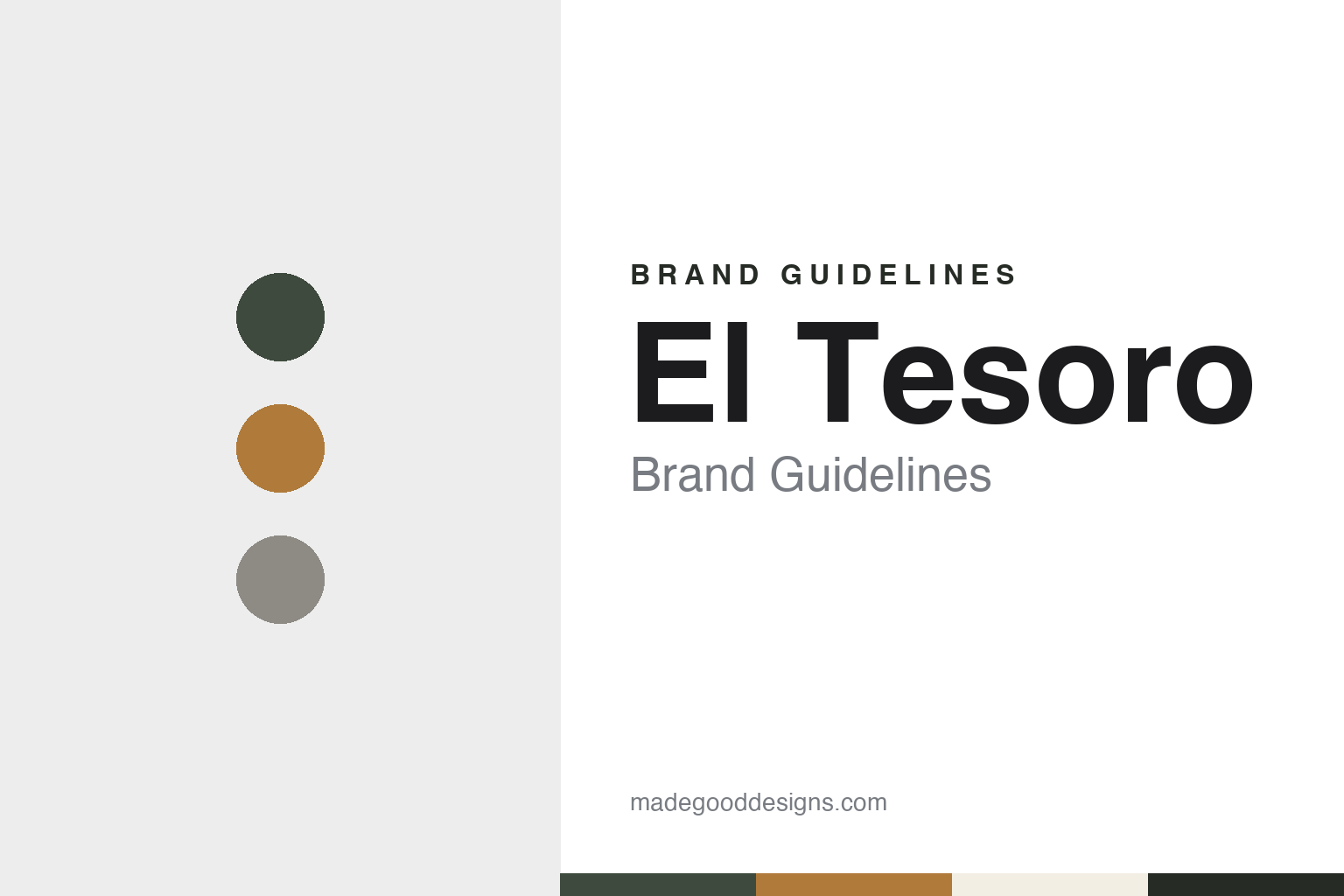
El Tesoro Brand Guidelines
The La Alteña tahona tequila with a stone on the stopper.
Aa
Two constants: a highland agave, volcanic stone and oak palette and a signature serif register. Abstract homage — not an El Tesoro product or mark; no label, logo, closure or bottle is reproduced.
La Alteña
A highland distillery opened by an agave grower.
El Tesoro comes from La Alteña, a distillery in Arandas, in the highlands of Jalisco. A heritage site published by Beam Suntory, the brand’s owner at the time, dates its opening to 7 July 1937 and names the founder as Don Felipe Camarena, an agave grower whose family, it says, had made tequila since the early 1800s. The same site says the family’s earlier distillery was abandoned and destroyed during the Mexican Revolution and the Cristero War, and that La Alteña was first called Camarena Hermanos. Punch reported in 2013 that Don Felipe’s father, Don Pedro Camarena, lost his distillery to fire during the Revolution of 1910.
Don Felipe opened La Alteña partly so that his own agave would not go to waste, the Beam Suntory site says, and from 1940 he sold a 100% blue agave tequila under the name Tapatío, which is still made there. English Wikipedia says the business passed to his son Felipe J. Camarena Orozco and then to the next generation; Felipe J.’s son Carlos Camarena became chief executive and master distiller in 1995, according to the Beam Suntory site. Carlos also made Tequila Ocho at La Alteña, Punch reported in 2013, while his brother Felipe left in 2007, VinePair says, to build his own distillery, where he makes G4.
Colour
An export brand, then a global group.
El Tesoro began as a tequila for export. English Wikipedia describes El Tesoro de Don Felipe as a 1990 joint venture between the Camarena family and two American promoters of premium tequila, Robert J. Denton and Marilyn S. Smith; the Beam Suntory site gives the brand’s founding as 1988 in one place and the partnership as 1990 in another, with the first shipments reaching the United States in 1989 or 1990. The name means “the treasure.” The same site says Paradiso, an extra añejo aged in French oak barrels that had held cognac, followed in 1997 to mark La Alteña’s 60th anniversary; the brand credits it to a collaboration with Alain Royer of the cognac house A. de Fussigny.
The brand then moved into a large drinks business. In 1999 Fortune Brands bought the El Tesoro trademark and its exclusivity contract from Denton and Smith, English Wikipedia says; in October 2011 Fortune Brands sold its other businesses and renamed itself Beam Inc., which was later acquired by Suntory to form Beam Suntory. That company is now Suntory Global Spirits, which has marketed El Tesoro since 2024. The legal line on the brand’s website names Fielding & Jones Ltd. of Chicago and links to Suntory Global Spirits.
The Camarenas still make the tequila. In April 2025 El Tesoro named Jenny Camarena, Carlos’s sister, as master distiller and chief executive in his place, the whiskey writer Fred Minnick reported. She studied architecture in Guadalajara, Minnick wrote, and returned to La Alteña in 2015 to join the distilling team; the brand says she oversees the jimadors and distillers who grow and harvest the estate agave.
The process is the brand’s main message, and the company describes it step by step. Highland agave — six to nine years old, it says — is steamed in ovens called hornos for 48 hours and left to cool for a day, then crushed by a two-ton volcanic tahona stone. The juice and fibres ferment in open wooden vats with natural yeast and are distilled twice in small copper pot stills “to proof,” so that, the company says, no water has to be added. The reposado rests nine to eleven months in American oak ex-bourbon barrels, the añejo two to three years and the extra añejo four to five. The extra añejo, the Beam Suntory site says, began with barrels Felipe J. Camarena filled and then left for years, which Carlos later drew off and blended with older stock. The same site places La Alteña at about 7,000 feet, beside a natural spring.
Typography
Design and documentation.
The seven brands in this group are all tequilas: El Tesoro, G4, Cascahuín, La Gritona, Siete Leguas, Arette and Mijenta. Tequila is a protected name. English Wikipedia records that it became Mexico’s first appellation of origin in 1974, and that under that appellation the agave may be grown and the spirit made only in Jalisco and in selected municipalities of a few other Mexican states, from blue Weber agave. Within that common frame, the brands here range from family houses to younger labels.
A tequila brand’s identity is often carried less by the liquid than by its label, its bottle and the place it names, because the name on the front and the distillery behind it are not always the same thing. Every bottle carries a NOM number, which English Wikipedia describes as the government-assigned number of the distillery where the tequila was produced, so a single distillery can make tequila for more than one brand. That makes the questions behind each name worth asking plainly: who started it, who owns it now, and where its tequila is actually distilled.
Each guide separates what independent sources record from what the company says about itself — its founding story, its owners over time, where its tequila is made and how its labels have changed — and marks plainly what rests only on the company’s own word.
Aa
A signature serif for a label signed by Don Felipe. (Specimen set in Cormorant Garamond, a serif STAND-IN; NOT the El Tesoro logo.)
El Tesoro
A stone closure, a signature and a batch number.
The bottle tells the same story. In April 2018, Bev News Online reported, El Tesoro introduced a new bottle and label for its blanco, reposado and añejo, due on shelves that May. The changes it listed were a closure modelled on a tahona stone; agave flourishes honouring the estate-grown agave; five small icons for steps in the process — mature agave, natural fermentation, traditional oven cooking, copper stills and ageing in American oak; Don Felipe’s signature; and a batch number on every bottle. The design agency Stranger & Stranger lists among its work “a complete redesign of the El Tesoro range” that “honors the traditional stone tahonas used to crush the agave.” The brand’s website now carries the line “Hand-dipped. One at a time. Every time.”
Under Suntory the brand has borrowed casks from the rest of the group. The Mundial Collection is a series of limited cask-finished releases: a Laphroaig Edition in 2021, a Knob Creek Rye Edition in 2023 and a Basil Hayden Toast Edition in 2024, according to Suntory Global Spirits, which announced the next, the Yamazaki Edition, in October 2025 — an añejo rested for 12 months in casks from Yamazaki, the group’s Japanese whisky distillery, developed by Carlos and Jenny Camarena with Shinji Fukuyo of The House of Suntory.
The name needs care online. The full name on the label is El Tesoro de Don Felipe, and the tequila’s site is eltesorotequila.com. Tapatío, La Alteña’s older brand, shares its name with an unrelated hot sauce.
For a design guide, El Tesoro shows how a tequila owned by a global group can keep a family’s hand on the pack — a stone closure, a founder’s signature and the steps of the process printed on the label. Compare Sauza, another Suntory Global Spirits tequila, and Fortaleza, another tahona tequila in a family’s hands. For this guide we use highland agave, volcanic stone and oak with a serif, an unofficial interpretation; no product or logo is reproduced.
Explore & save
Keep El Tesoro’s identity on hand — save it to a board in the Made Good inspiration library.
El Tesoro identity set
Pin the El Tesoro highland agave, volcanic stone and oak palette and the signature serif register to your own board.


