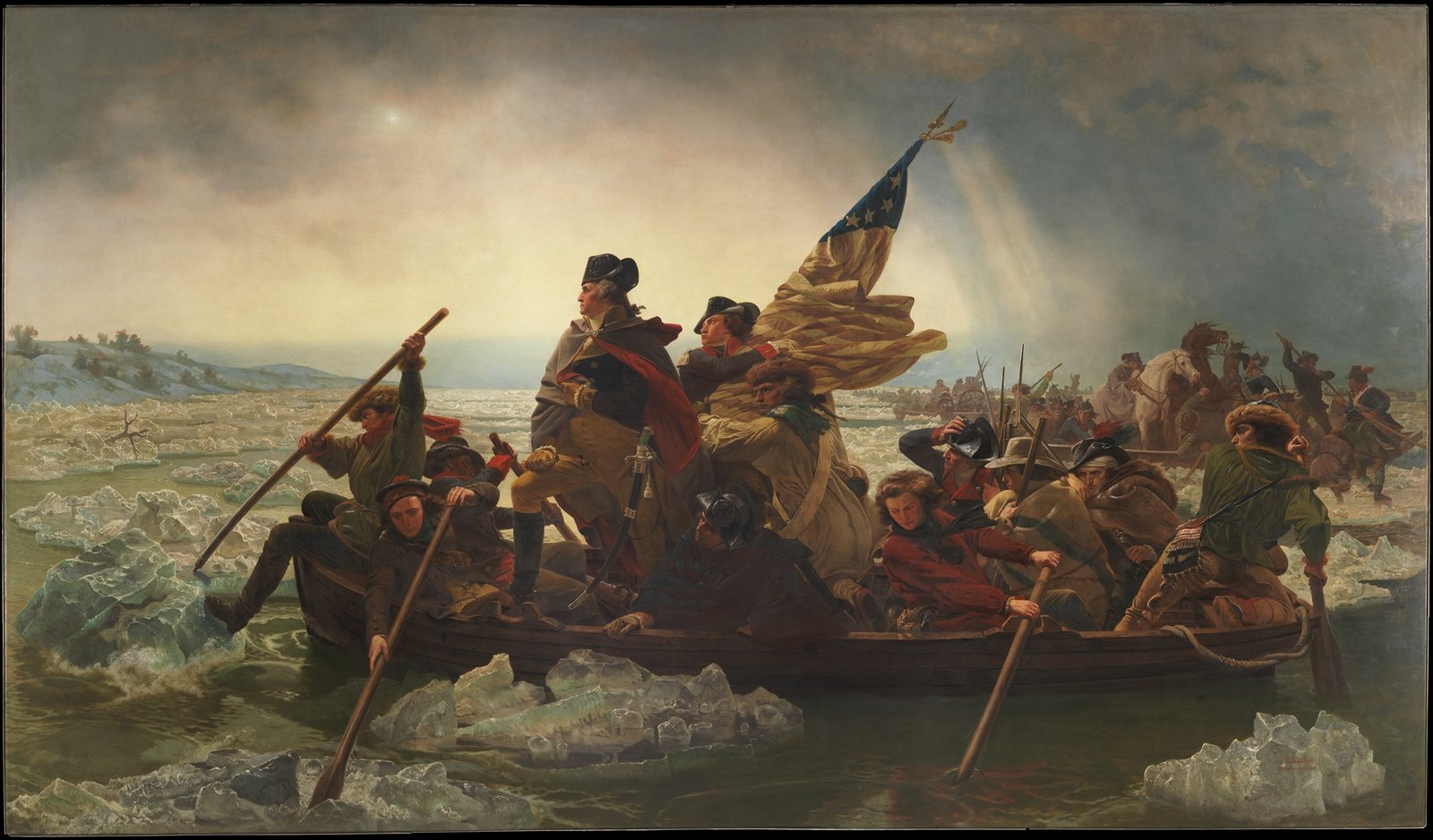
Emanuel Leutze made pictures that work like film stills: one figure, one decisive moment, and every other element pointing at it. Washington Crossing the Delaware, the canvas most people associate with him, is more than six metres wide, yet it reads at thumbnail size because the composition is so clear. Here is how he built that clarity, and what designers can borrow from it.
All the works shown here are flagged public domain by the Met or CC0 by the Cleveland Museum of Art. Browse more in the MGD museum inspiration collection.
Who was Emanuel Leutze?
The Met gives his life as Schwäbisch Gmünd 1816 to Washington, D.C., 1868, and authority records cite 24 May 1816 and 18 July 1868. He was brought to the United States as a child in 1825, grew up in Philadelphia and took his first formal lessons there from the portrait painter John Rubens Smith.
In 1841 he went back to Germany to study at the Düsseldorf academy. German and English biographies agree that he spent only about a year in the class of the director, Wilhelm von Schadow, and that the history painter Carl Friedrich Lessing shaped him more. He travelled to Munich in 1842 and then to Venice and Rome before settling again in Düsseldorf, where he married and stayed until 1859. He was among the founders of the Malkasten artists’ club in 1848, and American students in Düsseldorf found him a ready contact.
In 1859 he returned to the United States, working in New York and Washington. Congress commissioned him to paint a stairway mural in the Capitol, Westward the Course of Empire Takes Its Way, which is dated 1861. He died in Washington in 1868.
Key works by Emanuel Leutze
- Columbus Before the Council of Salamanca, 1841. His first Düsseldorf subject, now in the Musée des Beaux-Arts de Lyon.
- Sir Walter Raleigh Parting with His Wife, 1846. Known in print through the engraving shown below, issued by the American Art-Union.
- Washington Crossing the Delaware, 1851. Oil on canvas, 378.5 × 647.7 cm, the Met (gift of John Stewart Kennedy, 1897).
- Worthington Whittredge, 1856. A costume portrait of his friend, also at the Met.
- Westward the Course of Empire Takes Its Way, 1861. A mural about 20 by 30 feet behind the western staircase of the House of Representatives wing of the US Capitol; a smaller study is in the Smithsonian American Art Museum. Its title quotes a line by the philosopher George Berkeley, and it pictures westward expansion in the spirit of Manifest Destiny.
What to look at in Washington Crossing the Delaware
The Met records that Leutze began a first version in 1849, that it was damaged by fire in his studio in 1850, and that it was restored and bought by the Kunsthalle Bremen, only to be destroyed in a bombing raid in 1942. In January 1851, the museum says, he started the larger, slightly revised second version that now hangs in New York. It was shown in Düsseldorf and then sent to New York for its American debut.
Look first at the two diagonals. The boat runs almost flat from left to right, but the oars and poles cut across it at steep angles, and the flagstaff leans back against them. The crossing lines set up a push and pull, so a scene of men rowing hard feels like it is struggling forward. Washington stands where the diagonals meet.
Then look at the sky. The brightest area of the canvas sits behind Washington and the flag, while the ice and the far bank stay grey. Measured from the Met’s scan of the painting, the lit sky reads around #e0d1a6, a creamy yellow, and the storm clouds around #676960. The figures in the boat drop to warm darks near #3e382c and #312924. The picture is close to sepia, so the few accents of red and blue in the flag and cloak lining jump out.
The flag also shows how freely history painting treated facts. The Stars and Stripes design it shows was adopted by Congress in June 1777, months after the crossing of 25–26 December 1776. According to the Met’s published catalogue of its American paintings, an 1853 exhibition catalogue named the man holding the flag as James Monroe.
According to Britannica and Reynolda House Museum of American Art, Whittredge posed as the model for Washington. Leutze used American visitors in Düsseldorf as models and helpers.
The frame belongs to the design too. Since the 2010s the painting has hung in a carved replica frame with an eagle crest, made from an 1864 photograph that shows the original. German accounts note that it carried words from Henry Lee’s eulogy for Washington, so the frame acted as a title panel as well as a border.
Portraits and costume: the Whittredge picture
Leutze’s 1856 portrait of Worthington Whittredge, given to the Met in 1903, shows the same theatre at life size.

Whittredge stands in sixteenth-century dress: black doublet and cloak, a stiff white ruff, a gold chain with a medallion, and a white plume tucked under his arm. Almost the whole canvas is black. Measured from the Met’s scan, the ground and clothing sit between #1b1712 and #231e17, with the face and ruff the only large light areas. Leutze lets three small whites, the ruff, the cuffs and the feather, carry the picture.
Drawings and engravings: Leutze in black and white
His drawings show how he sketched ideas before staging them. The Soldier’s Farewell, from a scrapbook given to the Met in 1926 by James C. McGuire, is ink and graphite on thin letterpress paper.
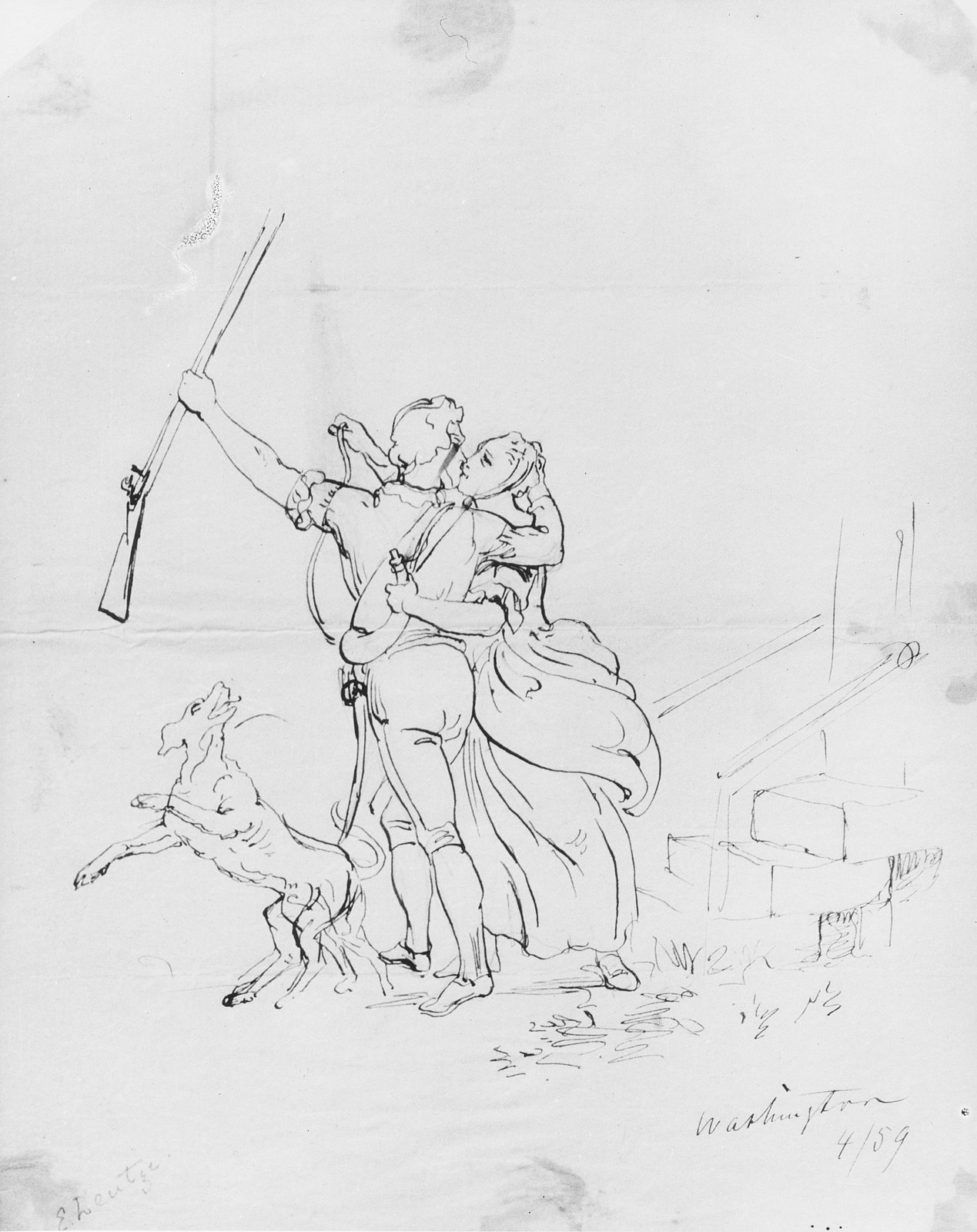
The figures are drawn in quick contour lines with almost no shading. A raised musket gives the strong diagonal, the dog repeats it in the opposite direction, and steps and a railing at the right suggest a doorway in a few strokes. The sheet is inscribed “Washington” and “4/59”, which fits the year he moved back to the United States.
Many people knew Leutze’s paintings only through prints. The Cleveland Museum of Art holds an 1846 engraving by Charles Kennedy Burt after Leutze’s Sir Walter Raleigh Parting with His Wife. It is Burt’s print, not a Leutze original.

The composition works like the Delaware picture in miniature: the couple are lit in the centre, an arch and stairway open at the left, and the dark vault presses down on them. The lettering under the image is worth studying. The title is in large outlined capitals, the subtitle in smaller spaced capitals, and the publication line in a flowing script, with a small cameo seal between the two lines of script. The engraved credits name Leutze as painter and Burt as engraver, and state that the American Art-Union published the print for its members from the original picture owned by David Leavitt. Measured from Cleveland’s scan, the paper margin reads around #e7d0b9 and the engraved image averages near #423d38. For more prints in this medium, see the engraving collection.
How designers can borrow from Emanuel Leutze
- Put the hero where the light is. Place your key element against the brightest area of the layout, and keep everything else a step or two darker.
- Use crossing diagonals for energy. A horizontal base with strong diagonals cutting through it reads as effort and movement, useful for campaign banners and covers.
- Work in sepia with one or two accents. A palette of creams and warm browns such as #e0d1a6 and #3e382c lets a single red or blue carry the emphasis.
- Treat the frame as typography. The Delaware frame and the Raleigh print both put words around the image. A lettered border or caption panel can give a hero image the weight of a poster.
- Mix letterforms with a clear hierarchy. Outlined capitals for the title, spaced capitals for the subtitle and a script for the credits: three styles, three levels, no confusion.
To pull your own values from a public domain scan, try our image colour picker.
Where Emanuel Leutze fits
Leutze belongs to the Düsseldorf school of history painting, with its literary subjects, careful drawing and theatrical staging, and his work sits within the wider Romantic taste for heroic national stories. Our guide to Romanticism in art covers that background. For the American landscape painter who posed as his Washington, read our guide to Worthington Whittredge.
Frequently asked questions
What is Emanuel Leutze known for?
For Washington Crossing the Delaware (1851) at the Met, and for the Capitol mural Westward the Course of Empire Takes Its Way (1861).
Why are there two versions of Washington Crossing the Delaware?
According to the Met, his first version was damaged by fire in his studio in 1850. It was restored and later destroyed in 1942 at the Kunsthalle Bremen. The Met’s canvas is his larger second version, begun in 1851.
Where did Emanuel Leutze train?
He studied with John Rubens Smith in Philadelphia, then at the Düsseldorf academy from 1841, where Carl Friedrich Lessing was his main influence.
Can designers use Emanuel Leutze images?
The works shown here are flagged public domain by the Met or CC0 by the Cleveland Museum of Art. Check the flag on each object record, as photographs of works in other collections may carry their own terms.