Han van Meegeren is remembered not for his own paintings but for the forgeries he sold as seventeenth-century masterpieces. His fakes deceived collectors, a major museum in Rotterdam and a senior Nazi official, and their exposure after the Second World War became a widely reported art-fraud case. None of his forgeries is a Vermeer, and none is shown here. Instead, this guide places genuine public-domain works by artists whose styles he imitated beside a plain account of what he did, so designers can see what he was trying to copy and what that tells us about style, authorship and trust.
A note on images: van Meegeren died in 1947, and the Met, the Art Institute of Chicago and the Cleveland Museum of Art hold no works by him. The three pictures below are genuine paintings by Pieter de Hooch, Gerard ter Borch and Frans Hals, flagged public domain or CC0 by their museums and labelled with their real makers. For more cleared images, browse the MGD museum inspiration collection.
Who was Han van Meegeren?
Britannica records that he was born on 10 October 1889 in Deventer, in the Netherlands, and died on 30 December 1947 in Amsterdam; Masterworks’ artist profile gives the same dates. He trained first as an architect. Masterworks records that he entered the technical college in Delft in 1907 and that in 1913 he received the college’s gold medal for a study of the interior of the Laurenskerk in Rotterdam, but left without taking the final architecture examination.
He then worked as a painter and illustrator in a traditional, realist manner. Britannica describes him as a Dutch painter known chiefly for an elaborate scheme of forging and selling paintings attributed to Dutch masters, a scheme that came to light only after the war.
Career outline: from imitation to fraud
Early exercises. According to accounts of his career, including TheCollector’s profile, he made a series of early pictures in the manners of Frans Hals, Pieter de Hooch, Gerard ter Borch and Vermeer before concentrating on Vermeer. Later works in the style of de Hooch included interiors with card players and drinkers.
The Rotterdam forgery, 1937. His painting The Supper at Emmaus was presented to the Dutch scholar Abraham Bredius, who praised it in The Burlington Magazine in 1937 as a masterpiece by Vermeer, according to FutureLearn’s art-crime course and the History of Information. Museum Boijmans in Rotterdam acquired it under its director Dirk Hannema; most sources date the purchase to 1937, while the Dutch broadcaster NOS gives 1938. The museum still owns the painting, now catalogued as a van Meegeren forgery, along with two other fakes by him, Head of Christ and Isaac Blessing Jacob. In 2010 it staged an exhibition titled Van Meegeren’s Fake Vermeers.

The sale to Göring. During the German occupation, one of his forgeries, a religious scene usually titled Christ with the Adulteress, was sold as a Vermeer to Hermann Göring. Sources give the date of the sale as 1942 or 1943.
Exposure after the war. Britannica notes that his activities came to light when an Allied art commission set out to identify works collected by Nazi leaders and return them to their owners. Facing a charge of collaboration for selling Dutch cultural heritage to the enemy, he confessed that the picture was his own work, and so were others, including The Supper at Emmaus. Several accounts, including TheCollector’s, say that to prove his claim he painted a new picture, Jesus among the Doctors, while under official observation.
Trial and death, 1947. He was convicted of falsification and fraud on 12 November 1947 and sentenced to one year in prison, according to Britannica and other accounts. Britannica reports that he died of a heart attack before serving the sentence.
What to look at: the style he tried to copy
Looking at genuine Dutch genre painting shows what any imitator had to reproduce, and why surface resemblance is not the same as authorship.
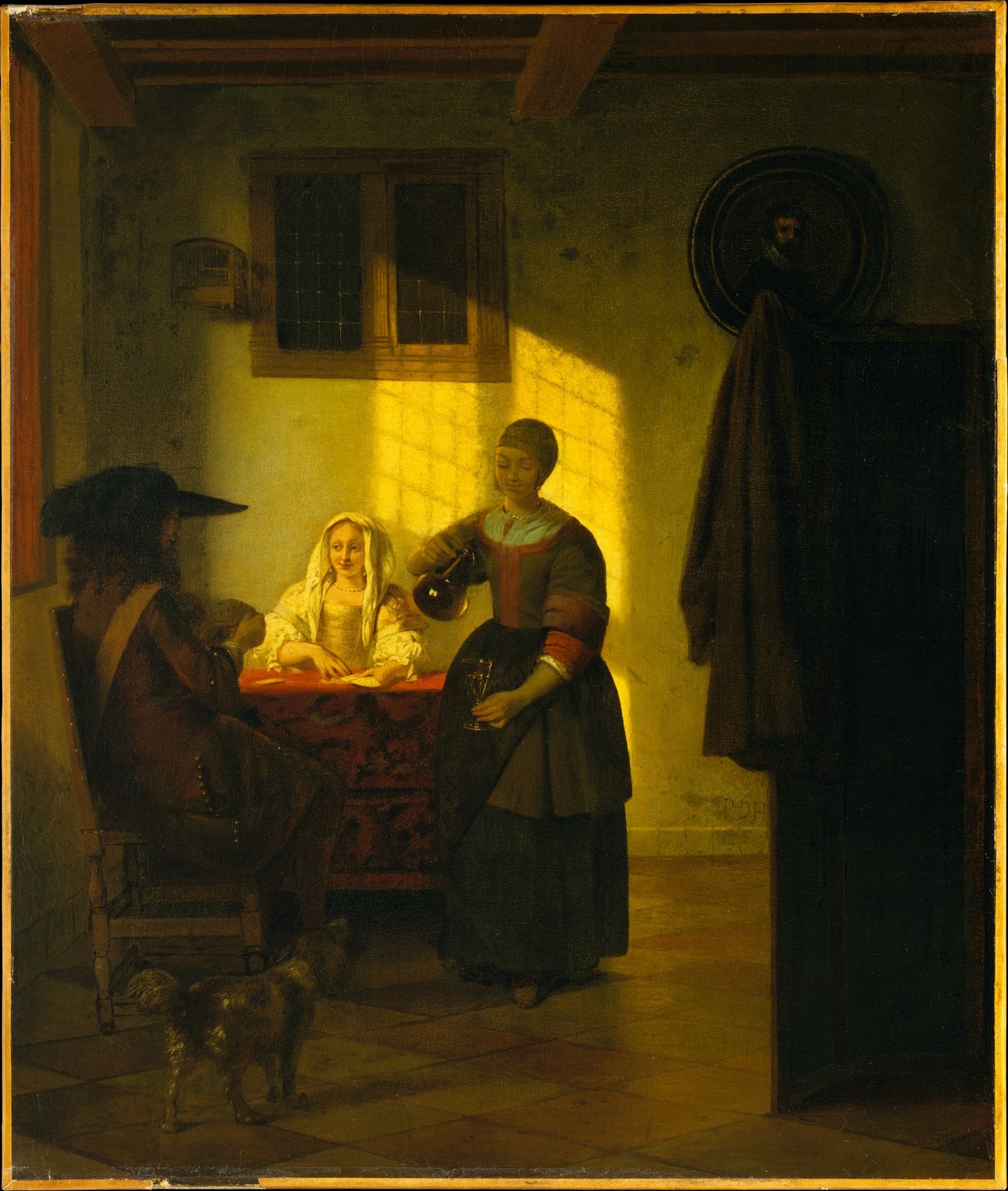
Light from one side. In de Hooch’s A Couple Playing Cards at the Met, a single window throws a slab of warm light across the back wall and the card table, while the doorway on the right sinks into shadow. Measured from the museum’s scan of this impression, the sunlit wall reads around #bf9413, the mid-tones around #64470b and #3f2e10, and the deep shadows near #10130c.
Geometry of rooms. Floor tiles, beams and the window frame set up a clear perspective grid. Figures sit inside the grid at modest scale, so the room becomes as important as the people.
Textiles as colour. Ter Borch’s lute player at the Met wears a blue jacket trimmed with white fur over a pale satin skirt, and the table carpet adds red, gold and blue pattern. The saturated colour is concentrated in fabric, while walls and backgrounds stay neutral.
Brushwork as signature. Hals’s portrait of Tieleman Roosterman at Cleveland shows the opposite approach: quick, visible strokes in the white ruff and lace cuffs against a mass of black clothing. Here the hand of the painter is part of the image, which is exactly what a forger finds hardest to fake.

Van Meegeren’s Vermeer-style fakes were not copies of known paintings. They were new compositions, often religious subjects, presented as lost works. For a fuller picture of the genuine article, read our guides to Johannes Vermeer and Dutch Golden Age painting.
Technique: faking age, not just appearance
The forgeries depended on making new paint behave like old paint. Accounts in FutureLearn’s art-crime course, History Hit and Chemistry World describe his key method: he mixed a synthetic resin, a phenol-formaldehyde of the Bakelite type, into his paints and then baked the finished canvas so the paint hardened quickly. Hard, cured paint resisted the solvent tests experts used at the time to judge whether paint was centuries old. FutureLearn adds that for The Supper at Emmaus he used a genuine seventeenth-century canvas and historical pigments.
Science exposed the method. The Belgian chemist Paul Coremans led a technical examination and published his findings in Amsterdam in 1949; a review in the German journal Kunstchronik and Chemistry World both describe his identification of phenol-formaldehyde resin in the paint. Chemistry World reports that a later team at Carnegie Mellon University in Pittsburgh used lead-210 dating, which measures the decay of a radioactive lead isotope in lead-based white paint, to confirm that the paint was modern.
The lesson for anyone who works with images is that the look of a thing and its material history are separate records. The forger could imitate one; the other could only be faked imperfectly.
How designers can use the van Meegeren case
Style is not authorship. A palette, a lighting scheme and a typical composition can be studied and reproduced, as this guide does with de Hooch’s colours. Use historical styles openly as inspiration, and never present a pastiche as the original artist’s work.
Label comparisons clearly. When you place an imitation beside a source, caption both with their real makers and dates.
Build provenance into your files. Keep source files, dated drafts, licences and museum object links for every asset: the design equivalent of a painting’s provenance. Our guide to public domain art explains how to check museum flags before reusing historic images.
Beware of confirmation bias. Experts wanted a lost masterpiece to exist, and the forgery supplied one. In brand and editorial work, the same pressure applies when a found image or quote seems too perfect. Check it against an independent source.
Learn colour from the real thing. Sample genuine public-domain paintings with the image colour picker, then build palettes that are clearly your own interpretation, not a claimed reproduction.
Where to see the story today
Museum Boijmans Van Beuningen in Rotterdam holds The Supper at Emmaus and other van Meegeren forgeries, catalogued as his work. The genuine paintings shown above are at the Metropolitan Museum of Art in New York and the Cleveland Museum of Art. Check each museum’s online collection for what is on view.
Frequently asked questions
Who was Han van Meegeren?
A Dutch painter (1889–1947), born in Deventer, who forged paintings and sold them as works by Dutch masters, especially Vermeer. He confessed after the Second World War and was convicted of falsification and fraud in 1947.
Are van Meegeren’s forgeries Vermeers?
No. They are his own paintings, made in the twentieth century and sold under Vermeer’s name. Museum Boijmans, which bought The Supper at Emmaus, now catalogues it as a van Meegeren forgery.
How were the forgeries detected?
After his confession, a technical examination led by Paul Coremans found a modern phenol-formaldehyde resin in the paint. Later lead-210 dating at Carnegie Mellon University supported the conclusion that the paint was modern.
Why are there no van Meegeren images in this guide?
The Met, the Art Institute of Chicago and the Cleveland Museum of Art hold no public-domain works by him. The images here are genuine works by de Hooch, ter Borch and Hals, labelled with their real makers, for comparison.