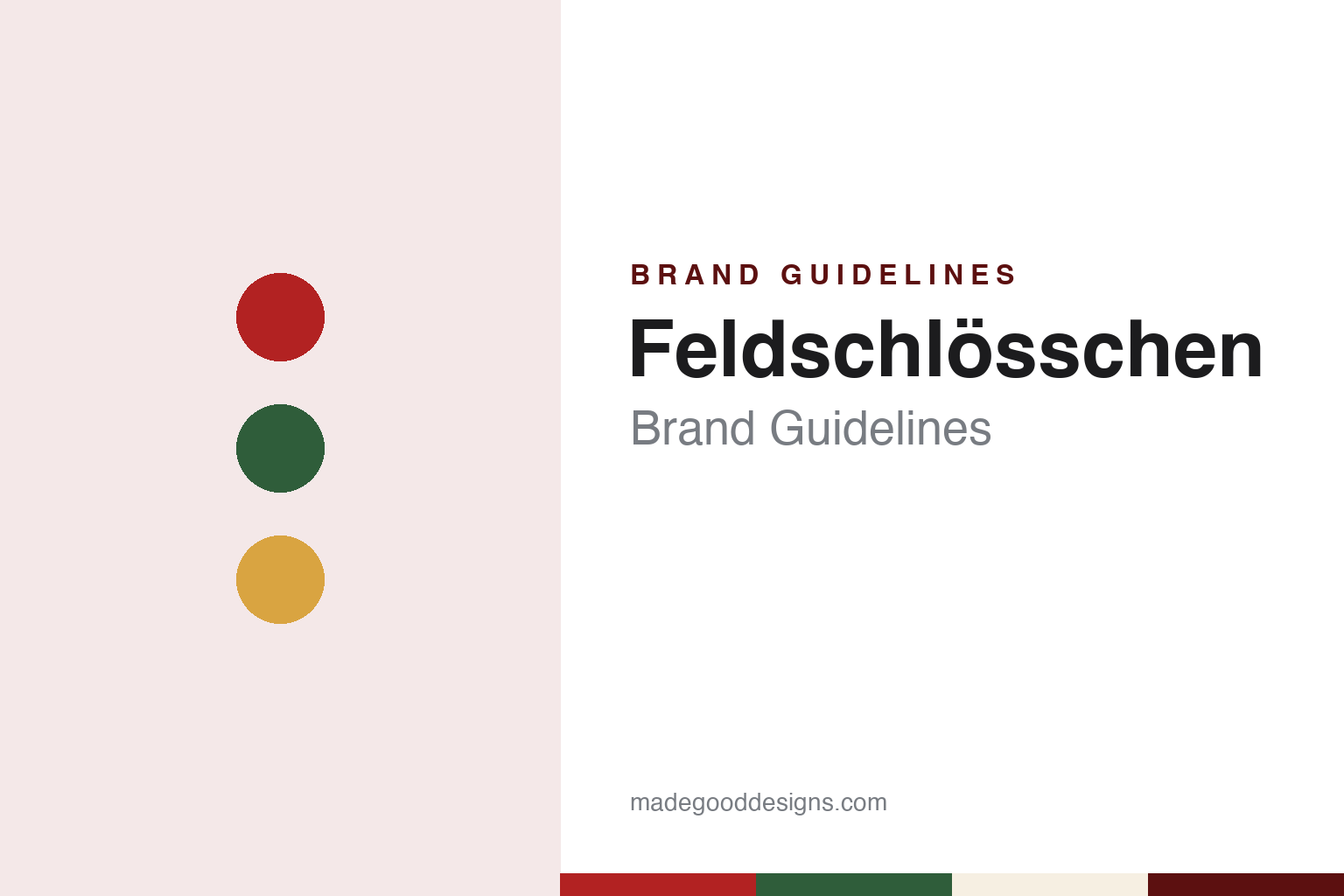
Feldschlösschen Brand Guidelines
The castle brewery of Rheinfelden, brewing since 1876.
Aa
Two constants: a brick red, calendar green and barley gold palette and a heavy slab serif register. Abstract homage — not a Feldschlösschen product or mark; no label, logo or bottle is reproduced.
A brewer, a farmer’s son and a railway
How a Rheinfelden brewery on the Bözberg line took its name and its castle.
Feldschlösschen — “little castle in the field” — is a Swiss brewery and beer brand based in Rheinfelden, in the canton of Aargau, just across the Rhine from Germany. The Historisches Lexikon der Schweiz (HLS), in Andreas Steigmeier’s entry, says the brewery was founded in 1876 by Theophil Roniger, a brewer and the son of an innkeeper, and Mathias Wüthrich, the son of a wealthy farmer. The company dates its first brew to 8 February 1876, a date German Wikipedia also gives, citing the Aargauer Zeitung.
The location was chosen for transport. The HLS notes that the brewery grew up beside the railway over the Bözberg, opened in 1875, and the name itself was borrowed: Roniger, the HLS says, took it from the brewery where he had trained, in Braunschweig in Germany. The castle followed the name. German Wikipedia says the large factory buildings, with their striking castle-like architecture drawing on several historical styles, were built between the 1880s and the 1910s, with the architects Langeloth of Frankfurt and Zimmermann of Freiburg im Breisgau among those involved, and that the ensemble is a listed monument. The HLS says this castle style, maintained to this day, gives the name its particular power of identification.
The business grew by consolidation. The company became a joint-stock company in 1890 and, the HLS says, grew by buying and closing breweries across Switzerland. It moved into soft drinks in the 1970s, took over the Basel brewery Warteck in 1989 and Sibra in 1991 (German Wikipedia describes the 1991 deal as the purchase of the Fribourg holding behind Cardinal beer), and in 1996 merged with Zurich’s Hürlimann to form the Feldschlösschen-Hürlimann Holding.
Colour
A red brick castle, a lettering from 1960 and a jubilee redesign.
The castle is the brand. In a release of 1 September 2026, Feldschlösschen called the red castle the most visible symbol of the brand for generations and traced its history. The company says the brick castle first appeared around 1900, carved in stone for the opening of a restaurant in Rheinfelden; that in 1923 the red brick castle appeared for the first time on one of the brewery’s tear-off calendars, on a green ground with ears of grain, and was entered in the commercial register as the brand’s logo; and that in 1960 the brand’s characteristic brick lettering was created for the brewery by the Zurich advertising agency Gisler & Gisler.
The brewery also has a poster history. The HLS illustrates its Feldschlösschen entry with an undated poster for the brewery by the artist Burkhard Mangold, held in the poster collection of the Museum für Gestaltung Zürich.
The 2026 release marked the brewery’s 150th anniversary with a new look, which the company described as the first comprehensive overhaul of the brand’s appearance since 2008. It says the castle was carefully developed and moved further to the centre, and that fine drawings now sit in the background of the packs: the castle, the brewery horses, the founder and first brewer Theophil Roniger, brew kettles and the raw materials of beer. Feldschlösschen Original was the first beer to change, in cans, bottles and multipacks, with the other beers to follow step by step. The company says the design came out of a long process that involved employees, customers and consumers, and quoted its brand director, Astrid Roland.
Typography
Design and documentation.
The seven brands in this group are Austrian and Swiss beers: Puntigamer, Schremser and Murauer from Austria, and Feldschlösschen, Calanda, Appenzeller Bier and Eichhof from Switzerland. Their ownership runs from global brewing groups to families and a cooperative. German Wikipedia records that Puntigamer’s Graz brewery is part of Brau Union Österreich, which Heineken has owned since 2003; that Heineken has owned Calanda in Chur since 1993 and Eichhof in Lucerne since 2008; and that Carlsberg has owned Feldschlösschen in Rheinfelden since 2000.
The others are independent. German Wikipedia says the Brauerei Schrems in the Waldviertel has belonged to the Trojan family since the nineteenth century, that the Brauerei Murau in Styria has been a cooperative since 1910, and that both were among the founding members of an association of Austria’s independent private breweries in 2021. Appenzeller Bier is made by the Brauerei Locher in Appenzell, a family company; the Historical Dictionary of Switzerland says Johann Christoph Locher began brewing beer in Appenzell in 1886.
A beer brand’s identity is usually carried by a label, a crest or an emblem and the town it names, because the company behind it may have changed hands or moved some of its production elsewhere. Each guide separates what independent sources record from what the brewery says about itself — its founding story, its owners over time, where its beer is brewed and bottled and how its labels have changed — and marks plainly what rests only on the company’s own word.
Aa
A heavy slab serif for a brewery whose lettering is built like brickwork. (Specimen set in Alfa Slab One, a slab-serif STAND-IN; NOT the Feldschlösschen logo or its 1960 lettering.)
Feldschlösschen
A Swiss brewery inside a Danish group.
The brewery has been Danish-owned since 2000. In a stock-exchange release of 3 November 2000, forwarded by its partner Orkla, Carlsberg announced that it was acquiring Feldschlösschen Getränke Holding, the beverage business of Feldschlösschen-Hürlimann Holding, with effect from 1 July 2000, and that Feldschlösschen would become part of Carlsberg Breweries, the beverage company Carlsberg and Orkla were then forming. Carlsberg said it planned to introduce locally brewed Carlsberg beer in Switzerland. The HLS says the old holding company, left without its drinks business, became a pure real-estate company.
Beer is not its only business. German Wikipedia says it has held the Swiss licence for Pepsi and 7 Up since 2022, citing the news agency SDA, and that it also owns the mineral-water brand Rhäzünser. It remains headquartered in Rheinfelden, where the castle buildings still house the brewery.
The name needs care. English Wikipedia notes that Feldschlößchen in Dresden, spelled with the German ß, is an unrelated German brewer, and Rheinfelden in the German state of Baden-Württemberg, across the river, is a different town. The Swiss company’s own site is feldschloesschen.swiss.
For a design guide, Feldschlösschen shows how a building can become a logo: a brewery named after a castle built itself one, painted it red on a calendar in 1923, and has kept redrawing it ever since. Compare Tuborg, a fellow Carlsberg brand from Denmark, and Calanda, the brewery in Chur. For this guide we use brick red, calendar green and barley gold with a heavy slab serif, an unofficial interpretation; no product or logo is reproduced.
Explore & save
Keep Feldschlösschen’s identity on hand — save it to a board in the Made Good inspiration library.
Feldschlösschen identity set
Pin the Feldschlösschen brick red, calendar green and barley gold palette and the heavy slab serif register to your own board.


