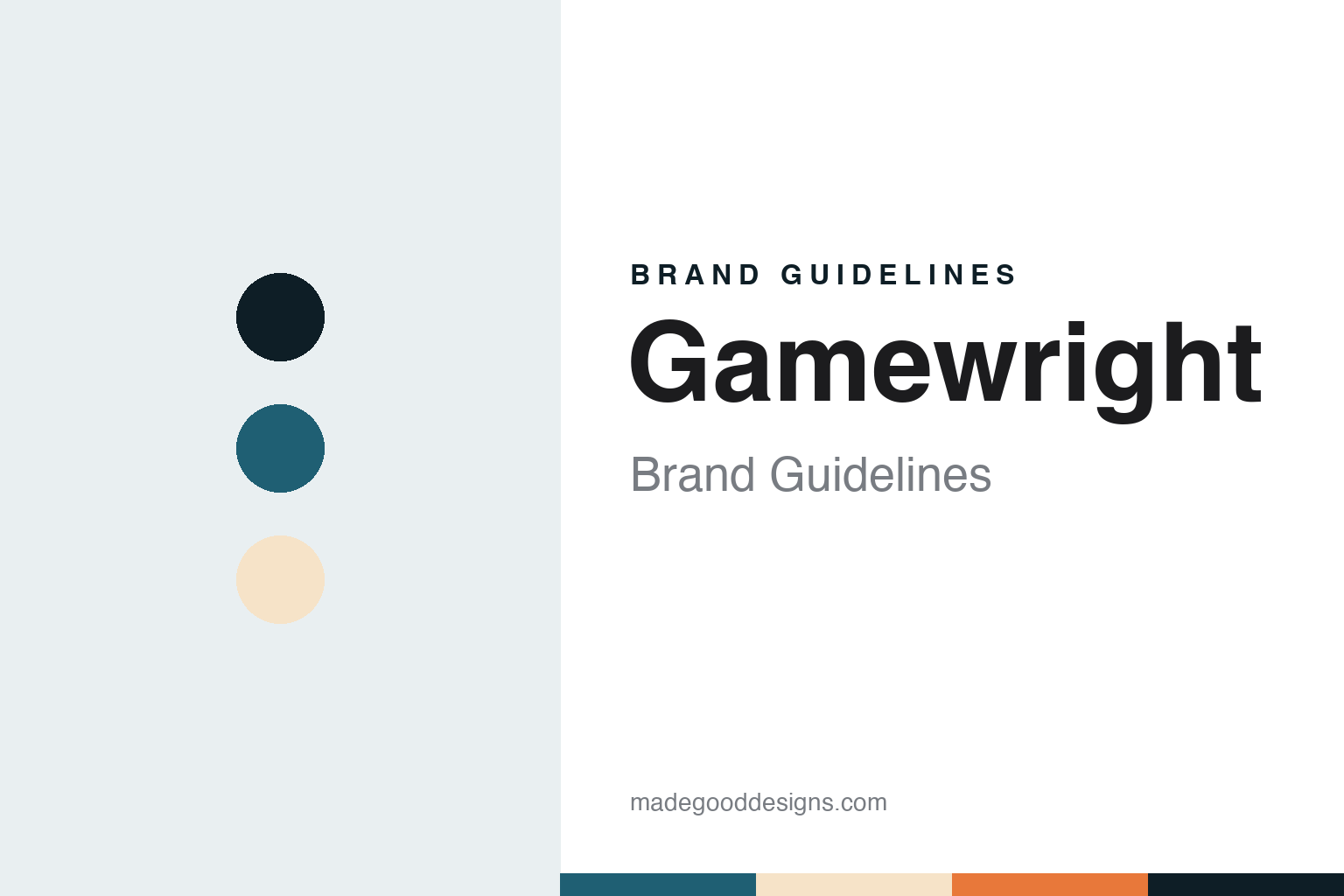
Gamewright Brand Guidelines
The Massachusetts family-game maker of Sleeping Queens and Forbidden Island.
Aa
Two constants: a Gamewright island teal and orange palette and a Rounded sans register. Abstract homage — not a Gamewright product or mark; no game, box, logo or artwork is reproduced.
Four parents
Better games for their own children.
Gamewright began in 1994 in Newton, Massachusetts, a suburb west of Boston. Its own account is brief: “Gamewright was founded in 1994 by four parents whose kids wanted great games.” English Wikipedia describes the founders as two families seeking better games for their children. Neither source names them, and we found no dated source that does, so we leave them unnamed.
The company gives its mission as “Create the highest quality family games with outstanding play-value.” Its catalogue has stayed close to that brief: card, dice, board and party games sorted by age, from games for three-year-olds to games for older children and adults.
One of its early titles set the tone. Rat-a-Tat Cat, designed by Monty and Ann Stambler, was introduced in 1995, according to English Wikipedia, which also records the Washington Post calling it “like poker for kids.”
Colour
A child’s dream and a sinking island.
Gamewright’s best-known story is Sleeping Queens. English Wikipedia says the game was invented in 2003 by Miranda Evarts, then six, from a dream, and developed with her family before they approached Gamewright; the company’s product page says she thought of it one night when she could not fall asleep and worked it out the next morning with her older sister and her parents. English Wikipedia says Gamewright acquired the rights and first published it in 2005, with illustrations by Jimmy Pickering based on her drawings. The Washington Post told her story in March 2005. Gamewright’s own Wikipedia entry gives a later date for the game’s development, so we follow the more detailed account.
In 2010 it published Forbidden Island, a game by Matt Leacock, the designer of Pandemic, set on a sinking island. Gamewright’s product page sells it as “Adventure…If You Dare,” describes players working as a team to capture four treasures and escape, and introduces Leacock as a “cooperative game master.” Its German edition, published by Schmidt Spiele as Die verbotene Insel, was nominated for the Spiel des Jahres in 2011, the jury’s website shows; the jury wrote that its fine components draw players straight into the scenario of a sinking island. English Wikipedia lists the sequels Forbidden Desert (2013), Forbidden Sky (2018) and Forbidden Jungle (2023).
Gamewright also became the American publisher of Sushi Go!, a card game by the designer Phil Walker-Harding, whom Gamewright credits as its “inventor.” The company describes it as a fast-paced pick-and-pass game in which players grab the best combinations of sushi as the cards go round, scoring for maki rolls and full sets of sashimi, with wasabi tripling the value of a nigiri; English Wikipedia lists Gamewright as its publisher from 2013 and records later spin-offs, including Sushi Roll. Other titles listed on Wikipedia include Qwixx, Dragonwood and Shifting Stones.
The product pages follow a consistent pattern that works as a kind of house system: each game carries a stock number — #230 for Sleeping Queens, #249 for Sushi Go!, #317 for Forbidden Island — together with an age band, a player count and a playing time, from 15 minutes for Sushi Go! to 30 for Forbidden Island.
Typography
Board-game publishing.
The seven brands in this group are all board-game publishers: Lookout Games, Gamewright, Thunderworks Games, North Star Games, Devir, Horrible Guild and Bézier Games. Board-game publishers sit at many different points in the hobby, from small studios built around the work of one or two designers to companies that now belong to much larger games groups, and a single title can be sold everywhere from a specialist game shop to a toy aisle.
A publisher’s identity is usually carried less by a single box than by a name, a logo on the box and the games it becomes known for, because the company behind the name may have changed hands, moved, or licensed its games to other publishers in other countries. That makes the questions behind each name worth asking plainly: who started it, who owns it now, and which games and designers made its reputation.
Each guide separates what independent sources record from what the company says about itself — its founding story, its owners over time, its best-known games and any honours from named awarding bodies — and marks plainly what rests only on the company’s own word.
Aa
A rounded sans — family games from Massachusetts. (Specimen set in Nunito, a rounded-sans STAND-IN; NOT the Gamewright logo.)
Gamewright
A games brand inside a puzzle company.
Gamewright is no longer a stand-alone company. Its website says plainly: “Gamewright is a division of Ceaco, Inc.,” the Massachusetts jigsaw-puzzle maker. We found no dated source for when Ceaco took Gamewright over, so we give the relationship as the company states it; the Gamewright name, its website and its product pages all continue under their own identity rather than Ceaco’s. Ceaco itself changed hands in November 2020, when Buffalo Games, the board-game and puzzle maker of Buffalo, New York, acquired it together with its contract manufacturer, Edaron, according to a November 2020 report by A&B Media citing Buffalo Business First; the report said Ceaco would continue to operate mostly as a standalone business. Buffalo Games has owned Ceaco, and with it Gamewright, since 2020.
Gamewright’s website now gives a new address in Canton, Massachusetts, south of Boston. Its about page does not say where its games are made, and we found no company statement on manufacturing in the sources we checked.
We found no published brand guidelines. Its identity is carried by its games and their names — a cat, sleeping queens, a forbidden island, sushi — more than by any documented corporate mark.
For a design guide, Gamewright shows how a family-games brand can keep a clear identity as a division inside a larger puzzle group. Compare North Star Games, another American publisher of family and party games, and Ravensburger, a games and puzzle maker. For this guide we use an island teal, a card cream and a game-night orange with a rounded sans, an unofficial interpretation; no product or logo is reproduced.
Explore & save
Keep Gamewright’s identity on hand — save it to a board in the Made Good inspiration library.
Gamewright identity set
Pin the Gamewright island teal and orange palette and the Rounded sans register to your own board.


