Ghirardelli Brand Guidelines
The Gold Rush chocolate company with its name in lights over the bay.
Aa
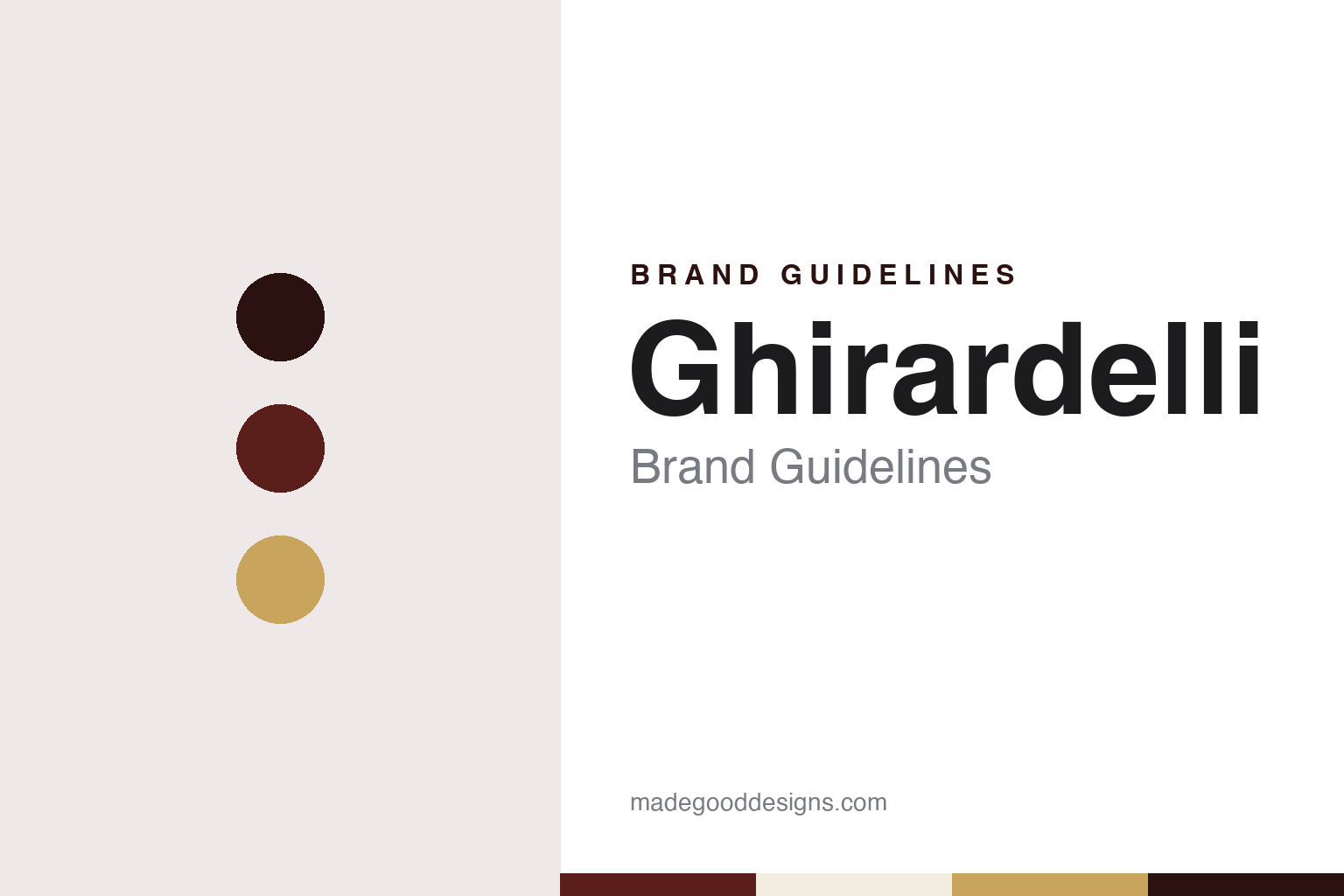
Two constants: a brick red, cocoa and gold palette and a Victorian serif register. Abstract homage — not a Ghirardelli product or mark; no wrapper, sign or logo is reproduced.
From Rapallo to the gold fields
A Genoa apprentice who sold sweets to miners.
Ghirardelli takes its name from Domenico Ghirardelli, born in Rapallo, on the Ligurian coast, in 1817. Wikipedia, citing a 2002 history in the journal California History, says he apprenticed in his teens with Romanengo, a noted confectioner in Genoa. Around 1838 he left for Uruguay and then Lima, where he ran a confectionery and began using the Spanish form of his first name, Domingo. His neighbour there was James Lick, who took some 600 pounds of Ghirardelli’s chocolate with him to San Francisco.
News of the California gold strike drew Ghirardelli north in 1849. The company’s own timeline says he opened a general store in Stockton selling supplies and sweets to miners, then a second store at Broadway and Battery in San Francisco. Both were lost to fire in May 1851, according to Wikipedia. In 1852 he opened a confectionery at Kearny and Washington streets, the business the company counts as its beginning; Wikipedia, citing a reference history of American companies, calls it the third-oldest chocolate company in the United States, after Baker’s and Whitman’s.
The firm grew into a trading house. By the 1860s it was selling chocolate, coffee and spices as far as China, Japan and Mexico, according to the company’s history, and around 1865, the company says, one of its workers found that a bag of ground chocolate hung in a warm room would shed its cocoa butter, leaving a residue that could be made into ground chocolate — the method it calls the Broma process. Three of Domingo’s sons became partners in 1884, he retired in 1892, and he died in Rapallo in January 1894.
In 1893 the company bought the Pioneer Woolen Building and much of the block on San Francisco’s northern waterfront and moved its manufacturing there. The company says the plant came through the 1906 earthquake and fire undamaged and resumed work within ten days. In 1923 it put up the illuminated sign spelling out its name, which the company says could be seen from ships passing through the Golden Gate.
Colour
Four owners in a dozen years.
The family sold the business in the early 1960s. Wikipedia says it was bought in 1963 by Vincent DeDomenico and the Golden Grain Macaroni Company, the maker of Rice-A-Roni; production left the waterfront for a new plant in San Leandro, across the bay, in 1967. The old factory block had already been sold: in 1962 William M. Roth and his mother, Lurline Matson Roth, bought it to keep it from being replaced by apartments, according to Wikipedia, and hired the landscape architect Lawrence Halprin and the firm Wurster, Bernardi & Emmons to turn its brick buildings into shops and restaurants. Ghirardelli Square opened in 1964; Wikipedia calls it the first major adaptive re-use project in the United States.
Halprin’s own account, in a 2003 oral history for the Cultural Landscape Foundation, adds a design detail: neighbours in Pacific Heights wanted the bright sign removed, so he had it turned to face the waterfront instead. The company and Lindt & Sprüngli say the Square became a city landmark in 1965; Wikipedia gives its landmark designation as 1970. Part of the site was listed on the National Register of Historic Places in 1982 as the Pioneer Woolen Mills and D. Ghirardelli Company. The Square is a separate property from the chocolate company: Wikipedia says it was bought by the Atlanta investor Jamestown L.P. in 2013.
The chocolate business, meanwhile, kept changing hands. The DeDomenico family sold it to Quaker Oats in 1986. Quaker sold it in 1992 to the investment firm Thomas H. Lee Co., which sold it in March 1996 to Hicks Muse Tate & Furst, the Los Angeles Times reported in January 1998, when it changed hands “for the fourth time in a dozen years.” The buyer that time was Lindt & Sprüngli of Switzerland, for undisclosed terms; Lindt said the deal would make it number two in the American premium-chocolate market.
Typography
Chocolate and documentation.
The seven brands in this group all sell chocolate under their own names, and six of them are American: Scharffen Berger, Ghirardelli, TCHO, Recchiuti, Vosges Haut-Chocolat and Compartés come from the United States, and Hotel Chocolat comes from the United Kingdom. The phrase “chocolate maker” covers a wide range of businesses, from companies that buy cocoa beans, roast and grind them and make their own bars, to confectioners and chocolatiers who buy in finished chocolate and turn it into truffles, bonbons, boxes and gifts, and many firms do some of each.
That range matters for design. A brand built on the bar lives on the wrapper and the shelf; a brand built on the shop lives in its windows, its boxes and the experience of buying a gift. Ownership matters too, because premium chocolate names are often bought by larger food groups, and a famous label does not always tell a shopper who stands behind it today. The one British name here adds a further model: a high-street chocolatier with its own shops and cafés that also grows cocoa on its own estate.
Each guide separates what independent sources record from what the company says about itself — who founded it, who owns it now, where its cocoa comes from and where its chocolate is made — and marks plainly what rests only on the company’s own word.
Aa
A Victorian serif — for a name first painted over a Gold Rush store. (Specimen set in Playfair Display, a serif STAND-IN; NOT the Ghirardelli logo.)
Ghirardelli
A Swiss-owned San Francisco name.
Under Lindt, Ghirardelli has built its range around a few formats. The company’s timeline dates its filled SQUARES to 1999, with Milk & Caramel as the best known; stand-up bags in 2003; Peppermint Bark in 2004; and Dark Squares in 2005, which it says were the first widely available chocolates to print the cacao content on the packaging. It has also become a large baking brand: the company says it became the number two baking brand in the United States in 2011, and Lindt & Sprüngli calls it a market leader in premium baking. Its shops, including those at Disneyland, Walt Disney World and the Empire State Building, sell hot fudge sundaes, which Wikipedia says have been a focus of the brand since the 1960s.
Lindt & Sprüngli lists Ghirardelli’s factory in San Leandro, California. On its own website, Ghirardelli has said that it controls every stage of its manufacturing, roasting beans in-house and rejecting up to 40 percent of the cocoa shipped to it; we give those as the company’s claims. The company does not name the countries its beans come from on the pages we checked. Its sustainability page says cocoa is bought under the Lindt & Sprüngli Farming Program, set up in 2008 and built on Rainforest Alliance certification, and that as of 2026 all the group’s cocoa volumes are Rainforest Alliance certified.
The brand’s look leans on its history: the founder’s name, the 1852 date and the waterfront where its sign still stands, even though chocolate has not been made there since the 1960s.
For a design guide, Ghirardelli shows how a founding date and a landmark can carry a brand through more than a century and many owners. Compare Guittard, another San Francisco chocolate company with Gold Rush roots, which has stayed in family hands, and Scharffen Berger, the Bay Area bean-to-bar maker. For this guide we use brick red, dark cocoa and a muted gold with a serif, an unofficial interpretation; no product or logo is reproduced.
Explore & save
Keep Ghirardelli’s identity on hand — save it to a board in the Made Good inspiration library.
Ghirardelli identity set
Pin the Ghirardelli brick red, cocoa and gold palette and the Victorian serif register to your own board.