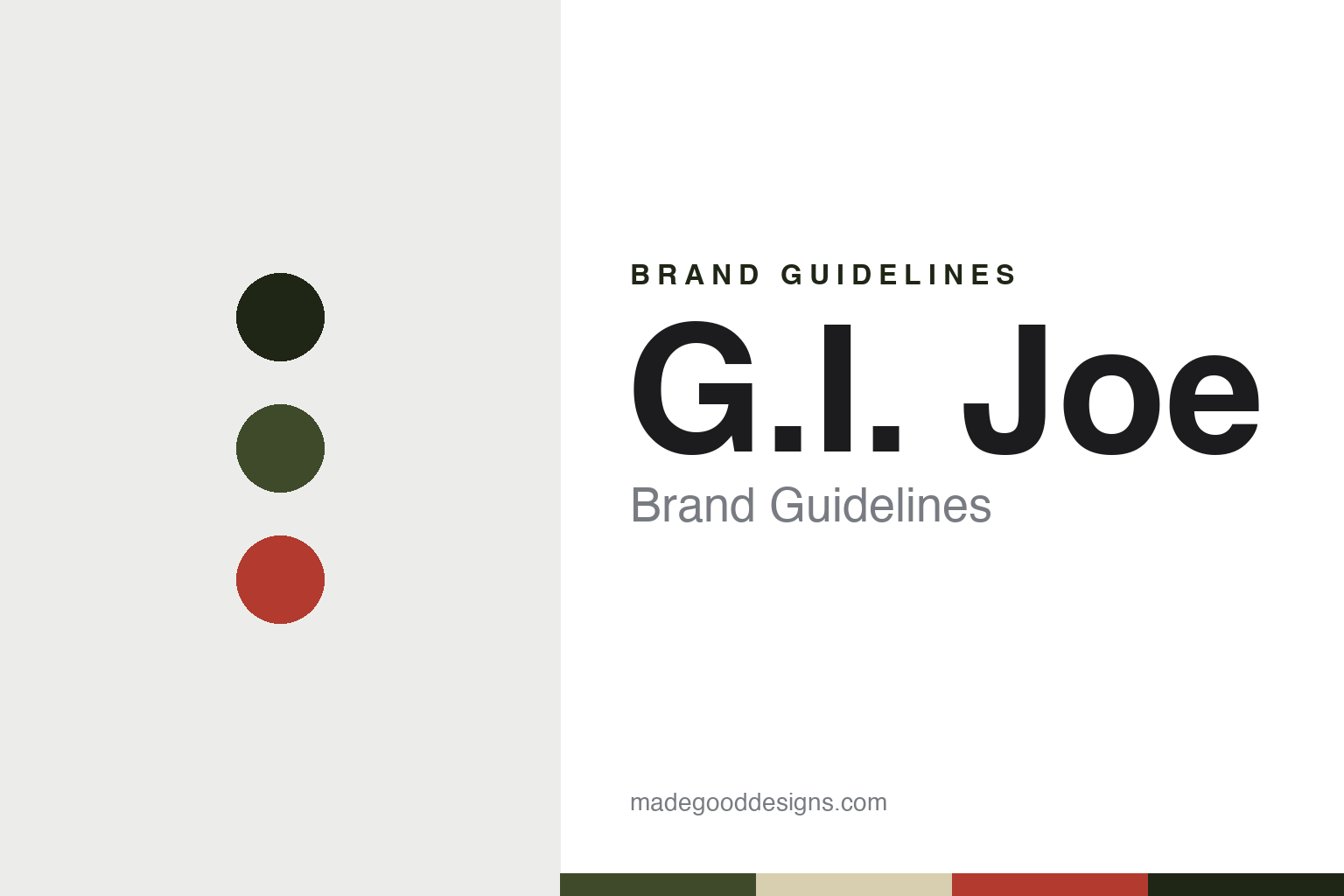
G.I. Joe Brand Guidelines
Hasbro’s 1964 action figure, relaunched at 3¾ inches in 1982.
Aa
Two constants: a field olive, khaki and signal red palette and a condensed stencil sans register. Abstract homage — not a G.I. Joe product or mark; no figure, logo or package is reproduced.
America’s movable fighting man
A licensing agent’s idea and a Rhode Island toy company.
G.I. Joe went on sale on 1 February 1964, a date marked each year as G.I. Joe Day, and English Wikipedia records its public showing at the New York Toy Fair on 9 February that year. The maker was Hassenfeld Brothers, the Rhode Island company founded in 1923 by Henry, Hillel and Herman Hassenfeld that is now called Hasbro. The name came from the everyday nickname for an American serviceman; The Strong National Museum of Play says the figure was named after the ordinary soldiers of the Second World War.
English Wikipedia credits the original idea, in 1963, to Stanley Weston, a Manhattan licensing agent, who made rough prototypes and marketing material and showed them to Donald Levine, a Hasbro executive; Weston then licensed the concept to Hasbro. The same article says the prototypes were called Rocky, Skip and Ace before the single name G.I. Joe was chosen, and that Levine later worked with Chronicle Books on a 1997 reproduction of the original figure.
The Strong describes the 1964 figure as an 11½-inch male figure with 21 moving parts, dressed in uniforms representing the U.S. military, and says Hasbro “branded it an ‘action figure’ to distinguish it from dolls.” The launch range covered four services, sold as Action Soldier, Action Sailor, Action Pilot and Action Marine, and Hasbro built vehicles, equipment and playsets around them. From 1964 to 1968, the museum notes, every figure came with a G.I. Joe Army Field Manual showing the other figures and uniforms on offer.
Colour
Adventure Team, a pause, then 3¾ inches and a comic book.
The line changed shape several times. In 1970 Hasbro settled on the name Adventure Team, and The Strong says the soldier of 1964 became a Land Adventurer recovering lost mummies and rescuing the environment. Two features that came with that era, flocked “Life-Like” hair in 1970 and the Kung-Fu Grip hands of 1974, had been developed in England by Palitoy for Action Man, the British version of the figure that Palitoy made under licence from 1966 to 1984. English Wikipedia lists other licensed names abroad, including Action Team in Germany and Italy, Action Joe in France and Falcon in Brazil. The 12-inch line ended in the United States in 1976, an 8-inch Super Joe followed in 1977, and The Strong says Hasbro retired Joe from production for a time in 1978.
The relaunch came in 1982 as G.I. Joe: A Real American Hero, at 3¾ inches, with vehicles, playsets and a story of the G.I. Joe team against the Cobra organization. English Wikipedia’s article on the comic says Hasbro chief executive Stephen Hassenfeld met Marvel president Jim Galton in 1981, that Marvel was taken on as creative consultant, and that issue one of the Marvel Comics series appeared in June 1982, written by Larry Hama, who wrote much of its run to December 1994. An animated series from Marvel Productions and Sunbow followed in 1983. The Strong credits a Saturday morning TV show and the long-running comic with the revival.
The 3¾-inch line was cancelled at the end of 1994. Hasbro brought back 12-inch figures for collectors from 1991, and later ranges included G.I. Joe Extreme in 1995, Sigma 6 in 2005, a 25th Anniversary line in 2007 and the 6-inch Classified Series announced in 2020. Live-action films followed in 2009 (G.I. Joe: The Rise of Cobra), 2013 (G.I. Joe: Retaliation) and 2021 (Snake Eyes). Comics passed from Marvel to Devil’s Due in 2001, IDW in 2009 and Skybound in 2023, whose Energon Universe also carries Transformers. The Strong inducted G.I. Joe into its National Toy Hall of Fame in 2004.
Typography
Design and documentation.
A toy brand often reaches its buyer through the package before the toy itself is ever touched. A window box lets a child see the figure, doll or vehicle through a clear panel while the printed board around it carries the name, the artwork and the age guidance, so the logo has to read clearly across a crowded shelf and still leave room for the product to show.
Blister cards work in a similar way on a smaller scale: a printed backing card, a moulded plastic bubble and a hang hole at the top. The card is usually designed to be seen hanging on a peg, which pushes the name and character art towards the upper half and keeps the logo bold enough to survive at a distance.
Die-cast and other small vehicle lines tend to rely on compact logos that can be printed on a box end, a card or even the base of the toy. Character mascots add another layer, standing in for the brand in advertising and on packs, so that a face or figure becomes as recognisable as the lettering beside it.
Aa
A condensed stencil sans — the register of a box header, a service patch and a field manual. (Specimen set in Oswald, a sans-serif STAND-IN; NOT the G.I. Joe logo.)
G.I. Joe
A trademark line, a scar and a boxed figure.
Much of the G.I. Joe identity was built into the toy itself. English Wikipedia says the line “America’s movable fighting man” is a registered Hasbro trademark and was printed on every boxed figure, and that the trademark was also moulded onto the figure’s body: the early mark read G.I. Joe with a ™ sign, which became ® once the name was registered, and the marking changed again after a patent was granted in late 1966. The same article describes a scar on the right cheek and the placement of the right thumbnail as features Hasbro used against cheap imitations, since a human figure as such cannot be protected.
The name itself travelled differently from country to country. In Britain the figure was sold by Palitoy as Action Man, and the 3¾-inch range arrived there as Action Force before being brought into line with the G.I. Joe name; in Brazil the 12-inch figure was Falcon and the smaller range Comandos em Ação; in India the line was produced under the Funskool brand.
The 1982 relaunch added a second layer of branding. The Real American Hero line gave each figure a code name and a speciality, set the team against Cobra, and used a comic book and a cartoon to carry those characters between toy releases, a pattern The Strong links directly to the line’s return. Later anniversary ranges reused the look of 1960s and 1980s packaging, and the 2003 anniversary sets reproduced the original 1964 boxed uniforms.
For a design guide, G.I. Joe shows how a name, a trademark slogan and a few moulded details can hold a toy line together across scale changes, licences and decades; compare Transformers, Hasbro’s 1984 line, and Marvel, whose comic carried the 1982 relaunch. For this guide we use field olive, khaki and signal red with a condensed stencil sans, an unofficial interpretation; no product or logo is reproduced.
Explore & save
Keep G.I. Joe’s identity on hand — save it to a board in the Made Good inspiration library.
G.I. Joe identity set
Pin the G.I. Joe field olive, khaki and signal red palette and the condensed stencil sans register to your own board.