Gorilla Glue Brand Guidelines
A woodworkers’ glue with a gorilla on the bottle.
Aa
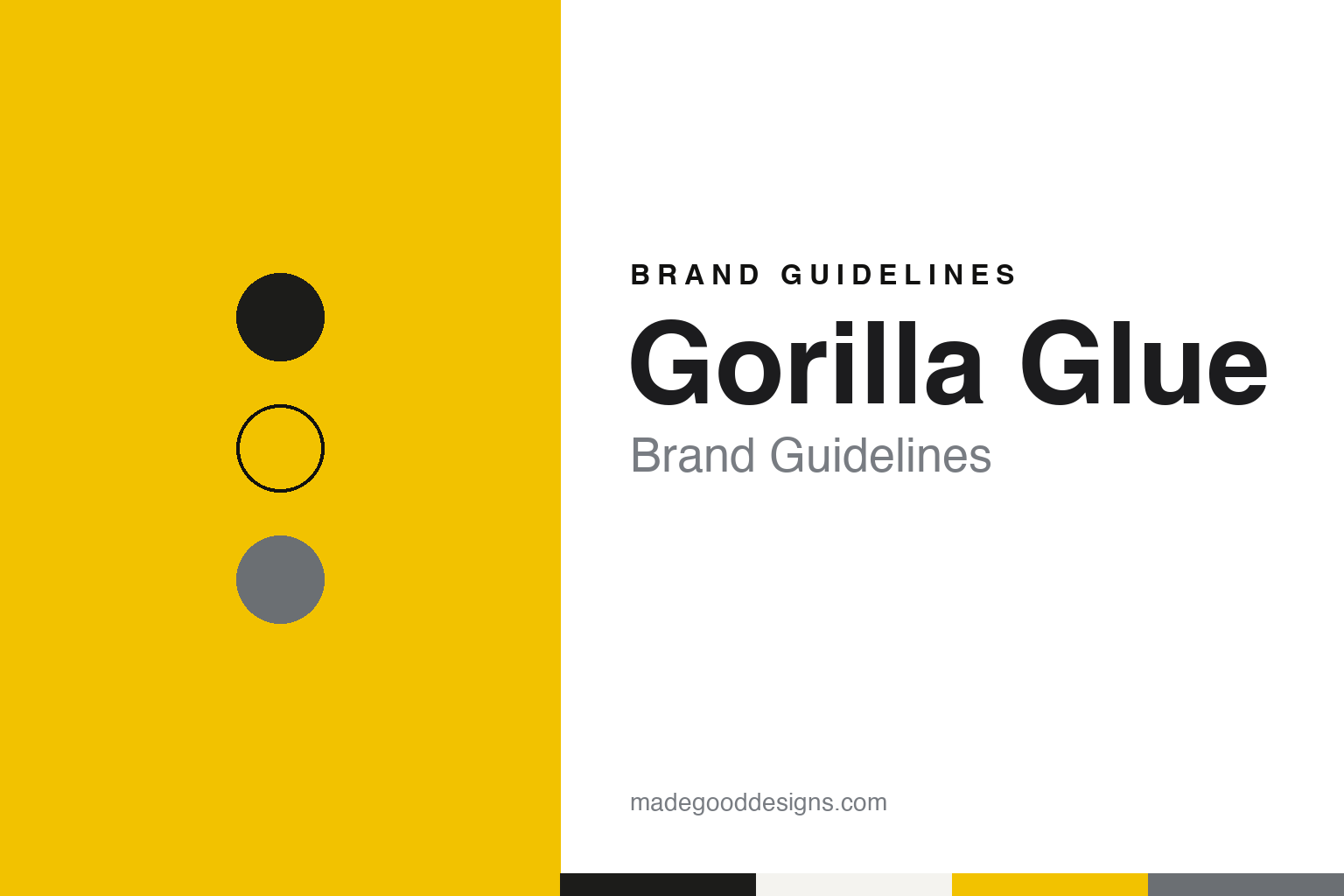
Two constants: a gorilla black, bottle amber and steel grey palette and a condensed heavy sans register. Abstract homage — not a Gorilla Glue product or mark; no bottle, mascot or logo is reproduced.
A glue found on a furniture trip
It began with teak, not with tools.
Gorilla Glue started as one woodworker’s discovery. Writing in Woodworker’s Journal in May 2008, Michael Dresdner said that in 1994 a woodworker named Mark Singer travelled to Indonesia to have models of his high-end outdoor teak furniture made there, and found the workshops using an industrial glue he did not know. It was a polyurethane adhesive suitable for interior and exterior work that would bond to wood and to a wide range of other materials. Singer, the magazine said, contracted with the Danish manufacturer of that glue, and Gorilla Glue was born. English Wikipedia tells the same story, adding that Singer created the brand name and acquired the North American rights to the glue from the Danish maker, and it dates the original Gorilla Glue’s first sale to 1994.
The early business was small. In the same article Pete Ragland, then president of the company, recalled that Singer pitched the glue to woodworkers through direct mail, specialty stores, lumberyards and woodworking shows, and that he kept the company to just two people. Within a year or two, Ragland said, several other glue companies had brought out competing products. A 2013 report in the Cincinnati Enquirer, republished by USA Today, described Gorilla Glue at that stage as a specialty product sold to West Coast furniture makers.
The product’s behaviour shaped how it was explained. Ragland told Woodworker’s Journal that the glue is a single-component polyurethane that expands as it cures, which lets it bond even loose fits but means joints must be well clamped, since the foam can push a seam apart; once cured, he said, squeeze-out has to be removed physically. Wikipedia likewise notes that the original glue expands slightly while drying and can foam out of a joint.
Colour
A tool company changes its name.
The brand’s second chapter belongs to a Cincinnati family. A 2019 article from Babson Thought & Action, based on a talk by Nick Ragland, said his father, Nick Ragland Sr., bought a small hand-tool venture called Lutz Tool in 1983. In 1999, according to Pete Ragland in Woodworker’s Journal, Singer sold Gorilla Glue to the Ragland family, then owners of the Lutz File and Tool Company, an industrial supplier of file handles; he said he and his four brothers bought the business and that all five were active in it. The Enquirer report also dates the purchase to 1999 and says the company, which also made screwdrivers and drill bits for independent hardware stores, changed its name in 2004 to reflect its most popular product. Wikipedia says the renamed business is The Gorilla Glue Company and that it is privately owned by the Ragland family.
The new owners took the glue beyond the woodshop. Pete Ragland said Singer had been selling almost exclusively to woodworkers, while the family saw a larger audience: it approached independent hardware stores and lumberyards, added smaller bottles alongside the pints and quarts Singer had sold, and later moved into big-box stores. By 2008, he said, the glue reached contractors, carpenters and do-it-yourselfers through box stores, mass merchants and craft stores as well as specialist shops.
The range widened at the same time. Ragland told the magazine that Gorilla Tape, the company’s version of duck tape, had arrived about three years before the 2008 interview, and that the company had since introduced a faster-curing Gorilla Glue that dries white instead of brown, sold in bottles and a glue pen, and a rubber-toughened Gorilla Super Glue. Wikipedia lists Super, a no-drip Gel Super and a construction adhesive among the variants, and the Babson article describes the company as a provider of adhesives, tapes and sealants.
Typography
Design and documentation.
Glue and correction products are among the most ordinary things in an office, a classroom or a craft drawer, and the brands behind them usually reach people through a tube, a stick, a bottle or a small dispenser rather than through anything grander. Many of these names began with a single product made to solve a particular, everyday problem, and some have since become shorthand for the whole kind of product they sell.
A brand in this category is often carried more by its name, its packaging colours and the shape of its container than by any single advertisement, and the company behind the name may have changed hands several times, been folded into a larger stationery or household group, or moved where its products are made. That makes the plain questions worth asking: who started it, who owns it now, and how its packaging and name have changed.
Each guide separates what independent sources record from what the company says about itself — its founding story, its owners over time and the way its labels have developed — and marks plainly what rests only on the company’s own word.
Aa
A tall, condensed heavy sans. (Specimen set in Anton, a condensed-sans STAND-IN; NOT the Gorilla Glue logo.)
Gorilla Glue
A mascot, a move and a family firm.
The company’s gorilla mascot moved to television in 2013. The Enquirer report described the mascot in print ads as a hairy paw clutching the glue, with the line about the “toughest jobs on planet earth”, and said the company was running what it called its first major national television advertising campaign, airing on channels including HGTV, DIY, The History Channel and Animal Planet. The agency Possible created the campaign; the company’s vice president of marketing and innovation, Matt Kemme, said the spots needed to show how the products work, not just that they are tough. A Hollywood animatronics shop built the gorilla, the paper reported, with an actor in the suit and two technicians controlling its face by remote. The gorilla does not talk, and one spot in which it swatted a generic glue out of a homeowner’s hand was kept off television because executives felt the character seemed too aggressive. Kemme told the paper that “it’s just not as scary with a gorilla on the package.”
The company has also defended the name. Wikipedia, citing The Cannabist, says Gorilla Glue Co. sued GG Strains, a Las Vegas developer of marijuana strains, and that a settlement reached in October 2017 required GG Strains and its licensees to stop using the Gorilla Glue name and gorilla imagery by 19 September 2018. Separately, the US Federal Trade Commission reviewed the company’s “Made in USA” claims in 2015; its closing letter, dated 5 June 2015, said some labels and marketing may have overstated how far the products were made in the United States, and the FTC decided to take no further action given the company’s stated plans to change its marketing.
Wikipedia says the company bought O’Keeffe’s, maker of Working Hands hand cream, in 2018, and moved in late 2016 from its Cincinnati base on Red Bank Road to Sharonville, a suburb of the city. The Babson article said Nick Sr. retired in 2002 and that Nick and Pete Ragland were serving as co-presidents.
For a design guide, Gorilla Glue shows how a mascot can carry a technical product: a tough animal made friendly, a dark bottle and a name that does the explaining. Compare a school-glue brand in our Elmer’s brand guidelines and a German adhesives maker in our UHU brand guidelines. For this guide we use gorilla black, bottle amber and steel grey with a condensed heavy sans, an unofficial interpretation; no product or logo is reproduced.
Explore & save
Keep Gorilla Glue’s identity on hand — save it to a board in the Made Good inspiration library.
Gorilla Glue identity set
Pin the Gorilla Glue black, amber and steel grey palette and the condensed heavy sans register to your own board.