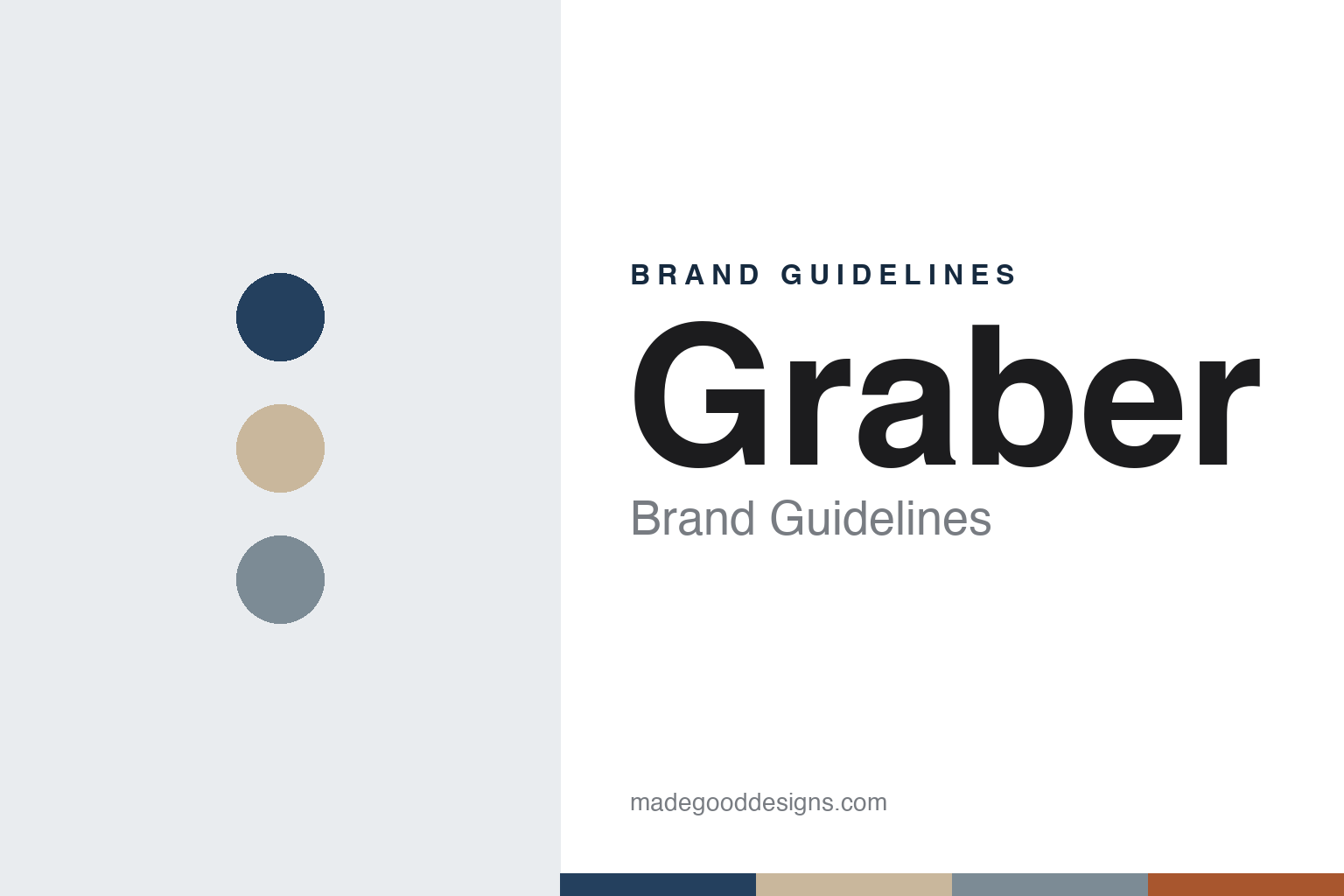
Graber Brand Guidelines
A drapery crane, a Wisconsin plant and a family of blinds and shades.
Aa
Two constants: a navy, oak, steel and rust palette and a sturdy American grotesque register. Abstract homage — not a Graber product or mark; no blind, rod or logo is reproduced.
A crane for curtains
Drapery hardware, wartime wood and a plant in Middleton.
Graber’s story starts with a piece of drapery hardware. The company history published by its parent, Springs Window Fashions, begins in 1932, when John N. Graber created the Badger Drapery Crane. The timeline quotes the period description of the product as an all-purpose, fully adjustable drapery crane meant to solve practically all drapery problems. A sponsored 2024 article in the trade magazine CE Pro says Graber developed the Badger Crane as an improvement to Venetian blinds he owned.
The business is tied to one Wisconsin town. CE Pro places the company’s roots in Middleton, Wisconsin, and the Springs Window Fashions timeline traces the company’s growth through a series of plants in that town.
The war years changed what the company made and how. The Springs timeline says that in 1942 Graber began in-house manufacturing, and that wood replaced metal in its products because of the scarcity of materials during the Second World War. After the war the business expanded: the timeline records that a new plant opened in Middleton in 1946, and that the current Middleton corporate office and plant opened in 1964.
The family name stayed on the product. The Springs history quotes an advertising line from 1971 attributed to Marie Graber, promoting high-fashion antiqued colours to brighten a room, showing that by then the company was selling style as well as hardware. In 1989, according to the same timeline, the company marked its 50-year anniversary with a party at Lakeview Park in Middleton.
Colour
Acquisitions, Springs Mills and a family of brands.
In the early 1970s Graber grew by buying other makers. The Springs Window Fashions timeline says the company purchased Illinois Shades, Elkirt Vertical Blind Company, Moriarity Manufacturing Company and Shades Inc., among others, to expand its range. Later in the decade it moved further into blinds: the timeline says Graber began producing custom horizontal blinds in 1977.
A change of ownership followed. According to the same timeline, Springs Mills purchased Graber in 1979, and Graber’s facilities in California and Pennsylvania were folded into its Middleton operations. Production in Wisconsin widened over the following years: the timeline says pleated shades began production in Middleton in 1983, and that in 1984 Graber won an exclusive drapery-hardware contract with Sears.
Graber then became one name in a group. The Springs timeline says that in 1989 the Bali brand was added to the Springs Window Fashion Division, joining Graber, and that Nanik was added in 1999 to grow the group’s premium wood products. It says contract manufacturing began in Reynosa, Mexico, in 1997. In the 2010s the group went on to acquire other window-covering and awning businesses, including MechoSystems in 2015 and SunSetter in 2016, according to the same history.
Ownership changed again in 2021. The Springs Window Fashions timeline records that year that the company came under new ownership by Clearlake Capital Group. The company’s contact details on the same page place its base on Graber Road in Middleton, the town where the Badger Drapery Crane business grew. CE Pro reported in October 2024 that the brand offered roller, natural and soft Roman shades, both manual and motorised, and that its motorised shades use Somfy motors. The magazine described Graber as a long-time Somfy partner, said its shades are dealer-protected so that licensed Graber dealers install them, and said the brand had moved into the custom-integration channel, offering home-technology installers in-person courses and online training as motorised shading grew.
Typography
Design and documentation.
The brands in this group all make or sell window coverings: blinds, shades, shutters and the fabrics and mechanisms behind them. Window-covering brands sit at many different points in the trade, from family workshops that cut each blind to order to names that now belong to much larger home-furnishings groups, and the same name can reach a buyer through a showroom, a decorator, a catalogue or a website.
A window-covering brand’s identity is usually carried less by one product than by a name, a swatch book, a showroom and the promise of a made-to-measure fit, because the company behind the name may have changed hands, moved its manufacturing or grown far beyond the place where it started. That makes the questions behind each name worth asking plainly: who started it, who owns it now, and where its blinds and shades are actually made.
Each guide separates what independent sources record from what the company says about itself — its founding story, its owners over time, where its products are made and how its identity has changed — and marks plainly what rests only on the company’s own word.
Aa
A sturdy American grotesque in the spirit of hardware packaging and dealer catalogues. (Specimen set in Libre Franklin, a sans STAND-IN; NOT the Graber logo.)
Graber
A family name that became a house brand.
Graber’s identity rests on its founder’s surname. The business began with a single piece of hardware the Badger Drapery Crane, and grew into a brand under which a company in Middleton sold drapery hardware, then blinds, then pleated and other shades. Through each change of owner, from Springs Mills in 1979 to Clearlake Capital in 2021, the Graber name has stayed on the product.
Its parent’s own history shows how the brand was presented. The Springs timeline leans on period voices: the 1932 description of the crane as a fix for practically all drapery problems, and the 1971 line attributed to Marie Graber about high-fashion antiqued colours. Together they mark a shift from solving a practical problem to selling colour and style for the home, the two things a window-covering brand has to carry.
Graber is also a brand defined by place. The Middleton plants of 1946 and 1964, the folding of other sites into Middleton after 1979 and the company’s address on Graber Road all tie the name to one Wisconsin town. Today Graber sits alongside Bali within Springs Window Fashions, and CE Pro described it in 2024 as a brand sold through licensed dealers, with a visualiser app that lets customers preview blinds and shades in their own rooms.
For a design guide, Graber shows how a founder’s name and a single practical invention can grow into a broad house brand without losing its sense of origin. Compare its sister brand in our Bali Blinds brand guidelines and another major window-covering name in our Hunter Douglas brand guidelines. For this guide we use navy, oak, steel and rust with a sans, an unofficial interpretation; no product or logo is reproduced.
Explore & save
Keep Graber’s identity on hand — save it to a board in the Made Good inspiration library.
Graber identity set
Pin the Graber navy, oak, steel and rust palette and the sturdy grotesque register to your own board.