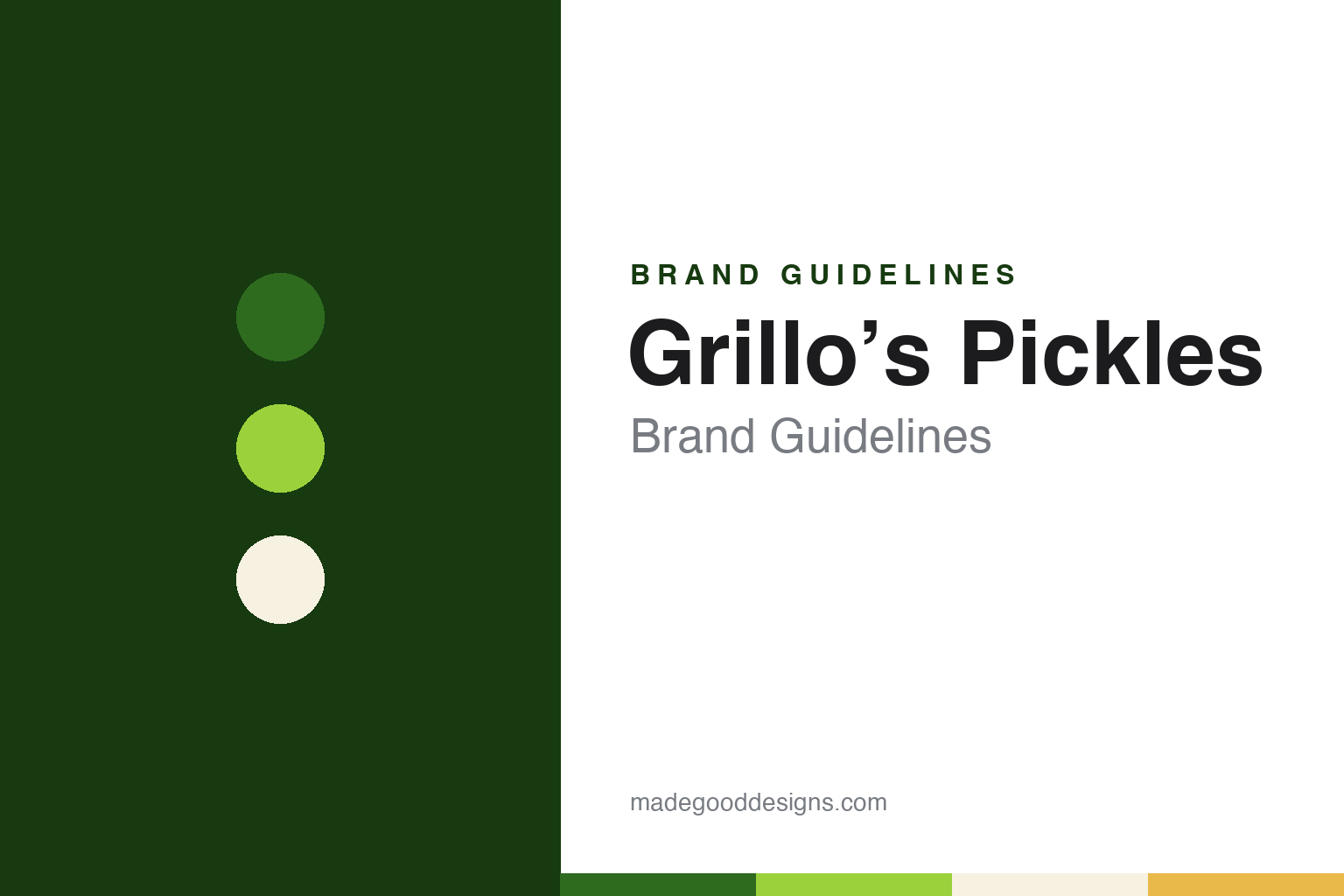
Grillo’s Pickles Brand Guidelines
A pickle cart, a family recipe and a mascot in a beach chair.
Aa
Two constants: a pickle green, dill green and clear-pack white palette and a bold grotesque register. Abstract homage — not a Grillo’s Pickles product or mark; no tub, label, mascot or logo is reproduced.
From a car to the Common
A missed shoe job, a grandfather’s recipe and a wooden cart.
Grillo’s Pickles is an American pickle brand founded in 2008 by Travis Grillo, who, as English Wikipedia puts it, began by selling pickles from a wooden cart on Boston Common using a family recipe. The brand’s story is closely tied to its founder’s training in design, and much of its look grew out of the way he sold his first pickles on the street.
A profile published by Central Connecticut State University on 1 September 2019 describes Grillo as a 2006 graduate who majored in ceramics there, building sculpting and design skills. The university says he had several meetings with a recruitment team at Nike about a product-line role, including feedback on a surf shoe he had designed, but did not get the job. Grillo grew up in Norwich, Connecticut, the profile says, watching and helping his father and grandfather make pickles at home, and the recipe is his grandfather Sam’s creation. As a student, he brought the pickles back to his dorm room, which he described to the university as his first marketing effort.
Food Dive, in a report on 3 February 2020, said the idea came to Grillo while he sat in his father’s backyard eating a pickle after the Nike rejection. In the summer of 2008, it said, he began selling the family pickles out of a car, with seven ingredients: cucumbers, salt, dill, garlic, water, grape leaves and vinegar. He then opened a pushcart on Boston Common with a big sign for Grillo’s Pickles.
The university profile adds the working details. Grillo moved to Boston around 2008 and found space to make and pack pickles at Katsiroubas Bros.; he brought a wooden cart to Boston Common and often worked in a pickle costume. The cart, it says, did steady business for four years, staffed by Grillo and his friends for the first two, and was followed by a pop-up pickle shop in Cambridge.
Colour
Whole Foods on the street, then national chains, then a bakery owner.
Retail came to Grillo’s from the street. The Central Connecticut profile says buyers from Whole Foods found Grillo on the street, and that he delivered his first load of pickles to a local Whole Foods store in his own van. When it sold out, Grillo tweeted updates whenever the pickles were back in stock, and the brand moved into more Whole Foods stores. While Grillo ran in-store tastings and demonstrations, the profile says, his business partner Eddie Andre worked the cart and the pop-up shop.
Other chains followed. The university names Costco, Target and Kroger, and says that by July 2019 Grillo’s Pickles were on sale in Walmart stores. Food Dive said in 2020 that the range included spears and chips as well as a Sandwich Maker cut, and that the company planned new launches including a pickle beverage and a “Pickle De Gallo.”
Outside investors joined along the way. BevNET reported on 27 April 2021 that the brand’s investors had included Breakaway Capital, Centerman Capital and Food Retail Ventures. In the same report, BevNET said the Boston-based Grillo’s Pickles had been sold to the bakery company King’s Hawaiian in a deal that closed earlier in 2021, with terms not disclosed. It described King’s Hawaiian as a family-owned business founded in Hawaii in the 1950s. King’s Hawaiian has owned Grillo’s since 2021.
The sale brought a change of leadership. BevNET said, citing the Boston Business Journal, that the company would remain in Boston, and that founder and chief executive Travis Grillo had left the company. Adam Kaufman, chief operating officer at Grillo’s since 2018 and an operating partner at Centerman Capital, became president in April 2021. Wikipedia says Kaufman later became chief executive.
By the time of the sale, BevNET said, the product mix had grown to include hot pickles, spears and chips, cold-pressed pickle vinegar drinks and a pickle de gallo dip, sold through retailers including Whole Foods, Target, Costco, Publix, Kroger, Safeway and Amazon.
Typography
Design and documentation.
The brands in this group are all American pickle names. Pickle brands in general reach people through a glass jar more than through any other object: a cylinder of brine, cucumbers and spice that sits on a shelf or in a chilled case, with a paper or printed label and a metal lid. Some pickles are sold shelf-stable in the ordinary grocery aisle, while others are kept refrigerated from the plant to the store, and that choice shapes where a jar is placed, how it is shipped and how the label has to read from a distance.
Because brine and cucumbers look much the same from one jar to the next, much of a pickle brand’s identity is carried by the label, the lid, the colour of the type and sometimes a mascot or a slogan. Many pickle names began as regional brands sold close to the farms and plants that supplied them, and some have since passed to national food companies. The questions worth asking are plain ones: who started it, who owns it now, and where the pickles are packed.
Each guide separates what independent sources record from what a company says about itself, and marks plainly what rests only on the company’s own word.
Aa
A bold grotesque — the loud, street-cart register of a hand-painted sign. (Specimen set in Bricolage Grotesque, a bold grotesque STAND-IN; NOT the Grillo’s Pickles logo.)
A pickle in a beach chair
Clear packs, a mascot and clothing that came before advertising.
Design has been part of Grillo’s from its first season. Food Dive wrote in 2020 that design for the brand had been important to Grillo since the beginning, and reported his explanation of the packaging: the clear packaging is a signature look, he said, chosen to show that the pickles are handmade and garden fresh.
The brand also has a character. The Central Connecticut profile in 2019 said that much of the company’s gear features Grillo’s own artwork, including the mascot Sam-Sam the Pickle Man, shown lounging on a beach chair on every Grillo’s-brand item. Food Dive described the merchandise as showing the brand’s personified pickle on products such as beanies, scarves and fanny packs.
Clothing came early, and for a practical reason. Food Dive said that while Grillo was still selling from the cart in Boston, he also sold shirts on the street featuring the company’s logo, and quoted him saying the clothing was created to get the brand out so people would come and buy his pickles. Later collaborations widened that line: Food Dive reported a graphic tee sold by Urban Outfitters and a limited-edition sneaker called “The Pickle” made with the basketball player Patrick Ewing. The university said the shoes, released in March 2019, carried the Grillo’s Pickles logo. BevNET added pickle-infused beer and co-branded Rugrats pickle packaging to the list of the brand’s tie-ins.
For a design guide, Grillo’s Pickles shows how a founder trained in design can turn a street cart, a costume, a mascot and a clear pack into one consistent identity that carried over into clothing. Compare it with Claussen, a pickle brand founded in Chicago, and McClure’s, a family pickle business from Detroit. For this guide we use pickle green, dill green, clear-pack white and garlic gold with a sans-serif, an unofficial interpretation; no product or logo is reproduced.
Explore & save
Keep Grillo’s Pickles’s identity on hand — save it to a board in the Made Good inspiration library.
Grillo’s Pickles identity set
Pin the Grillo’s Pickles pickle green, dill green and clear-pack white palette and the bold grotesque register to your own board.


