Harrods Brand Guidelines
From a one-room Brompton grocer to a terracotta landmark on Brompton Road.
Aa
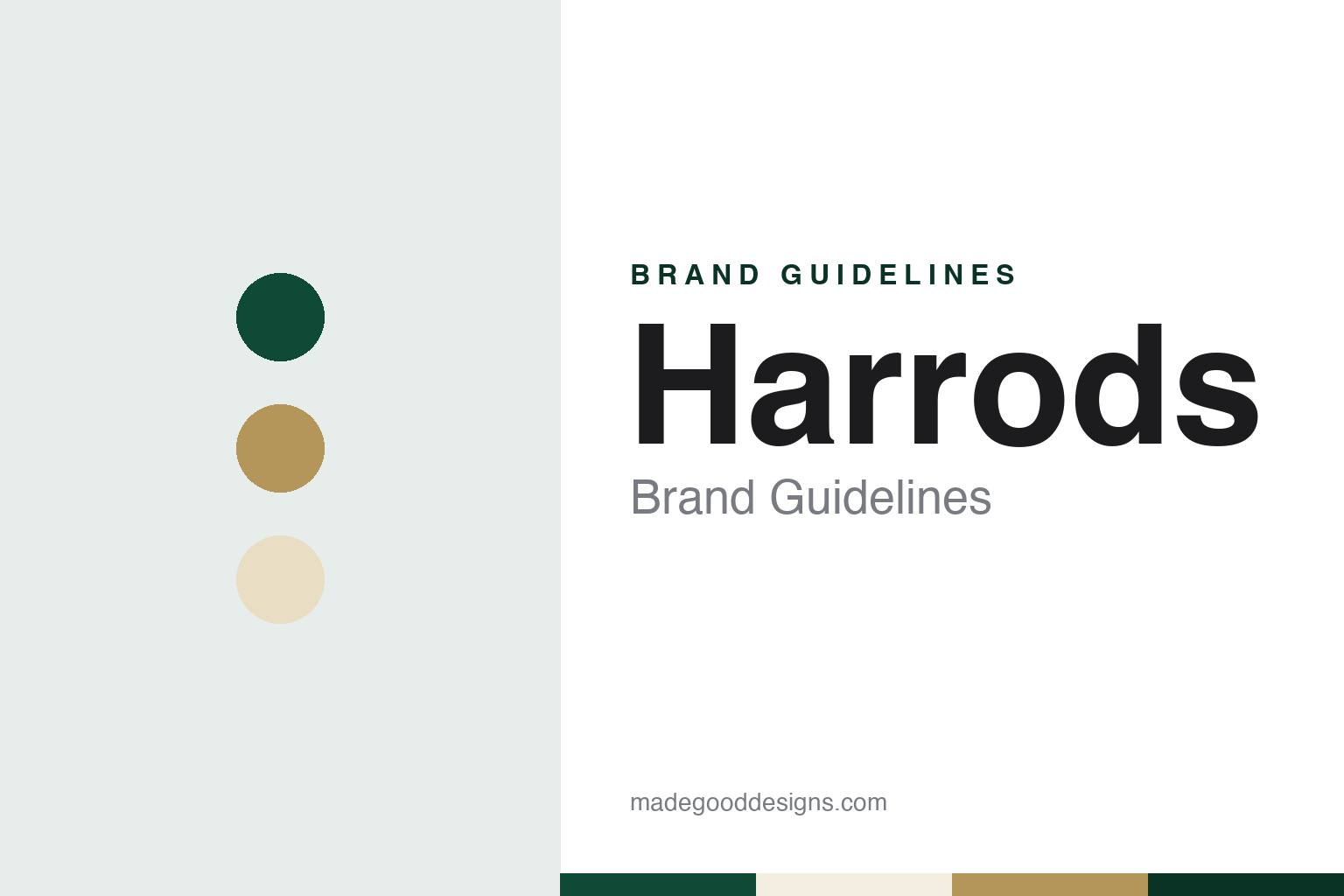
Two constants: a store green, gold and cream palette and a classic serif register. Abstract homage — not a Harrods product or mark; no logo, bag or packaging is reproduced.
A shop in Brompton
A tea and grocery trader, a son who built the business, and a fire.
Harrods takes its name from Charles Henry Harrod, a London trader whose early businesses, English Wikipedia says, ranged from drapery in Southwark to a wholesale grocery in Stepney with a particular interest in tea. In 1849 he took over a small shop in the district of Brompton, on the site the store still occupies. The BBC, reporting on the store’s sale in May 2010, gave the same year, describing Harrods as established in 1849. Wikipedia says the business began in a single room with two assistants and a messenger boy, and that the Great Exhibition of 1851 in nearby Hyde Park was part of the attraction of the location.
The person who turned the shop into a store was his son, Charles Digby Harrod. Wikipedia credits him with building a retail operation that sold medicines, perfumes, stationery, fruit and vegetables, and with acquiring the neighbouring buildings as trade grew. The range is worth noting for a design guide: from early on the name stood for many kinds of goods under one roof, which is the idea the store’s later motto would put into Latin.
In December 1883 the store was destroyed by fire. Wikipedia records that Harrod kept his commitments to make Christmas deliveries that year and that a new building went up quickly on the same site. In 1889 he sold his interest through a stock market flotation, and the business became Harrod’s Stores Limited, with Richard Burbidge as managing director. The Burbidge family ran the company across three generations, Wikipedia says, with Woodman Burbidge succeeding his father in 1917 and Richard Burbidge following in 1935.
The building on Brompton Road today came next. Designed by the architect C. W. Stephens for Charles Digby Harrod, the present store on Brompton Road opened in 1905, and Wikipedia notes that it was Grade II* listed in 1969. Its terracotta façade, domes and rows of windows give the name a physical form that reads from the length of the street. Before that, on 16 November 1898, the store had installed a moving staircase, which Wikipedia describes as a woven leather conveyor with a mahogany and plate-glass balustrade.
Colour
House of Fraser, the Fayed years and Qatar Holding.
From 1889 until 1959 Harrods was a listed company in its own right. In 1959 it was acquired by House of Fraser, the department store group, and Wikipedia says the bid saw off competing interest from Debenhams and United Drapery Stores. In 1985 House of Fraser, Harrods included, was bought by the brothers Mohamed and Ali Fayed; the BBC’s 2010 report dates Mohamed Al Fayed’s takeover of the business to that year. When House of Fraser returned to the stock market in 1994, Harrods was moved out of the group and stayed private, and Wikipedia says the present legal entity, the Harrods Group, was established in 2006.
The store’s relationship with royal warrants is part of its visual history, since warrant crests were displayed on the building and its goods. Wikipedia says Harrods had held royal warrants since 1910 and that they were removed in 2000. The name itself has been guarded closely. In 1986 the New Zealand town of Ōtorohanga briefly called itself “Harrodsville” in support of a local restaurateur named Harrod who faced legal threats over his restaurant’s name, and Wikipedia says the action was later dropped. In 2009 a company names adjudicator ordered a business called Harrods Limousine Ltd to change its name after Harrods applied under the Companies Act 2006.
On 8 May 2010 the store changed hands again. The BBC reported that Harrods had been sold to Qatar Holding, the investment arm of the Qatar Investment Authority, in a deal signed in the early hours of that morning and covering all parts of the Harrods group. Mohamed Al Fayed took the title of honorary chairman and, the BBC said, would not be involved in running the company day to day. Qatar Holding has owned Harrods since 2010.
Through these changes, the store’s address, building and motto stayed fixed. The BBC listed the motto in 2010 as Omnia Omnibus Ubique, “All Things for All People, Everywhere.” Wikipedia singles out the Food Halls, the jewellery rooms and the seasonal Christmas department among its departments, and notes the store’s long association with toys: the Tale of Peter Rabbit soft toy appeared in Harrods catalogues from 1910, and Wikipedia says A. A. Milne bought the teddy bear that became the model for Winnie-the-Pooh at the store in 1921.
Typography
Design and documentation.
A retail identity is read in passing, often from across a street, so it tends to lean on a few repeated signals rather than a single mark. A founder’s name above the door is a common one: a surname turned into a wordmark carries a sense of a particular person and place long after the business has changed hands. The shopfront works at the scale of architecture, where fascia lettering, window frames, awnings and the material of the building itself become part of how a name is remembered.
The carrier bag moves that identity out of the shop and along the pavement, so bag colour can matter as much as the logo itself. A consistent house colour lets a fleet of vans, a loyalty card, a till receipt and a website feel like one voice. Inside, signage and wayfinding do quieter work: department names, aisle markers and shelf labels need a typeface that stays legible at a distance and under strip lighting. Reading these pieces together, rather than the logo alone, gives a fuller picture of how a shop presents itself.
Aa
A high-contrast serif with a classic, engraved feel — the register of a shop fascia and a gift card. (Specimen set in Playfair Display, a serif STAND-IN; NOT the Harrods logo.)
Harrods
A surname, a building and a motto.
The Harrods identity begins with a surname. The name of Charles Henry Harrod passed to a shop in 1849, to a listed company in 1889 and to every owner since, from House of Fraser to the Fayed family and Qatar Holding. The company registered in 1889 as Harrod’s Stores Limited, with the possessive still in the name, and the shorter form Harrods is the one written on the store today.
The second element is architecture. The C. W. Stephens building that opened in 1905 is the backdrop to almost every image of the brand, and it was listed at Grade II* in 1969. The windows, domes and terracotta give the brand a set of fixed visual points on Brompton Road.
The third is the motto. Omnia Omnibus Ubique puts in three Latin words the range that Charles Digby Harrod built up in the nineteenth century, and the BBC quoted it in English as “All Things for All People, Everywhere” when the store was sold in 2010. Paired with the Food Halls, the toy departments and the Christmas displays that Wikipedia describes, the motto turns a long list of goods into a single promise attached to the name.
The fourth is continuity through ownership changes. House of Fraser bought the store in 1959, the Fayed brothers bought House of Fraser in 1985, Harrods was split off in 1994 and Qatar Holding acquired it in May 2010. Each owner took on the same surname, the same building on Brompton Road and the same motto.
For a design guide, Harrods shows how a founder’s surname, a listed building and a Latin motto can hold a department store together through more than a century and a half of new owners. Compare it with Selfridges, another London department store named after its founder, and with John Lewis. For this guide we use store green, lettering gold and cream with a classic serif, an unofficial interpretation; no product or logo is reproduced.
Explore & save
Keep Harrods’s identity on hand — save it to a board in the Made Good inspiration library.
Harrods identity set
Pin the Harrods store green, gold and cream palette and the classic serif register to your own board.