High End Systems Brand Guidelines
The Austin installer that built its own moving lights, then a console line.
Aa
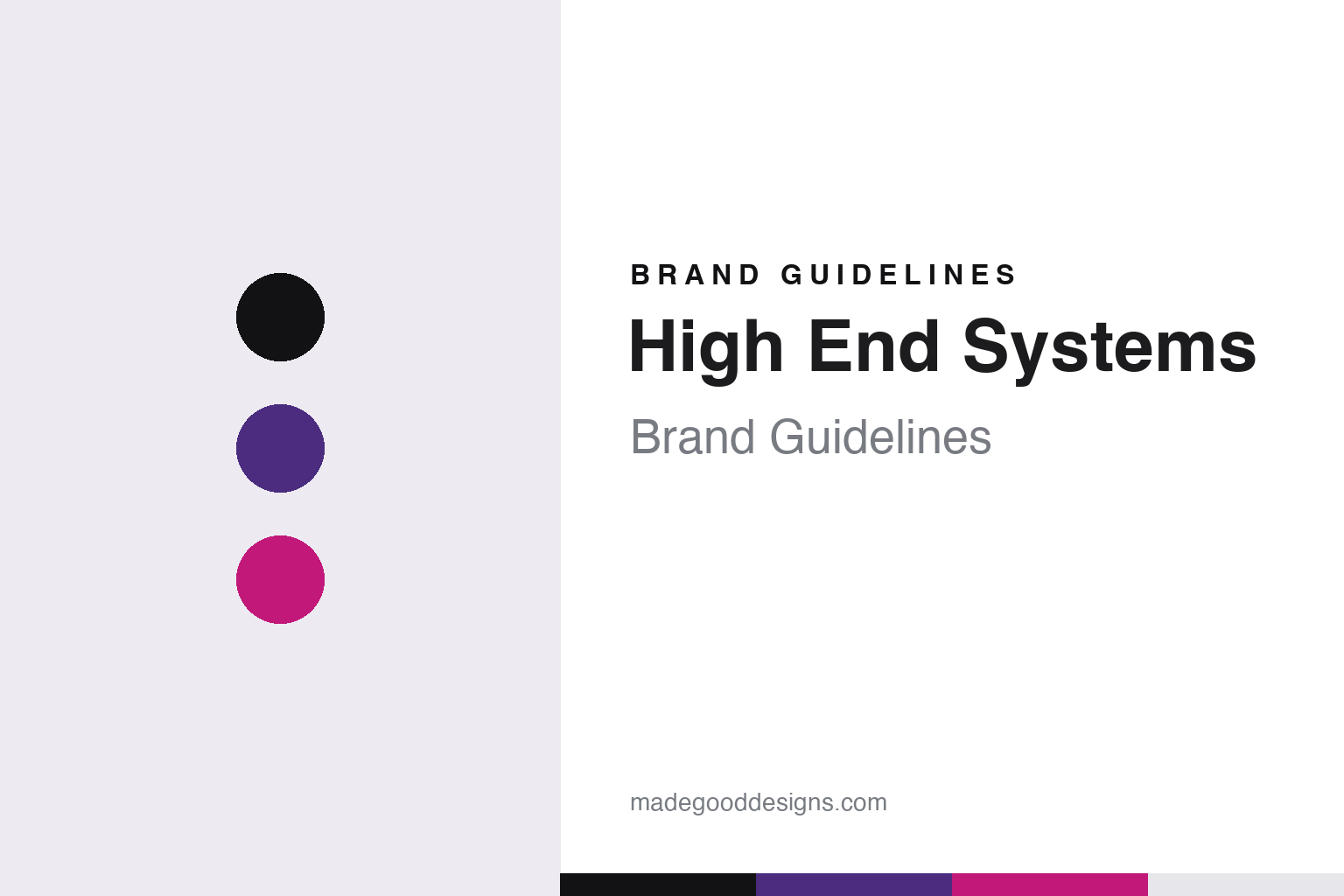
Two constants: a violet, black and magenta palette and a grotesque sans register. Abstract homage — not a High End Systems product or mark; no fixture, console, logo or nameplate is reproduced.
Blackstone to High End
An Austin installer that started building its own lights.
High End Systems grew out of an installation business in Austin, Texas. English Wikipedia traces it to Blackstone Audio Visual, run by Lowell Fowler, which began by installing advanced lighting in nightclubs, and names Fowler, Richard Belliveau, David Blair and Bob Schacherl as partners. PLSN, profiling Belliveau in August 2009, said Fowler, Belliveau and Schacherl partnered to form what became High End Systems. According to Wikipedia, Belliveau set up a manufacturing division, Lightwave Research, and High End Systems was incorporated to keep equipment sales and distribution separate from the installation work.
Belliveau began by improving products the company distributed, PLSN said, and moved on to his own designs: the Laser Chorus, which came out of experiments with low-power lasers, and the Dataflash strobe, which came out of work with xenon flash lamps. Wikipedia credits him with the Color Pro of 1987, a colour-fading fixture built around dichroic filters, which the company made itself at a time when few lighting firms did.
The breakthrough was the Intellabeam, an automated moving-mirror fixture. Wikipedia dates it to 1989 and says it let production companies buy automated lighting instead of renting it, challenging Vari-Lite’s hold on touring. PLSN gave a slightly later timeline: Belliveau began designing the fixture in 1990, the company was shipping it within eight months, and its first major tour was Dire Straits’ “On Every Street” tour of 1991, with lighting designer Chas Herington.
Colour
Cyberlight, Studio Color and the Hog.
A long line of moving lights followed. PLSN’s 2009 profile listed the Cyberlight, Studio Color, Trackspot and Technobeam among Belliveau’s designs for the company, said he held more than 100 patents, and reported that the Parnelli Awards had chosen him for their Visionary Innovator Award that year.
The company then moved toward video. In 2000, Wikipedia says, High End introduced Catalyst, a system that paired a video projector with a motorised mirror head and a DMX-controlled media server; by 2002 Catalyst had become a media server in its own right and the mirror head was sold separately. Digital luminaires with built-in media servers came next — the DL.1, then the DL.2, DL.3 and DL.V — and that work led to the Axon media server. PLSN described the DL.1 as a way for touring crews to project images from DVDs and video onto stages, walls and other surfaces.
The console side came from outside. The Backstage Heritage Collection says Flying Pig Systems, the maker of the Wholehog console, was founded in October 1991 by Nick Archdale, Tom Thorne and Nils Thorjussen, and that a merger with High End Systems was announced in April 1999, with High End becoming the worldwide distributor of the Wholehog range; the ControlBooth wiki dates High End’s purchase of Flying Pig to 2000.
The Hog name has run on through the Hog 4 range. In October 2017 AV Network reported that High End Systems would resume exclusive distribution of the compact HedgeHog 4 consoles, which it said could load show files from any of the larger desks in the range and were aimed at school theatres, nightclubs, corporate events, medium-scale rental work and houses of worship.
Typography
Lighting and its makers.
Stage and entertainment lighting is sold to a small, technical audience — lighting designers, programmers, rental companies and venue technicians — and its makers present themselves accordingly. The product is the picture: moving heads, LED washes and profile fixtures photographed against black, often with a single beam cutting through haze, so that the shape and colour of the light carry the message rather than the housing.
Much of that presentation happens on the show floor. Fixture makers routinely launch new products at trade shows such as Prolight + Sound in Frankfurt, PLASA in London and LDI in Las Vegas, and their stands are built as small productions, with timed light shows and rigs of their own fixtures. Robe, for instance, marked its twentieth anniversary at PLASA in 2014, and Claypaky first showed its one-word logo at LDI in 2016, according to trade reports and the company.
Ranges are usually split by use. Touring fixtures are sold on output, speed and weight; theatre fixtures on quiet running, framing and colour rendering; architectural lines on outdoor ratings and long-term installation. Control is its own category, and several fixture makers now also own console or data brands, so screenshots of control-desk interfaces sit beside photographs of the lights themselves.
The visual language that results is consistent across the sector: dark backgrounds, saturated beams, and colour-temperature scales running from warm to cool white. This guide sets out what can be checked about each company — who founded it, who owns it and where it says its fixtures are made — and attributes to the company anything that rests on its own word.
Aa
A grotesque sans for a touring-era brand. (Specimen set in Archivo, a sans STAND-IN; NOT the High End Systems logo.)
High End Systems
From Barco to ETC.
The founders’ era ended in 2008, when the Belgian technology group Barco bought High End Systems, according to Wikipedia, which cites Reuters of June 2008; PLSN in 2009 described the company as “a member of the Barco Group.” Nine years later it changed hands again. On 30 March 2017 Electronic Theatre Controls (ETC) announced that it had completed its purchase of the Austin company from Barco Inc. and would run it as a separate company from its Austin facility, naming the Sola family of all-LED automated fixtures and the Wholehog consoles. Customers would still contact the Austin office for sales and service, and worldwide sales channels would stay the same for the foreseeable future, ETC said. “We welcome the High End team to the ETC family,” its chief executive Fred Foster said, and its vice president of marketing, David Lincecum, said ETC planned to expand work on the High End portfolio. In a blog post that April, ETC said the two companies had talked on and off since about 2001, when a proposed merger reached due diligence before falling through, and had resumed talks in January 2017; as a privately owned company, ETC said, it could invest for long-term gains rather than short-term results.
The brand now sits inside ETC. In November 2026 the highend.com address forwarded visitors to ETC’s own website, and ETC continues to publish Hog software and support: in August 2025 it announced an exchange programme for owners of “the High End Systems DMX Processor 8000,” a unit not supported by version 5 of the Hog operating system.
For a design guide, High End Systems shows how a company built on one designer’s fixtures can end up best known for a console line it took on from another maker. Compare ETC, its owner since 2017, and Vari-Lite, the touring name the Intellabeam challenged. For this guide we use a dichroic violet, stage black and a magenta with a sans, an unofficial interpretation; no product or logo is reproduced.
Explore & save
Keep High End Systems’s identity on hand — save it to a board in the Made Good inspiration library.
High End Systems identity set
Pin the High End Systems violet, black and magenta palette and the grotesque sans register to your own board.