ADB Brand Guidelines
The Belgian dimmer maker that grew up with the theatre.
Aa
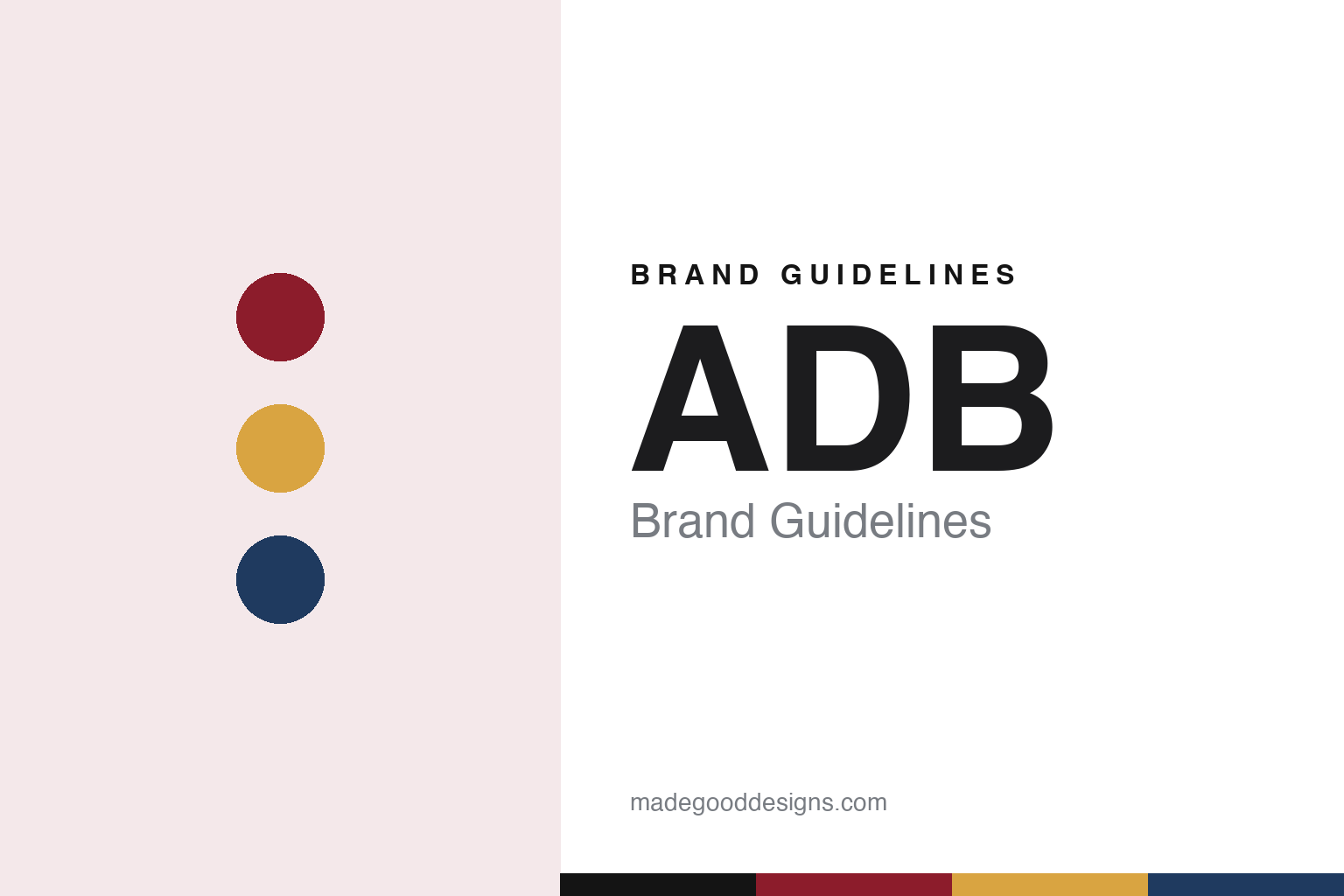
Two constants: an ADB curtain red and tungsten amber palette and an Engineering sans register. Abstract homage — not an ADB product or mark; no luminaire, desk or logo is reproduced.
Rheostats
A founder’s initials and a laboratory resistor.
ADB takes its name from its founder’s initials. The company’s own history, published by its current parent Claypaky, says Adrien de Backer founded it in Belgium in 1920 to make electrical equipment for laboratories, mainly rheostats — variable resistors used to limit and adjust current. The Backstage Heritage Collection at Theatrecrafts, an archive of British stage-lighting history, gives the same origin.
The move into theatre came quickly. From 1925, the company history says, ADB applied its rheostats, and later its RHEOTOR variable transformers, to dimming light in theatres, music halls and cinemas, and it made the first light dimmer for the city theatre of Mechelen (Malines), which it says stayed in service for more than forty years. Its first spotlights followed in 1938, and lighting control soon became electromechanical and partly motorised, with relays.
The decades after the war were a run of control technologies. ADB’s history lists dimmers based on thyratrons and magnetic amplifiers, thyristor dimmers from 1965, and memory desks that stored cues on punched cards, ferrite cores, magnetic tape and floppy discs before moving to microprocessors in 1985. Theatrecrafts gives the same sequence and holds ADB control desks and dimmer boards in its collection.
It was a family business until 1987, when it was acquired by the Siemens group. PLSN, the American lighting trade magazine, reported in 2016 that under Siemens ADB grew from a maker of digital dimmers, memory control and spotlight optics into a broadline manufacturer, with facilities in Belgium and France and a sales unit in Germany.
Colour
Siemens, a buy-out and two French letters.
The Siemens years produced some of ADB’s best-known products. The company says it released its EURODIM digital dimmer series in 1987, the year it was technical sponsor to the Belgian broadcaster RTBF for the Eurovision Song Contest. Its later landmarks include the WARP of 2004, a silent, fanless zoom profile spotlight with motorised functions and a control ring; the EURODIM TwinTech dimmer system of 2011; the ALC4 LED cyclorama light of 2013; and the Liberty and Freedom desks, running its Hathor theatre software.
Ownership changed again in late 2002, when Christian Léonard, then general manager of ADB-TTV France, led a management buy-out, PLSN reported. ADB’s own history says the group was restructured and its production streamlined after the buy-out. By 2016 the operating company, ADB TTV SAS, was based at Saint-Quentin in northern France, with a factory there, while research, product engineering, marketing and international sales remained in Belgium, according to PLSN.
ADB’s fixtures and controls have served major opera houses. When the company changed hands in 2016, Osram named the National Grand Theatre in Beijing, the Opéra Garnier in Paris and the Teatro alla Scala in Milan among the venues that had used its products.
The British trade press followed the company through each stage. Theatrecrafts lists three profiles in Lighting & Sound International: “ADB Cleared for Take Off” in June 1987, the year of the Siemens purchase; “ADB Strategy for the Nineties” in January 1991; and “ADB in Profile” in March 2004, after the buy-out. By 2016, Osram said, ADB’s range covered three families — luminaires, dimmers and lighting control desks — sold worldwide through a network of independent distributors.
Typography
Design and documentation.
Stage and entertainment lighting is sold to a small, technical audience — lighting designers, programmers, rental companies and venue technicians — and its makers present themselves accordingly. The product is the picture: moving heads, LED washes and profile fixtures photographed against black, often with a single beam cutting through haze, so that the shape and colour of the light carry the message rather than the housing.
Much of that presentation happens on the show floor. Fixture makers routinely launch new products at trade shows such as Prolight + Sound in Frankfurt, PLASA in London and LDI in Las Vegas, and their stands are built as small productions, with timed light shows and rigs of their own fixtures. Robe, for instance, marked its twentieth anniversary at PLASA in 2014, and Claypaky first showed its one-word logo at LDI in 2016, according to trade reports and the company.
Ranges are usually split by use. Touring fixtures are sold on output, speed and weight; theatre fixtures on quiet running, framing and colour rendering; architectural lines on outdoor ratings and long-term installation. Control is its own category, and several fixture makers now also own console or data brands, so screenshots of control-desk interfaces sit beside photographs of the lights themselves.
The visual language that results is consistent across the sector: dark backgrounds, saturated beams, and colour-temperature scales running from warm to cool white. This guide sets out what can be checked about each company — who founded it, who owns it and where it says its fixtures are made — and attributes to the company anything that rests on its own word.
Aa
An engineering sans — three initials from 1920. (Specimen set in Libre Franklin, a sans STAND-IN; NOT the ADB logo.)
ADB
From Siemens to Clay Paky and EK.
On 3 August 2016 Osram completed the purchase of certain assets of ADB TTV SAS, Osram and the trade magazine LSi reported the next day, and placed the business inside its Italian moving-light subsidiary Clay Paky, which had joined Osram in 2014; English Wikipedia says Clay Paky was founded in Italy in August 1976 by Pasquale Quadri, from the shortened form of whose name, Paky, it took its own. Clay Paky’s chief executive Pio Nahum called ADB’s range “fully complementary” to his own, and Léonard, owner since 2002, said he was proud to have found “a new and safe roof” for the business. Claypaky’s own timeline says the deal created ADB Stagelight SASU.
The parent changed twice more. English Wikipedia records that Osram sold Clay Paky to the ARRI group on 20 December 2022. On 13 May 2025 ARRI and Claypaky announced an agreement to sell Claypaky to EK Inc., whose chief executive Raymond Chen spoke of “the acquisition of Claypaky, along with its theatrical brand ADB”; the release said Claypaky would keep its headquarters and its research and operations in Italy. Claypaky’s timeline now says it became part of EK Lights in May 2025.
Today the name appears as ADB by Claypaky, which Claypaky describes as its “portfolio of static fixtures for the theatrical world,” with “over a century” of history behind it. Its newer products include the ORKIS CYC, a multispectral cyclorama light that Claypaky says uses its FLOW active liquid cooling. The ADB name is also shared by unrelated companies, including the Swiss set-top-box maker Advanced Digital Broadcast.
For a design guide, ADB shows how three initials can carry a century of theatre engineering through several owners. Compare Clay Paky, its Italian parent brand, and ARRI, which owned both from 2022 to 2025. For this guide we use a curtain red, a tungsten amber and a deep blue with a sans, an unofficial interpretation; no product or logo is reproduced.
Explore & save
Keep ADB’s identity on hand — save it to a board in the Made Good inspiration library.
ADB identity set
Pin the ADB curtain red and tungsten amber palette and the Engineering sans register to your own board.