Hot Dog on a Stick Brand Guidelines
A Muscle Beach stand that dressed its staff as the sign.
Aa
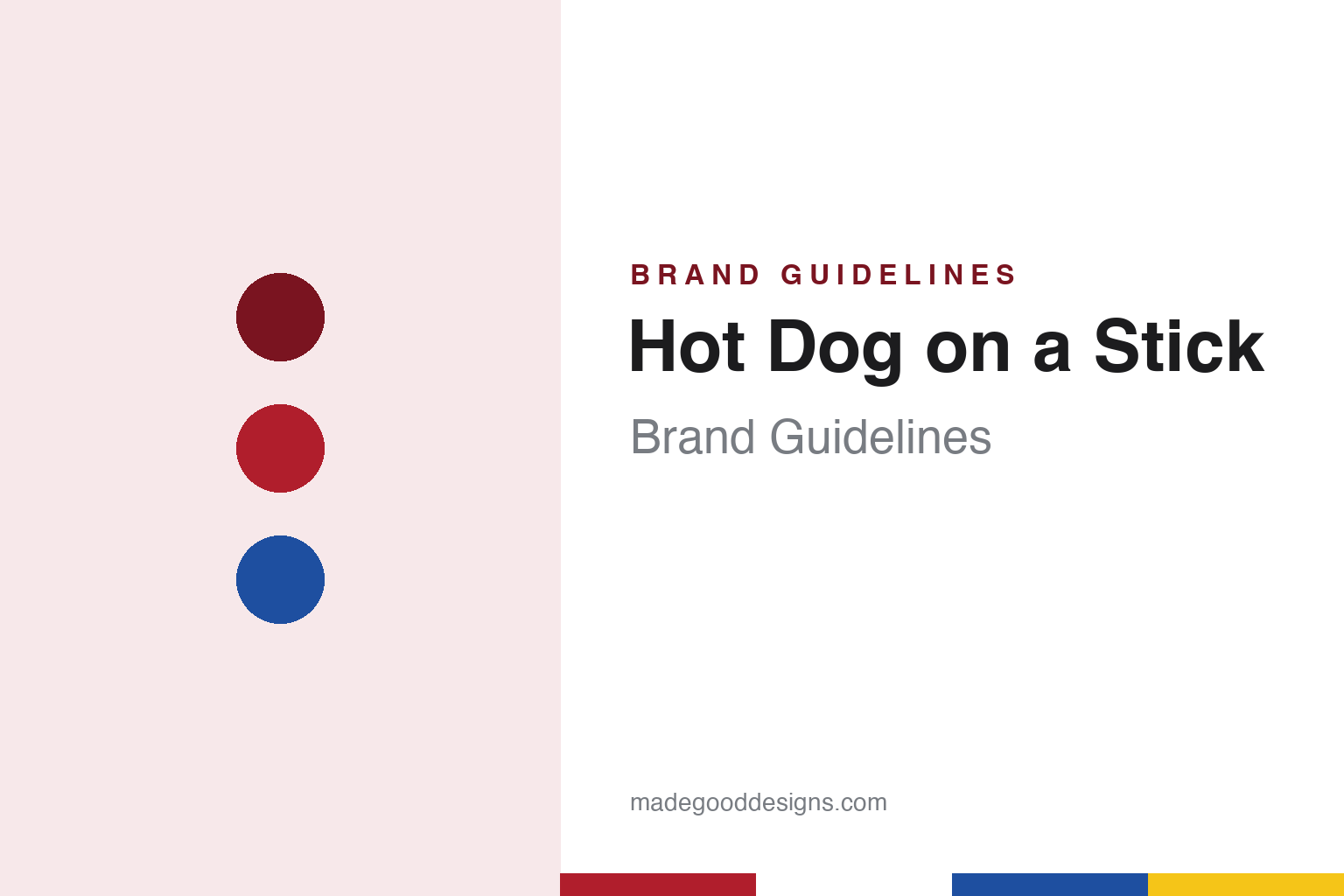
Two constants: a stripe red, stripe blue and lemonade yellow palette and a boardwalk slab serif register. Abstract homage — not a Hot Dog on a Stick product or mark; no uniform, cap or logo is reproduced.
Muscle Beach, 1946
Party Puffs, a cornbread batter and a green paper cup.
Hot Dog on a Stick began in 1946 at Muscle Beach, beside the Santa Monica Pier in California. The International Directory of Company Histories, in its 2005 profile of the operating company, HDOS Enterprises, says Dave Barham, a Missouri-born former window washer who had moved to Southern California in 1939 and worked testing radar and radio equipment at Lockheed, bought a small beach concession that year with money borrowed from his older brother, Hugh. He renamed it Party Puffs. The company’s own history describes the stand as bright red and barn-like, selling ice cream cones and lemonade.
Barham replaced the concession’s cotton candy and snow cones with a hot dog dipped in a batter adapted from his mother’s cornbread recipe and fried on a stick, something that could be eaten while strolling the beach. He called the batter Party Batter, and the Directory says he liked to claim the stick served as a handle, a source of hickory smoke flavour and a toothpick. Because broken glass in the sand was a problem at Muscle Beach, he served lemonade in a green paper cup, which became another signature of the business. From 1948 he also sold hot dogs on sticks and lemonade at the Los Angeles County Fair, and for decades he ran trailers on the fair circuit.
Stands opened on other California beaches in the early 1950s. Customers never understood the Party Puffs name, according to the Directory, and around 1960 Barham dropped it in favour of Hot Dog on a Stick, after the item itself; the company says the stand was renamed to highlight its new menu staple. In 1962, Wikipedia says, a stand opened on the Redondo Beach Pier. Easy Reader, the South Bay weekly, reported in August 2024 that Craig Reidt had bought that stand from Barham in 1979, had run it independently as Craig’s Hot Dog on a Stick, still using the original party batter and lemonade recipes, and was closing it after Labor Day that year.
Colour
Malls, employee owners and a run of new parents.
In the early 1970s Barham turned to shopping malls. The Directory says a stand opened at the Old Town Mall in October 1972 and that, after persuading the San Diego mall developer Ernie Hahn, he opened in November 1973 at Fashion Place Mall in Murray, Utah, outside Salt Lake City, at a time when enclosed malls seldom allowed food and drink inside. Cheese on a stick joined the menu around then, and the chain grew through regional malls in the decades that followed, mostly as company-owned stands.
From late 1989 Barham set up an employee stock ownership plan so that his staff could take over the chain, the Directory says, and passed the fair concessions to his children. The employees took ownership of HDOS Enterprises in 1991 and paid off the plan’s loan in 1997; the company was based in Carlsbad, California. In 1998 management hired a design agency to rebrand after some three decades with the same logo and packaging, and the lemonade, long sold simply as Original Lemonade, became Muscle Beach Lemonade. Fredrica Thode, whom Barham had hired as a receptionist in 1980, became president in 2001.
HDOS Enterprises filed for Chapter 11 protection in February 2014 to restructure its leases, and in August 2014 Nation’s Restaurant News reported that Global Franchise Group, an Atlanta-based portfolio company of Levine Leichtman Capital Partners whose brands included Great American Cookies, Pretzelmaker and Marble Slab Creamery, had acquired it out of bankruptcy. FAT Brands, the owner of Fatburger and Johnny Rockets, completed its purchase of Global Franchise Group on 22 July 2021, Wikipedia says. Wikipedia dates FAT Brands’ own Chapter 11 filing to 26 January 2026. In July 2026 the Las Vegas company Amazing Brands, parent of Pinkbox Doughnuts, Siegel’s Bagelmania and Piero’s Italian Cuisine, announced that an affiliate had bought Hot Dog on a Stick through a court-approved sale, as the Los Angeles Business Journal and KSNV News 3 reported. Amazing Brands has owned the chain since 2026; its founder, Stephen Siegel, told Restaurant Business that he grew up on the brand and that his wife had once managed the Montebello Town Center location.
Typography
Design and documentation.
A mall treat shop has to be read from a distance and in a hurry. Many of its customers are walking past, often with somewhere else to be, so the name above the counter, the colour of the canopy and the shape of the sign do most of the work before anyone reaches the menu board. In a food court or on a concourse, a kiosk may stand only a few steps from a rival, which puts weight on a short name, a strong colour and a sign that can be seen from the escalator.
Up close, the identity moves onto smaller things: the cup, the cone sleeve, the spoon, the napkin, the take-home tub and the paper bag. These are the pieces that leave the shop, and they often carry the brand further than the storefront does. The counter itself, with its freezer cases, mixing stations or display glass, is part of the show.
Each guide in this group looks at who started the name, who owns it now, and how its signs, cups, characters and packaging have been described in dated sources, and marks plainly what rests on the company’s own word.
Aa
A boardwalk slab serif — the register of a painted beach-stand sign. (Specimen set in Alfa Slab One, a slab-serif STAND-IN; NOT the Hot Dog on a Stick logo.)
Hot Dog on a Stick
Stripes, a tall cap and hand-stomped lemonade.
Barham developed the uniform in the later 1960s after a visit to Las Vegas, the Directory says. He noticed that showgirls in matching costumes and headdresses both stood out and looked interchangeable, and wanted his staff to put on a show while giving customers the sense that the same person was serving them each time, so that every stand felt familiar. The result was a sleeveless top with vertical stripes of red, white, blue and yellow, worn at first with hot pants, and a cap modelled on those worn by riders at a horse show and made taller in the manner of a showgirl’s headdress. It made its debut at the fairgrounds in Indio, near Palm Springs, replacing an earlier polka-dot uniform, and over time the cap grew taller. Barham also installed platforms behind the counter so that staff stood higher. The 1998 rebranding looked again at the uniform, the Directory says, but the only change was the addition of a cap sleeve.
The company describes the stripes today as “Red, White and Blue with a Splash of Lemonade”, calls its staff Hotdoggers and says the hats are never supposed to leave the store; Restaurant Business described them in 2026 as jockey-style hats. Easy Reader, writing about the independent Redondo stand in 2024, noted that its staff did not wear the chain’s red, gold and blue-striped hats. The company sells its drink as hand-stomped lemonade, and in 2026 Amazing Brands said it was exploring grocery versions of “The Original Fresh Hand-Stomped Lemonade”.
The original Santa Monica stand was completely renovated in 2022, Restaurant Business reported. Announcing its purchase in July 2026, Amazing Brands said it planned to modernise the brand’s design while keeping its core identity, and to look beyond malls to street-front sites, drive-throughs, airports, stadiums and resort markets, FastCasual reported, beginning with a search for a flagship on the Las Vegas Strip.
For a design guide, Hot Dog on a Stick shows how a uniform can carry a brand as strongly as a sign, with striped tops and tall caps that have put the staff at the centre of the stand since the 1960s, and how a name taken from the product itself has lasted through every change of owner. Compare it with Wetzel’s Pretzels, another Southern California mall snack chain, and Nathan’s Famous, the Coney Island hot dog stand. For this guide we use stripe red, stripe blue and lemonade yellow with a slab serif, an unofficial interpretation; no product or logo is reproduced.
Explore & save
Keep Hot Dog on a Stick’s identity on hand — save it to a board in the Made Good inspiration library.
Hot Dog on a Stick identity set
Pin the Hot Dog on a Stick stripe red, stripe blue and lemonade yellow palette and the boardwalk slab serif register to your own board.