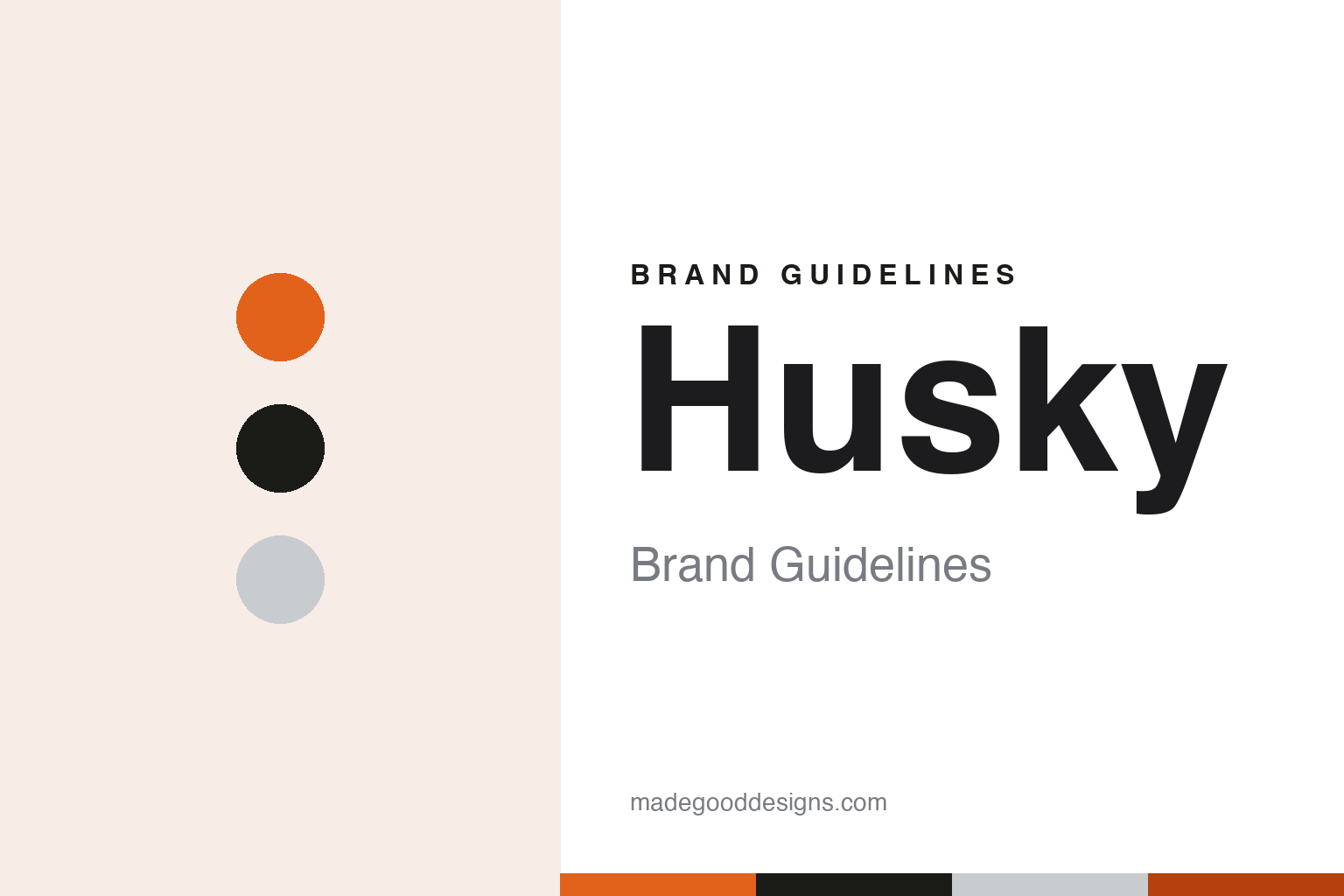
Husky Brand Guidelines
The 1924 Milwaukee wrench name behind The Home Depot’s tools.
Aa
Two constants: an orange, black and chrome palette and a heavy grotesque register. Abstract homage — not a Husky product or mark; no tool, logo or nameplate is reproduced.
Husky Wrench
Four men, a ratchet and a Milwaukee workshop.
Husky is best known today as the tool brand of The Home Depot, the American home-improvement retailer, where it is sold on hand tools, air tools and tool storage. The name itself is much older than that arrangement. It began in Milwaukee, Wisconsin, in 1924, with a small socket-wrench maker called the Husky Wrench Company.
The most detailed history of that company is the one assembled by Alloy Artifacts, a collectors’ reference on American hand tools, from trade journals of the period. It names four founders — Sigmund Mandl, Joseph O. Wirtish, Oscar W. Engerson and John G. Zummach — and says, citing notices in The Metal Industry, Automotive Industries and the SAE Journal in 1924, that several of them had previously worked for the Snap-On Wrench Company, the Kenosha firm now known as Snap-on. Mandl, the vice-president and chief engineer, put his name on the company’s patents and trademark application.
That application, filed on 9 February 1924, gave 29 January 1924 as the first use of the Husky name, and the registration was issued that July, Alloy Artifacts says. Mandl had filed a patent for a ratchet wrench on 1 February, days after the company began, and the site suggests the ratchet was the reason the company was formed. Its early products were socket sets — the No. 986 set, advertised in Popular Mechanics in April 1925, combined a ratchet, a sliding T-handle, a speed crank, an extension, a universal joint and hex sockets — and in 1926 the company moved to larger premises in Milwaukee.
In 1928 Husky agreed a selling arrangement with the J.H. Williams company, and trade papers reported the two joining sales forces; a 1928 McMaster-Carr catalogue offered a kit that combined Husky sockets with Williams wrenches, according to Alloy Artifacts. By January 1929 the firm had become the Husky Corporation. The Chicago Tribune reported that month that it had been bought by Olsen Manufacturing of Kenosha, and the company moved to a former truck factory there. By 1931 Mandl was working as an engineer for Blackhawk Manufacturing in Milwaukee.
Colour
From a Kenosha catalogue to a hardware-store aisle.
The independent company did not last long. In mid-1933 the Husky Corporation filed for bankruptcy, Automotive News reported in June that year, and it was later acquired by the New Britain Machine Company of New Britain, Connecticut, a maker of machinery and hand tools. Alloy Artifacts says no details of the purchase have been found, but by the mid-1930s Husky tools were being made to the same designs as New Britain’s own “None Better” line, and New Britain renewed the Husky trademark in 1944.
English Wikipedia continues the chain from there. New Britain Machine was bought by the conglomerate Litton Industries in the 1970s; when Litton closed its hand-tool division in the 1980s, it sold the Husky name, along with the Blackhawk brand, to National Hand Tool; and The Stanley Works acquired Husky when it bought National Hand Tool in 1986. Stanley, the Connecticut tool maker, is now part of Stanley Black & Decker, the group that also owns DeWalt and, since 2017, Craftsman.
The turn toward The Home Depot came in October 1992. The Hartford Courant reported on 31 October that year that Stanley was supplying Home Depot with a line of mechanics’ tools and toolboxes, replacing business it had lost when Sears, Roebuck dropped Stanley as a supplier of the wrenches, ratchets and sockets it sold under the Craftsman name. A Home Depot spokesman told the paper the new line would be called Husky Professional Mechanics Tools, and described it as “an aggressive challenge to Sears’ Craftsman line.” Stanley’s spokesman noted that the Home Depot range included tool boxes and tool sets that had not been part of the Sears business.
According to English Wikipedia, Stanley at first supplied the brand exclusively to The Home Depot and later transferred the rights to the Husky name to the retailer. The same article says Husky hand tools have since been made for Home Depot by several suppliers, naming Western Forge, Apex Tool Group, CSPS and Iron Bridge Tools, and that Home Depot also sells a higher-priced line marked Husky Pro. It gives the brand’s slogan as “The toughest name in tools.”
Typography
Design and documentation.
The brands in this group are all names stamped on mechanics’ and hardware-store tools: wrenches, ratchets, sockets, screwdrivers and the chests that hold them. Tool brands in general sit at many different points in the trade, from companies that sell from a van parked outside a garage to names that belong to a retailer and appear only on its own shelves, and a single name can be sold to professionals and home workshops at the same time.
A tool brand’s identity is usually carried less by one product than by a name forged or stamped into steel, a colour on a toolbox, a logo on a truck and the look of a catalogue. The company behind that name may have been sold, merged or renamed, and the place where the tools are made may have moved more than once. That makes the questions behind each name worth asking plainly: who started it, who owns it now, and where its tools are actually made.
Each guide separates what independent sources record from what the company says about itself — its founding story, its owners over time, where its tools are made and how its marks have changed — and marks plainly what rests only on the company’s own word.
Aa
A heavy grotesque — the register of a hardware-store aisle. (Specimen set in Archivo Black, a sans STAND-IN; NOT the Husky logo.)
Husky
An underlined name and an H in a circle.
The earliest Husky marks are documented in the trademark record rather than in any design archive. The 1924 registration covered the word “Husky” with an underline joining the H and the Y, and the company listed its goods as socket wrenches and socket-wrench sets, Alloy Artifacts says, reproducing a 1924 line card on which the logo appears. The cover of the Husky Corporation’s Catalog No. 31, from 1931, carries an inverted triangle reading “Guaranteed Quality” over a small H in a circle — the earliest known use, the site says, of a mark that New Britain Machine later used widely.
Those early marks belong to a different era from the one most shoppers know. Since 1992 the name has been tied to a retailer rather than a factory, and the brand has been carried by whichever company makes each product for The Home Depot. English Wikipedia lists the retailer’s other tool lines alongside it: Workforce, an earlier budget brand that has largely been phased out, and HDX, introduced in 2012. It also records that Home Depot once let customers exchange a broken Craftsman or other-brand hand tool for a comparable Husky one, a programme since discontinued.
The rivalry runs through the history of every brand in this round. Husky was launched at Home Depot as an answer to Sears’ Craftsman; Lowe’s answered both of them in 1998 with Kobalt, made at first by J.H. Williams — the company that had sold Husky sockets alongside its own wrenches in the 1920s. Husky’s own founders, meanwhile, had come from Snap-on, the tool-truck company that still sells directly to mechanics.
The name is a common one: English Wikipedia lists other businesses called Husky, among them Husky Energy, and notes that the Swedish Husqvarna group is sometimes called Husky in English. This guide covers the hand-tool and tool-storage brand sold by The Home Depot.
For a design guide, Husky shows how a trademark can outlast its maker and be carried by a retailer across a century of owners. Compare Craftsman, the Sears brand it was launched to challenge, and Snap-on, where its founders had worked. For this guide we use a shop orange, black and a chrome grey with a heavy sans, an unofficial interpretation; no product or logo is reproduced.
Explore & save
Keep Husky’s identity on hand — save it to a board in the Made Good inspiration library.
Husky identity set
Pin the Husky orange, black and chrome palette and the heavy grotesque register to your own board.


