Liebherr Brand Guidelines
A building firm, a tower crane, and one family name on everything after it.
Aa
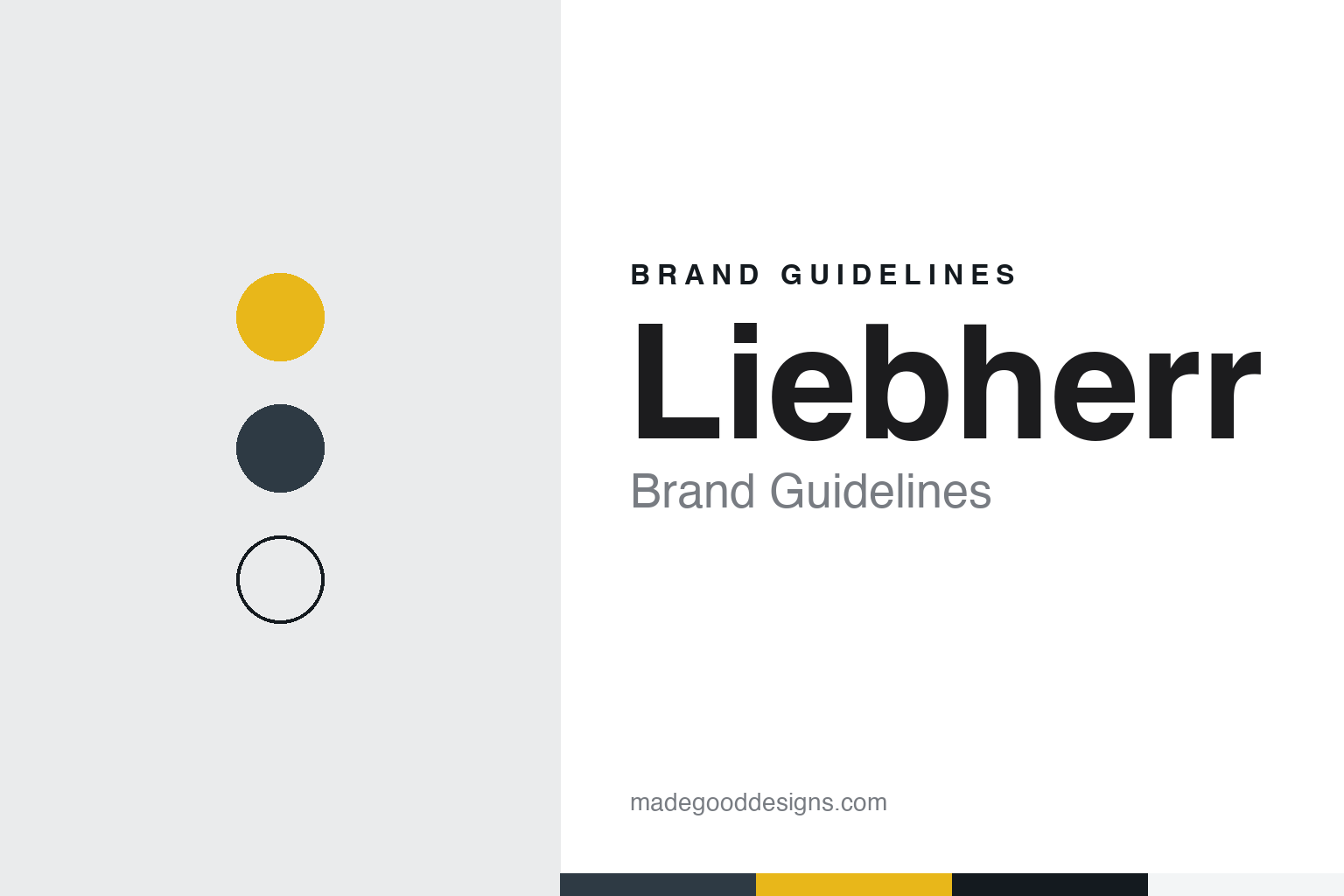
Two constants: a graphite, crane yellow and cool white palette and an engineered sans register. Abstract homage — not a Liebherr product or mark; no crane, refrigerator or logo is reproduced.
A crane for small sites
A builder’s son, a fair in Frankfurt and a crane that went up in hours.
Liebherr began on a building site. German Wikipedia says that in 1938 Hans Liebherr took over the running of his parents’ construction business in Kirchdorf an der Iller, in the Biberach district of Upper Swabia. After he returned from the Second World War, it says, he developed a mobile tower crane in 1949, the TK 10, meant to make work easier on small building sites and designed to be assembled within a few hours. The crane was shown the same year at the autumn trade fair in Frankfurt, and German Wikipedia says demand for it turned the building firm into a construction-machinery maker that was adding further models by 1950. English Wikipedia gives the same year and place, then in the state of Württemberg-Hohenzollern in West Germany, citing an archived company portrait.
The excavator came soon after. German Wikipedia says that in 1953 a rented cable excavator moved so little earth for its own weight that Liebherr set out to build a hydraulic machine of his own, the L300, which used hydraulic cylinders to push the bucket into the ground rather than relying on its weight. Kirchdorf is still the group’s excavator plant: German Wikipedia lists Kirchdorf an der Iller as the home of Liebherr’s mobile and crawler hydraulic excavators, with production there dating from 1949.
The same year brought the question that led to refrigerators. According to German Wikipedia, in 1953 the manager of Liebherr’s bank asked whether he would like to take over an insolvent refrigerator factory. Liebherr visited the plant, compared its production costs and component prices with the prices of refrigerators then on sale, and decided against the purchase. Instead he built a factory of his own in Ochsenhausen, a town in the same district, where, German Wikipedia says, Liebherr developed its own refrigerator in 1954, with series production starting a year later. In the early years the Ochsenhausen works also made oil heaters and washing machines, according to the German article on Liebherr-Hausgeräte, which cites a 2024 company post.
Colour
From Swabia to Ireland, Austria and a Swiss holding.
The group then spread outward. German Wikipedia says Liebherr built a second crane works in Biberach an der Riß in 1954, and that in 1958 Liebherr set up a company in Ireland, its earliest outside Germany; English Wikipedia says the Irish factory in Killarney, County Kerry, has built container cranes since 1958 and ships them through the port of Fenit. In 1960, German Wikipedia says, repair work on aircraft landing gear and hydraulic equipment began in Lindenberg im Allgäu, the origin of the Liebherr Aerospace division, and a wheel-loader works opened in Bischofshofen, Austria. Mobile cranes followed in Ehingen on the Danube from 1969, and plants in the United States and Brazil opened in the 1970s.
The holding structure moved to Switzerland. German Wikipedia says Hans Liebherr founded Liebherr Machines Bulle S.A. in Bulle in 1978 and in 1982, with the founding of Liebherr-International S.A., moved the group’s headquarters there. The parent company today is Liebherr-International AG in Bulle, and both English and German Wikipedia describe the group as owned and run by the Liebherr family. German Wikipedia says the siblings Isolde and Willi Liebherr have led it since 1993. English Wikipedia says they became vice president and president of the administrative board of Liebherr-International AG in 1999, and that in March 2023 Stéfanie Wohlfarth became vice president and Jan Liebherr president, citing a company press release of 4 January 2023. German Wikipedia names a third generation of the family in the management.
Refrigeration is one product segment among many. Liebherr’s group website lists refrigeration and freezing beside earthmoving, material handling, deep foundation, mining, concrete technology, tower cranes, mobile and crawler cranes, maritime cranes, aerospace and transportation systems, gear technology and automation, components and hotels. The appliance business is run by Liebherr-Hausgeräte GmbH in Ochsenhausen. German Wikipedia lists its production companies as Ochsenhausen since 1954, Lienz in Austria since 1980, Radinovo in Bulgaria since 2000, Kluang in Malaysia since 2007 for commercial appliances, and Aurangabad in India since 2018, a plant The Times of India reported opening on 9 May 2018. The same article records that in the 1980s Liebherr worked with the Chinese Qingdao Refrigerator Co., today Haier, on entering Asian markets, citing Die Welt in July 2016, and that a sales, service and digital site opened in Ulm in 2020.
Typography
Design and documentation.
The brands in this group all make major appliances for the home: cookers and ovens, refrigerators, dishwashers and laundry machines. European and global appliance brands sit at many different points in the trade, from family companies that still carry a founder’s name to labels that now belong to much larger industrial groups, and a single name can appear on products built in several countries for different markets.
An appliance brand’s identity is usually carried less by one machine than by a badge, a name and the look of a range, because the company behind the name may have changed hands, merged with a rival, been bought by a group abroad or moved its factories over the decades. That makes the questions behind each name worth asking plainly: who started it, who owns it now, and where its appliances are actually made.
Each guide separates what independent sources record from what the company says about itself — its founding story, its owners over time, where its appliances are made and how its marks have changed — and marks plainly what rests only on the company’s own word.
Aa
An engineered sans — a clean, spec-plate and catalogue register. (Specimen set in Archivo, a sans-serif STAND-IN; NOT the Liebherr logo.)
One name, many machines
The same wordmark on a crane and a kitchen refrigerator.
The family name is the identity across all of these businesses. The Liebherr wordmark appears on domestic refrigerators in the same form as on cranes and excavators, and English Wikipedia’s infobox labels the current version of the logo as in use since 2021. Model codes carry much of the rest of the vocabulary. The machines pictured on the English article run from LTM telescopic mobile cranes and the LR 13000 crawler crane to the T 282 mining truck, with excavators and tower cranes carrying the Litronic suffix; the LHM harbour cranes and RL offshore cranes take the same lettering into ports and onto the sea. On its group website, Liebherr describes its offer as “a large, continually developing range of sophisticated products and services”.
The appliance side has its own shop fronts. English Wikipedia says that in March 2020 Liebherr opened an Asia-Pacific headquarters in Singapore together with a flagship store for its appliances, citing a company release carried by Yahoo Finance. The group’s history has also been treated as a subject in its own right: in 2005 the Museum Biberach published Liebherr – Kräne + mehr (“cranes and more”), edited by Frank Brunecker, a title German Wikipedia lists in its reading for the appliance company.
For a design guide, Liebherr shows how a single family name can sit unchanged on a tower crane and on a kitchen refrigerator, with model codes rather than sub-brands doing the sorting. Compare it with the German family appliance maker Miele and with the American refrigeration specialist Sub-Zero. For this guide we use graphite, crane yellow and cool white with an engineered sans, an unofficial interpretation; no product or logo is reproduced.
Explore & save
Keep Liebherr’s identity on hand — save it to a board in the Made Good inspiration library.
Liebherr identity set
Pin the Liebherr graphite, crane yellow and cool white palette and the engineered sans register to your own board.