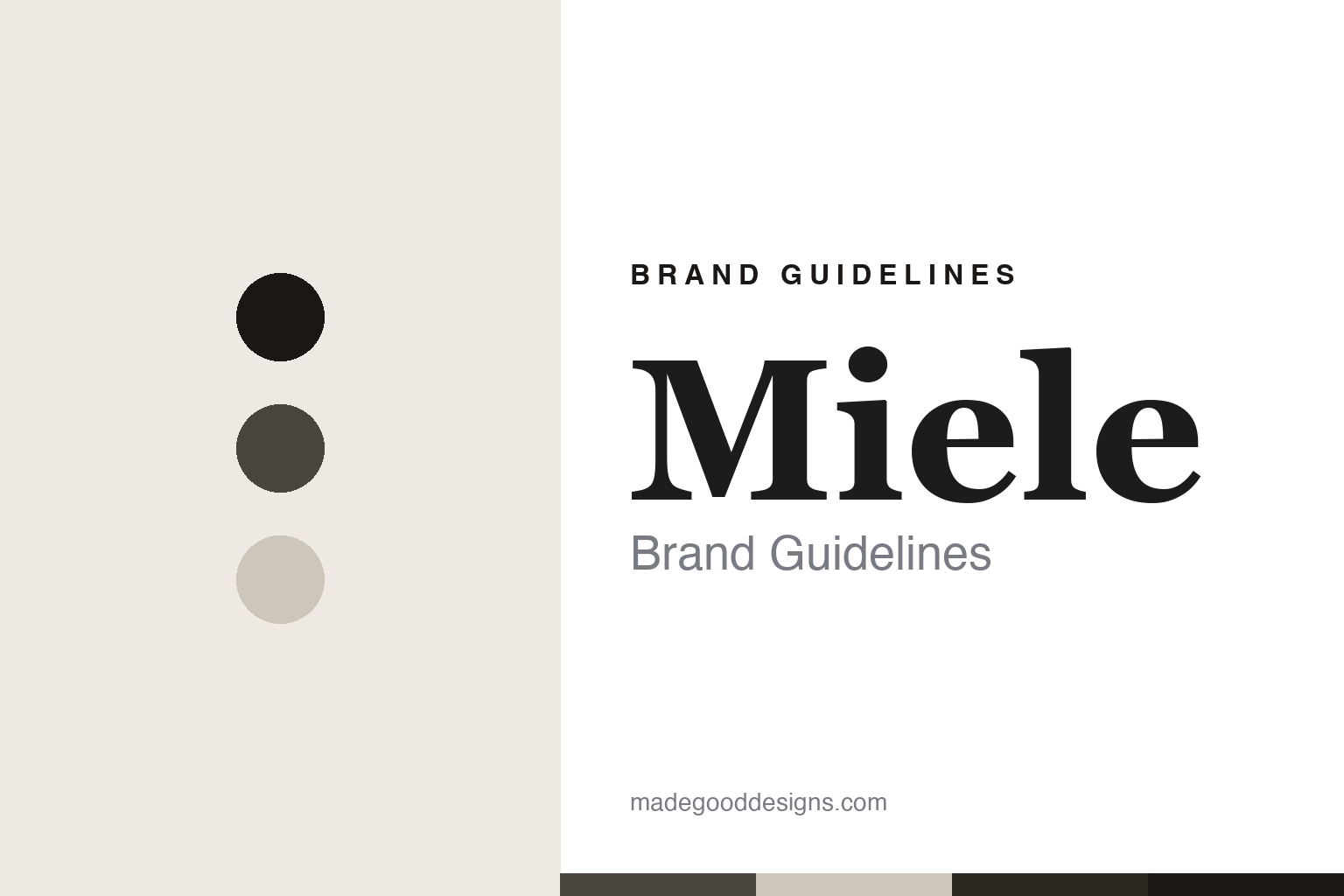
Miele Brand Guidelines
The German family premium.
Aa
Two constants: a premium-graphite palette and a premium-serif register. Abstract homage — not a Miele product or mark; no vacuum, canister or logo is reproduced.
The German family premium
Miele is the private, two-family German maker whose predominantly German-and-Austrian manufacturing anchors a “Forever Better” premium.
Miele brings the round its premium node — the maker that treats a vacuum as a durable German appliance, not a disposable one. It is Miele & Cie. KG, based in Gütersloh, Germany, founded in 1899. Miele makes and sells the machines, and its answer to a round about who owns floorcare and where it is made is unusually clean: a private, family-owned German company that still builds predominantly in Germany and Austria.
Its identity is the German family premium. The two-family private ownership, the German-and-Austrian manufacturing and the long-life premium ethos are the story here. A vacuum, premium. The German family premium.
(Honest notes, so the ownership, the manufacturing and the ethos are framed accurately. Miele sells premium canister and cordless-stick vacuums as part of a wider appliance range, and we report its language as the brand’s own. On ownership, the point that matters: Miele is privately held by two founding families — the Miele family with roughly 51.1% and the Zinkann family with roughly 48.9% — with no outside or public shareholders, so it is a two-family company, not solely the Miele family. On founding: 1899, by engineer Carl Miele and businessman Reinhard Zinkann, originally making cream separators in Herzebrock, with 125 years marked in 2024. On where it is made, the real differentiator: Miele manufactures predominantly in Germany and Austria, across around fifteen plants worldwide with eight in Germany, so we say predominantly German-and-Austrian-made, not that every single SKU is German-built. On the ethos: its promise, “Immer Besser” (Forever Better), is a registered slogan we report but do not adopt. Its designs, the Miele name, the red and the slogan are IP we describe but do not reproduce; these tones are an unofficial interpretation, deliberately not the brand red.)
Colour
Miele lives in a premium graphite. Click a swatch to copy the hex.
Miele’s identity is premium, durable and understated — a premium graphite, an ink, a pale stone, a deep umber, and a paper. The palette leans premium graphite and pale stone: a restrained, high-end register that nods to engineered longevity rather than a loud logo colour, and deliberately not to the brand’s own red. It signals the German family premium — premium, durable and understated. The honest caveat: with no adopted brand hex, and with the red treated as a protected mark, these values are an original, unofficial interpretation, not first-party colours.
The lesson is a premium graphite signals a durable, understated identity. Miele’s world is an appliance tested to last, built at home in Germany. For designers, it is a reminder that a restrained graphite and a soft pale stone can carry a hardware brand — a premium tone held as colour, never the signature red. Because these tones can fail as small text, keep type dark and let the colour live in the accents, palette and band. The takeaways: name both families and their split; date it to 1899; say predominantly German-and-Austrian-made; and report “Immer Besser” as a registered slogan rather than adopt it.
Typography
The register is a premium serif — durable, understated, engineered.
Miele’s identity carries a durable, understated, engineered spirit — a premium maker of things built to last, not a value brand. A premium serif captures the mood: refined, quiet and confident, the register of German engineering held for decades. Set in a premium-graphite palette, the premium serif feels durable and understated — exactly the personality Miele carries. It behaves like a made, engineered thing rather than a loud logo, mirroring a carpet-pile weave and a fine dust-flow ripple. (Miele’s real machines and the names are things we describe but do not reproduce, and the exact typeface is not ours to use.) Because it is not ours to use, the honest description is “a premium-serif brand,” shown here in a stand-in. The type behaves like the brand: durable, understated and engineered.
Aa
A premium-serif brand — durable and understated. (Specimen set in Fraunces, a premium-serif STAND-IN; NOT the Miele logo or its red livery.)
The vacuum cleaner
Miele stands for the German family premium.
Miele brings the round its premium node. A premium-graphite palette, a premium serif and an 1899 founding make one thing — the German family premium — the whole identity: premium, durable and understated. The two-family ownership is the pitch, and the German-and-Austrian manufacturing is the proof. The point is a maker that builds a vacuum to last and builds it at home, in a round about who owns floorcare and where it is made.
Put to work, the identity is the brand told straight, the ownership named and the manufacturing described precisely. A brand in this spirit would name both families and their roughly even split, date it to 1899, and say predominantly German-and-Austrian-made. A reader in this spirit would keep the facts right: Miele sells premium canister and cordless vacuums as heroes; it is Miele & Cie. KG of Gütersloh, founded in 1899 by Carl Miele and Reinhard Zinkann; it is privately held by the Miele and Zinkann families; it builds predominantly in Germany and Austria; and its ethos is “Immer Besser.” Miele sits second in the round, after Shark. The honest editorial moves are to name both families, to date it to 1899, to say predominantly German-and-Austrian-made, and to treat the red and the slogan as protected.
For designers and brand-builders, Miele continues the vacuum cleaner: make durable premium the identity — and let honest local manufacturing carry the story. The lessons: sell longevity, not novelty, in a disposable category; keep a private, family-controlled structure as a feature rather than hide it; ground a premium claim in real German-and-Austrian manufacturing rather than a badge; hedge the “made in Germany” claim to “predominantly” so it stays true; and never reproduce a logo, a red or a registered slogan. It is also a reminder to stay precise: Miele is the private, two-family German maker whose predominantly German-and-Austrian manufacturing anchors a “Forever Better” premium — with the palette here an unofficial interpretation. The hook is that patience: in a market of cheaper, faster-obsolescing machines, Miele tests its appliances to last for years and still builds most of them at home, owned by the same two families for over a century — a premium earned by durability, not decoration. Read that way, Miele is less an appliance brand than a durability promise: premium, durable, understated. The lesson for a brand is that longevity and honest manufacturing reinforce each other, and hedging the where-made claim keeps the story earned. Miele made the-German-family-premium the identity — proof that durability carries a round.
Explore & save
Keep Miele’s identity on hand — save it to a board in the Made Good inspiration library.
Miele identity set
Pin the premium-graphite palette and the premium-serif register to your own board.


