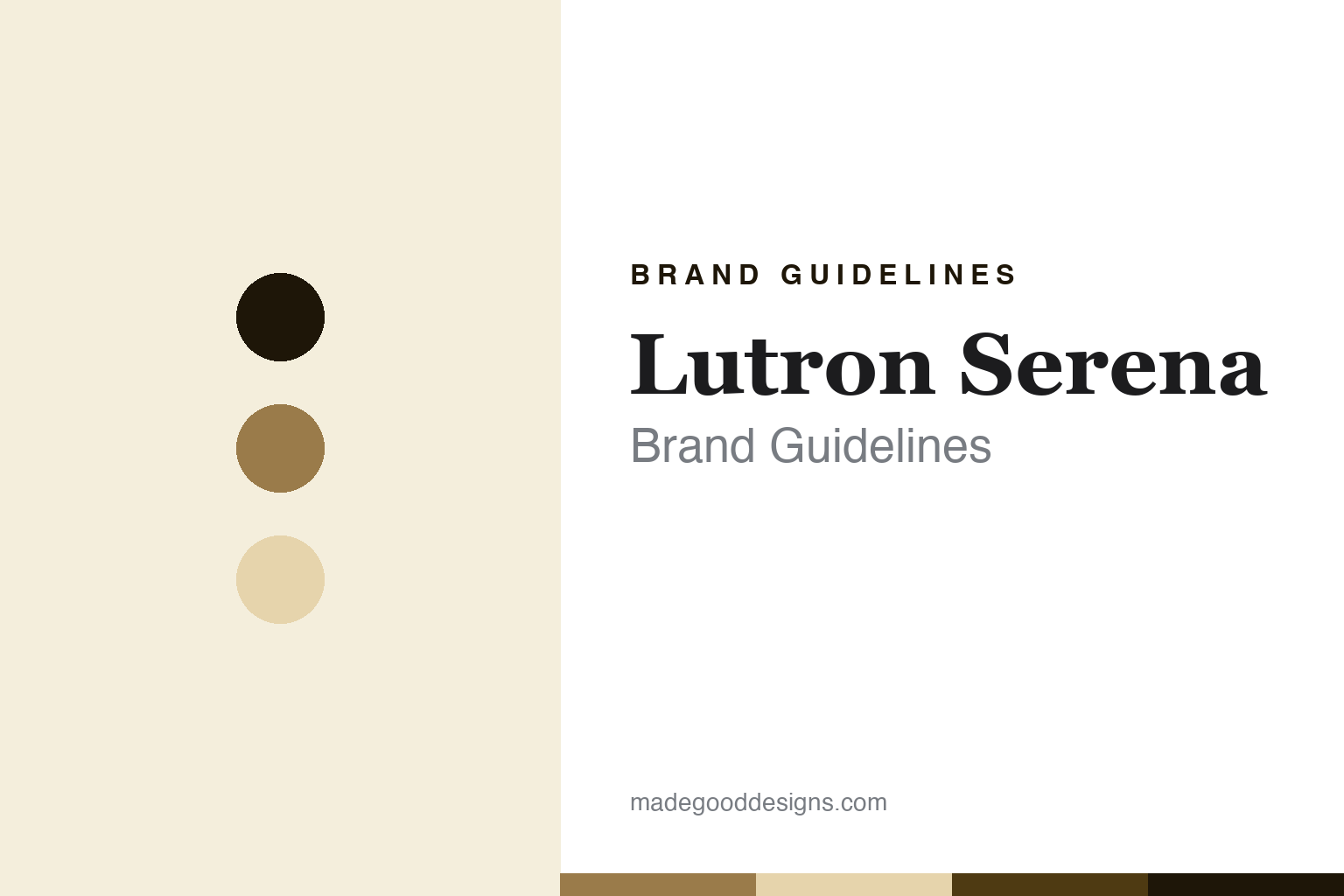
Lutron Serena Brand Guidelines
The private, RF-quiet shade.
Aa
Two constants: a serena-bronze palette and a serena-serif register. Abstract homage — not a Lutron or Serena product or mark; no shade, motor or logo is reproduced.
The private, RF-quiet shade
Lutron Serena is the motorised-shade line from the private, family-owned US company whose founder invented the solid-state dimmer, run on proprietary Clear Connect RF.
Lutron Serena follows Hunter Douglas PowerView as the round’s heritage-American node — the motorised-shade line from a private, family-owned company that has made light-control its craft for more than sixty years, and that pointedly runs its shades on its own radio rather than the industry’s new standard. Its answer to a round about who owns the moving window and where it is made is a confident, closed one: an independent US manufacturer, family-owned by choice, engineering its own quiet path.
Its identity is the private, RF-quiet shade. The dimmer-inventor heritage, the private family ownership and the proprietary Clear Connect radio are the story here. A closed system, deliberately. The private, RF-quiet shade.
(Honest notes, so the ownership and the technology are framed accurately. Serena is Lutron’s residential motorised-shade line — battery-powered honeycomb and roller shades, sold for straightforward installation and paired to Lutron’s hubs; we report its language as the brand’s own. On origin: Lutron Electronics was founded in 1961 in Coopersburg, Pennsylvania, by Joel Spira with his wife Ruth Spira, and Joel Spira is credited with inventing the solid-state dimmer — the engineering root of the whole company. On ownership: Lutron is privately held and family-owned, with no stock ticker, remaining private by the founders’ explicit wish. On technology, precisely: Serena runs on Lutron’s proprietary Clear Connect radio-frequency system and pairs to the Caséta hub or larger RA systems, which bridge to Apple Home, Amazon Alexa and Google; Lutron is deliberately Matter-agnostic — its Caséta hub is not a Matter controller — so we do not describe Serena as a Matter or Thread device, and we treat its closed radio as a design choice, framed neutrally. On where it is made: Lutron is a documented US manufacturer, with plants in Pennsylvania and in Ashland, Virginia, but we did not find a line-specific statement that Serena is entirely US-made, so we credit Lutron’s US manufacturing at the company level and do not over-claim for the line. Its designs and the Lutron and Serena names are IP we describe but do not reproduce; there is no official brand hex; these tones are an unofficial interpretation.)
Colour
Lutron Serena lives in a serena bronze. Click a swatch to copy the hex.
Serena’s identity is private, engineered and calm — a serena bronze, an ink, a pale bronze, a deep bronze, and a paper. The palette leans serena bronze and pale bronze: a warm, refined register that nods to a quiet, premium light-control heritage rather than a loud logo colour. It signals the private, RF-quiet shade — private, engineered and calm. The honest caveat: with no official brand hex, these values are a warm, unofficial interpretation, not first-party colours.
The lesson is a warm bronze signals a private, premium identity. Serena’s world is the shade that speaks its maker’s own radio. For designers, it is a reminder that a warm bronze and a soft pale can carry a heritage, engineering-led brand — a refined tone held as an accent, not a product shot. Because a mid hue can fail as small text, keep type dark and let the colour live in the accents, palette and band. The takeaways: credit Lutron as the dimmer inventor; attribute the private, family ownership; name Clear Connect and note the deliberate Matter-agnostic stance neutrally; and credit US manufacturing at the company level without over-claiming for the Serena line.
Typography
The register is a serena serif — private, engineered, calm.
Serena’s identity carries a private, engineered, calm spirit — a family firm that keeps its own counsel and its own radio, not a follower. A serena serif captures the mood: refined, quiet and self-assured, the register of a maker that solves its own problems. Set in a serena-bronze palette, the serena serif feels private and premium — exactly the personality Serena carries. It behaves like a made, considered thing rather than a loud logo, mirroring an honeycomb-cell grid and a drape-fold. (Serena’s real products and the Lutron name are things we describe but do not reproduce, and the exact typeface is not ours to use.) Because it is not ours to use, the honest description is “a serena-serif brand,” shown here in a stand-in. The type behaves like the brand: private, engineered and calm.
Aa
A serena-serif brand — private and premium. (Specimen set in Cormorant Garamond, a serena-serif STAND-IN; NOT the Lutron or Serena logo or products.)
The shade node
Lutron Serena stands for the private, RF-quiet shade.
Lutron Serena sits third in the round as its heritage-American node. A serena-bronze palette, a serena serif and a dimmer-inventor’s history make one thing — the private, RF-quiet shade — the whole identity: private, engineered and calm. The light-control heritage is the pitch, the private family ownership is the frame, and the proprietary Clear Connect radio is the turn. The point is a shade that deliberately runs its maker’s own radio rather than the industry standard, in a round about who owns the moving window and where it is made.
Put to work, the identity is the brand told straight, the ownership named and the technology framed neutrally. A brand in this spirit would credit Lutron as the dimmer inventor, attribute the private family ownership, name Clear Connect and describe the Matter-agnostic stance as a design choice, and credit US manufacturing without over-claiming for Serena. A reader in this spirit would keep the facts right: Serena is Lutron’s battery-powered honeycomb and roller shade line; Lutron was founded in 1961 in Coopersburg, Pennsylvania, by Joel and Ruth Spira, with Joel Spira credited for the solid-state dimmer; the company is private and family-owned with no ticker; Serena runs on proprietary Clear Connect RF and pairs to Caséta or RA to reach Apple, Alexa and Google, and Lutron is deliberately not a Matter device; and Lutron is a documented US manufacturer with plants in Pennsylvania and Virginia, though the Serena line’s specific origin is not separately documented. Serena sits after Hunter Douglas PowerView and before Eve MotionBlinds. The honest editorial moves are to credit the invention, to attribute the private ownership, to frame the closed radio neutrally, and to keep the US-made claim at the company level.
For designers and brand-builders, Serena carries the shade node: frame a closed system as a choice — and keep a made-in claim at the level it is documented. The lessons: a company can build a premium identity on staying private and family-owned, here by the founders’ own wish; a proprietary radio, Clear Connect, and a deliberately Matter-agnostic stance are described as engineering choices, not failings; a documented US manufacturing base is credited at the company level, with plants in Pennsylvania and Virginia, without over-claiming that a specific line is entirely US-made; and an inventor’s legacy, the solid-state dimmer, anchors the story. It is also a reminder to stay precise: Lutron Serena is the private US company’s motorised-shade line, running on Clear Connect rather than Matter — with the palette here an unofficial interpretation. The hook is that independence: while much of the category rushes to a shared standard, the company whose founder invented the dimmer keeps its shades on its own radio, on its own terms, as a private family firm. Read that way, Serena is less a gadget than the private, RF-quiet shade: private, engineered, calm. The lesson for a brand is that framing the closed system as a choice and keeping the made-in claim honest reinforce each other, and crediting the inventor keeps the story earned. Serena made the-private-RF-quiet-shade the identity — proof that a deliberate, private path can anchor a node.
Explore & save
Keep Lutron Serena’s identity on hand — save it to a board in the Made Good inspiration library.
Lutron Serena identity set
Pin the serena-bronze palette and the serena-serif register to your own board.


