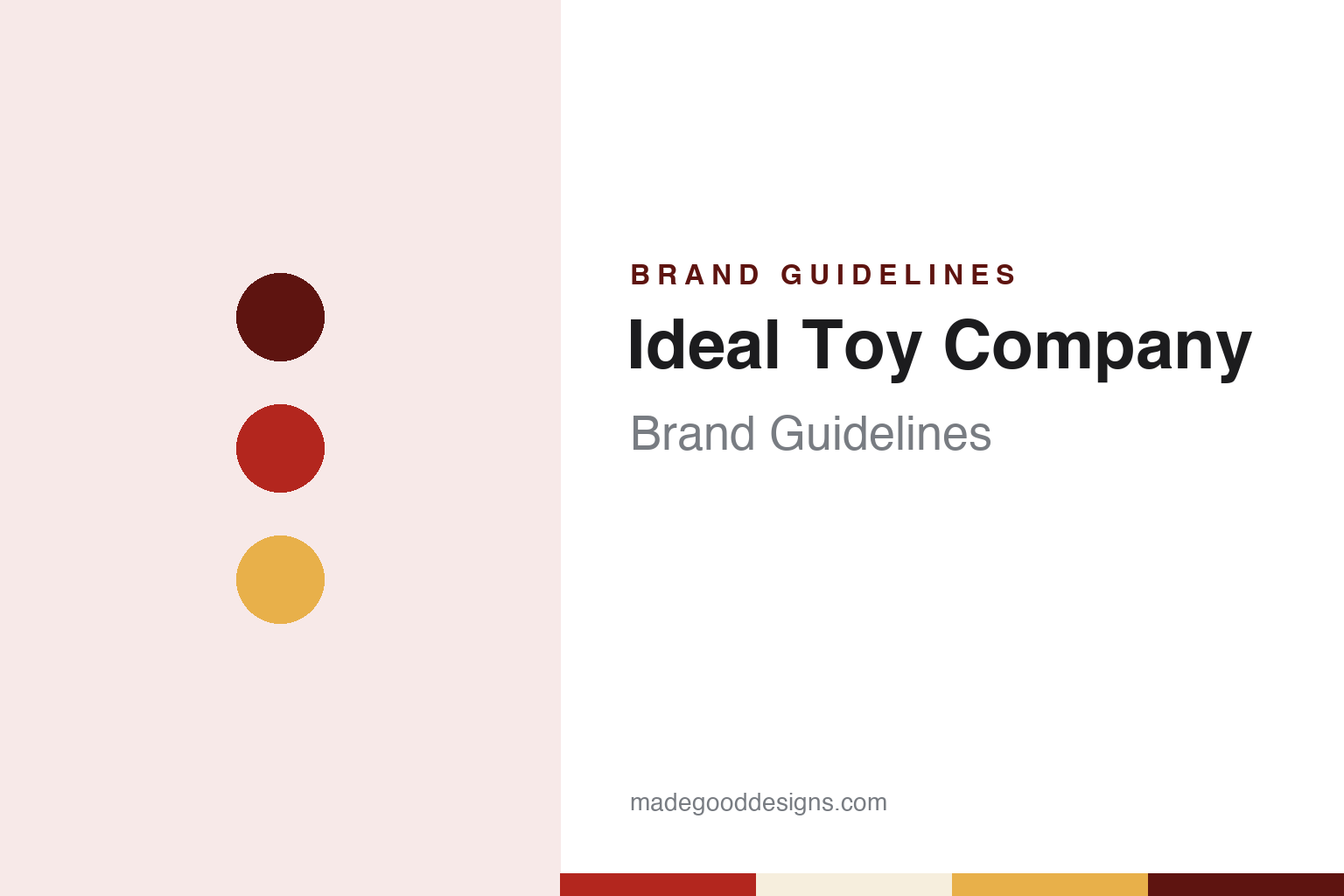
Ideal Toy Company Brand Guidelines
The Brooklyn teddy bear maker that became View-Master Ideal.
Aa
Two constants: a toy-box red, bear honey and catalogue cream palette and a catalogue display serif register. Abstract homage — not an Ideal product or mark; no toy, box or logo is reproduced.
Ideal Novelty and Toy
A Brooklyn shop, a cartoon bear and a family firm.
The story Ideal is usually linked with begins with a newspaper cartoon. The National Park Service, in its account of the teddy bear published by the Theodore Roosevelt Birthplace National Historic Site, says the political cartoonist Clifford Berryman lampooned the president’s refusal to shoot a bear on a hunting trip in a cartoon that appeared in the Washington Post on 16 November 1902. Morris Michtom, described by the Park Service as a Brooklyn candy shop owner who also made stuffed animals with his wife Rose, saw the cartoon and made a toy bear dedicated to the president, which he called “Teddy’s Bear”. After receiving Roosevelt’s permission to use his name, the Park Service says, Michtom mass-produced the bears, and their popularity led him to found the company that became Ideal.
English Wikipedia dates that company, the Ideal Novelty and Toy Company, to 1903 in Brooklyn and names Morris and Rose Michtom as its founders. It says Ideal began making dolls in 1907 to sit alongside its bears, starting with a doll of the Yellow Kid, the character from Richard Felton Outcault’s comic strip, and following it with baby and character dolls. Those early dolls were made of composition, a mixture of sawdust and glue, and Wikipedia says Ideal advertised them as “unbreakable” to set them apart from ceramic dolls. A boy doll called the Uneeda Kid, tied to a biscuit brand, followed in 1914.
The 1930s fixed the company’s doll business in the public mind. Wikipedia records the Betsy Wetsy doll, introduced in 1934 and named after the daughter of Abraham Katz, the head of the company, and the Shirley Temple doll, which made its debut the same year. Licensed dolls of Disney characters and of Judy Garland followed. In 1938, by Wikipedia’s account, the business dropped “Novelty” from its name and became the Ideal Toy Company, the name it would carry until 1984, with Katz, a nephew of Morris Michtom, as chief executive.
For decades the company was based in Hollis, Queens, in New York City, where Wikipedia places its manufacturing complex. It remained a privately held, family-run firm through the war years, with Lionel A. Weintraub, Katz’s son-in-law, joining in 1941 and later rising to president, chairman and chief executive.
Colour
Dolls, games, a cube and a run of new owners.
After the Second World War the doll line moved into new materials and tie-ins. Wikipedia lists Toni, introduced at the end of the 1940s with a home-permanent brand, and Miss Revlon in the 1950s, each named for a cosmetics company, and later Tammy (1962–1966), Crissy (1969–1974) and Patti Playpal. From 1953 to 1968 Ideal held the licence to make the U.S. Forest Service’s Smokey Bear, Wikipedia says, so a bear once again carried the company’s name into homes. In 1968 it took over the moulds, patents and trademarks of the bankrupt American Character Doll Company, including the Tressy doll.
Games became a second business. Wikipedia says Ideal had a hobby division in the 1950s and shifted to games in 1962; its titles included Mouse Trap, Hands Down, KerPlunk and Tip-It, alongside Captain Action figures, Evel Knievel toys and Muppet puppets in the 1960s and 1970s. By 1970 the Hollis site was too small, and the company opened a facility in Newark, New Jersey, in the early 1970s while keeping the Queens factory running.
Ideal’s connection with a Hungarian puzzle came late in its life. The Strong National Museum of Play, which inducted Rubik’s Cube into the National Toy Hall of Fame in 2014, says the design teacher Ernő Rubik assembled his first cube puzzle in 1974 and called it the Magic Cube; after a toy agent pitched it to Ideal, the company renamed it Rubik’s Cube and began putting it in stores in 1980.
Ownership then changed quickly. Wikipedia says Ideal moved its headquarters from Queens to New Jersey in 1982 and was sold to CBS Toys the same year. In 1984 CBS sold it to Viewmaster International, which renamed itself View-Master Ideal, and in 1989 View-Master Ideal was bought by Tyco Toys of Mount Laurel, New Jersey. The Los Angeles Times reported on 19 November 1996 that Mattel had agreed to buy Tyco Toys, and Wikipedia records that the Ideal line stayed with Tyco until Tyco’s merger with Mattel in 1997. At that point Ideal stopped existing as a company of its own. Its United Kingdom assets went to Hasbro, which has since released games such as Mouse Trap and KerPlunk under its MB Games brand, Wikipedia says.
Typography
Design and documentation.
A toy company’s name usually reaches people indirectly. Children meet the characters, the dolls and the games first, and the maker’s mark sits in a corner of the box, on the base of a figure or on the back of the instructions. For many toy makers the corporate logo works more like a signature than a headline, a small, repeatable sign that has to sit beside a crowd of louder product names without competing with them.
The places where that mark does its main work are mostly trade settings: the cover of a dealer catalogue, the spine of a retail display, the stand or showroom at a toy fair where buyers see a season’s range before it reaches shops. A company that changes owners, merges with a rival or licenses its name may carry several versions of its mark across those settings at once, and older boxes keep earlier versions in circulation long after a redesign.
Each guide follows the company rather than any single toy: who founded it and where, who has owned it since, how its name and mark have changed, and which lines it is remembered for, with the company’s own account marked as its own.
Aa
A catalogue display serif — the register of a dealer catalogue cover and a showroom sign. (Specimen set in DM Serif Display, a serif STAND-IN; NOT the Ideal logo.)
Ideal
A plain word that outlived its company.
Ideal’s identity rested on a single ordinary English word, and the company changed the words around it more often than the word itself. Wikipedia charts three corporate names: Ideal Novelty and Toy Company from 1903 to 1938, Ideal Toy Company from 1938 to 1984, and View-Master Ideal from 1984 to 1997, after the stereo-viewer company that bought it took on the Ideal name as well. Wikipedia illustrates the company with an original Ideal logo it dates to 1938 and a separate later logo, so the mark was redrawn at least once while the word stayed constant.
The name has had a long life after the company. Wikipedia says the Ideal trademarks, and most toy moulds not bought by Hasbro or Mattel, were acquired by Jay Horowitz of American Plastic Equipment and transferred to its subsidiary American Classic Toys, which licensed the mark to Plaza Toys for its Fiddlestix building sticks and sold the mark and toy rights to Poof-Slinky in January 2011. A press release dated 29 January 2014 announced the formation of Alex Brands from Alex Toys, Poof-Slinky and Zoob, and listed IDEAL among its brands, describing it as a nostalgic name covering games, activity kits, magic sets and classic toys. Wikipedia says that grouping followed the May 2013 purchase of Alex Toys by Propel Equity Partners.
For a design guide, Ideal shows how a toy company’s name can travel separately from the company: a word first attached to a Brooklyn family business, carried through doll counters, game shelves and a renamed stereo-viewer firm, and then sold on as a trademark after the business itself had been folded into a larger group. Compare it with Rubik’s Cube, the puzzle Ideal renamed and put in stores in 1980, and Barbie, the doll line of Mattel, which absorbed Ideal’s last owner in 1997. For this guide we use toy-box red, bear honey and catalogue cream with a serif, an unofficial interpretation; no product or logo is reproduced.
Explore & save
Keep Ideal Toy Company’s identity on hand — save it to a board in the Made Good inspiration library.
Ideal Toy Company identity set
Pin the Ideal toy-box red, bear honey and catalogue cream palette and the catalogue display serif register to your own board.