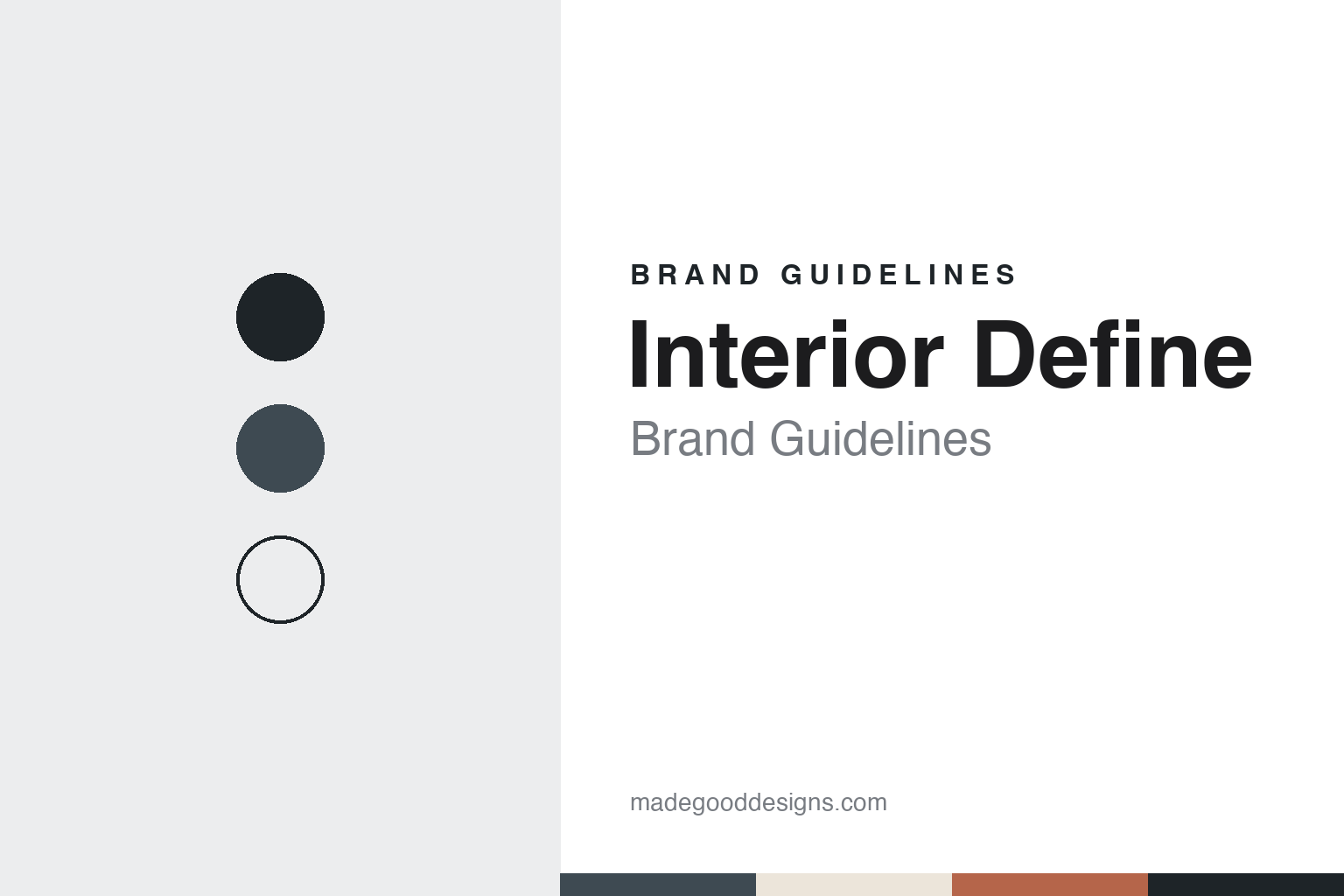
Interior Define Brand Guidelines
A Chicago custom-sofa brand owned by Havenly since 2023.
Aa
Two constants: an Interior Define slate, linen and terracotta palette and a Quiet serif register. Abstract homage — not an Interior Define product or mark; no sofa, logo or showroom is reproduced.
A sofa built after the order
A Chicago start-up with a Bonobos lineage.
Interior Define is a Chicago furniture brand that began as an online seller of custom upholstered furniture. TechCrunch, writing on 8 September 2014, described it as a Chicago-based e-commerce company and named its founders as Rob Royer, a former employee of the menswear brand Bonobos who came from a family of interior designers and architects, and Steve Mcclearn, a former vice-president of commerce at Sears Brands. The same report said that Andy Dunn, the founder of Bonobos, sat on the board. The brand had launched earlier that year; six months after its launch, TechCrunch reported, it had opened a retail store in Chicago and was shipping sofas to customers across the United States.
The idea was customisation at the point of sale. Customers buying online or in the Chicago store could choose the cushions, the legs and the upholstery of a sofa, and, as Royer told TechCrunch, every piece was built after the order had been placed. “We thought of a better way to give consumers customized upholstered furniture,” Royer told the site, and the made-after-order system, he said, was what allowed the company to offer so many options. The same article recorded where the furniture was made: in factories in the Foshan region of China, which was part of the reason a sofa took weeks rather than days to arrive. It also noted early design collaborations with the lifestyle site The Everygirl and with the television host Alison Victoria.
Colour
From sofas to beds, dining and more showrooms.
The range grew outward from the sofa. Business of Home, writing on 28 June 2018, called sofas the brand’s original focus and reported that it had added bed frames in 2017 and was then launching a dining line built around a Parsons-style table and chairs named Audrey, Dylan and Kit, each available in a choice of finishes and upholstery. By then, the magazine said, the company that had started online had showrooms in Chicago, where it was headquartered, Los Angeles, New York and Austin, Texas. Royer, quoted in the same piece, described the brand’s mission as building a personalised and comfortable way to shop for a sofa, and called dining another “highly considered” furniture category.
Leadership also changed over these years. By the end of 2022, Business of Home reported, the chief executive was Antonio Nieves. That was the year in which the company’s financial position became public through its own customers.
Typography
Design and documentation.
The brands in this group all sell furniture direct to the people who buy it, mainly through their own websites, rather than leaving the sale to a department store or a showroom chain. Direct-to-consumer furniture brands in general sit at many different points in the trade: some design in one city and build in workshops far away, some ship sofas flat in boxes, some build each piece to order, and some later open stores of their own or change hands.
A furniture brand of this kind usually carries its identity less through a single product than through its website, its photography, its packaging and the way it explains how a piece is made and delivered. The company behind the name may have changed owners, moved its production or grown well beyond the place where it began, so the plain questions behind each name are worth asking: who started it, who owns it now, and where its furniture is actually made.
Each guide separates what independent sources record from what the company says about itself — its founding story, its owners over time, where its pieces are made and how its identity has changed — and marks plainly what rests only on the company’s own word.
Aa
A quiet serif for a brand sold through rooms and swatches. (Specimen set in Fraunces, a serif STAND-IN; NOT the Interior Define logo.)
Interior Define
An assignment for creditors, and a new owner.
The account of what happened next comes mainly from Business of Home, which published a detailed explainer on 9 January 2023. Customer complaints about delayed orders had begun in the autumn of 2022. The trade publication reported that the company had run short of cash during 2022 and could not pay some of its suppliers, including the factories in Asia that made its furniture and delivery companies in the United States, and that it had made several rounds of layoffs during the year.
The legal route it took was not a bankruptcy filing. According to Business of Home, the company entered an assignment for the benefit of creditors, a process governed by state law in which the original legal entity is dissolved and its remaining assets are sold, with the proceeds going largely to secured creditors. As part of that process the online design service Havenly bought the brand’s assets, including the Interior Define name, its designs, copyrights, website and social channels. Business of Home reported that Havenly planned to run Interior Define as a largely unchanged brand under a new legal entity without the old company’s debts, and that Nieves had resigned. TechCrunch, reporting on a later Havenly acquisition on 21 February 2024, confirmed that Havenly had acquired Interior Define the previous year. Havenly has owned Interior Define since 2023, and the brand’s website, interiordefine.com, was still trading in October 2026, linking to Havenly.
Havenly is an online interior-design service, and Interior Define was one of several brands it gathered. In the same February 2024 report, TechCrunch said Havenly had bought the home-furnishing brand The Inside in 2022 and was then acquiring the artisan home-décor brand The Citizenry, its third acquisition in two years, as part of an effort to build a collection of home brands. Havenly’s chief executive, Lee Mayer, described the aim as a design-first ecosystem for the rising, digitally native home consumer. In that collection, Interior Define sits alongside The Inside and The Citizenry.
The episode matters for a design reading because the identity survived the company. What Havenly bought was, in large part, the brand itself: the name, the product designs and the digital storefront. The made-to-order idea of 2014, in which a sofa is configured on a screen and built afterwards, carried on under the new owner.
For a design guide, Interior Define shows how a made-to-order furniture brand can carry its identity through configuration, made-to-order production and showrooms rather than a heavy mark. Compare its fellow Chicago names Crate & Barrel and CB2, and the Los Angeles-area custom-sofa maker Joybird. For this guide we use slate, linen and terracotta with a quiet serif, an unofficial interpretation; no product or logo is reproduced.
Explore & save
Keep Interior Define’s identity on hand — save it to a board in the Made Good inspiration library.
Interior Define identity set
Pin the Interior Define slate, linen and terracotta palette and the Quiet serif register to your own board.