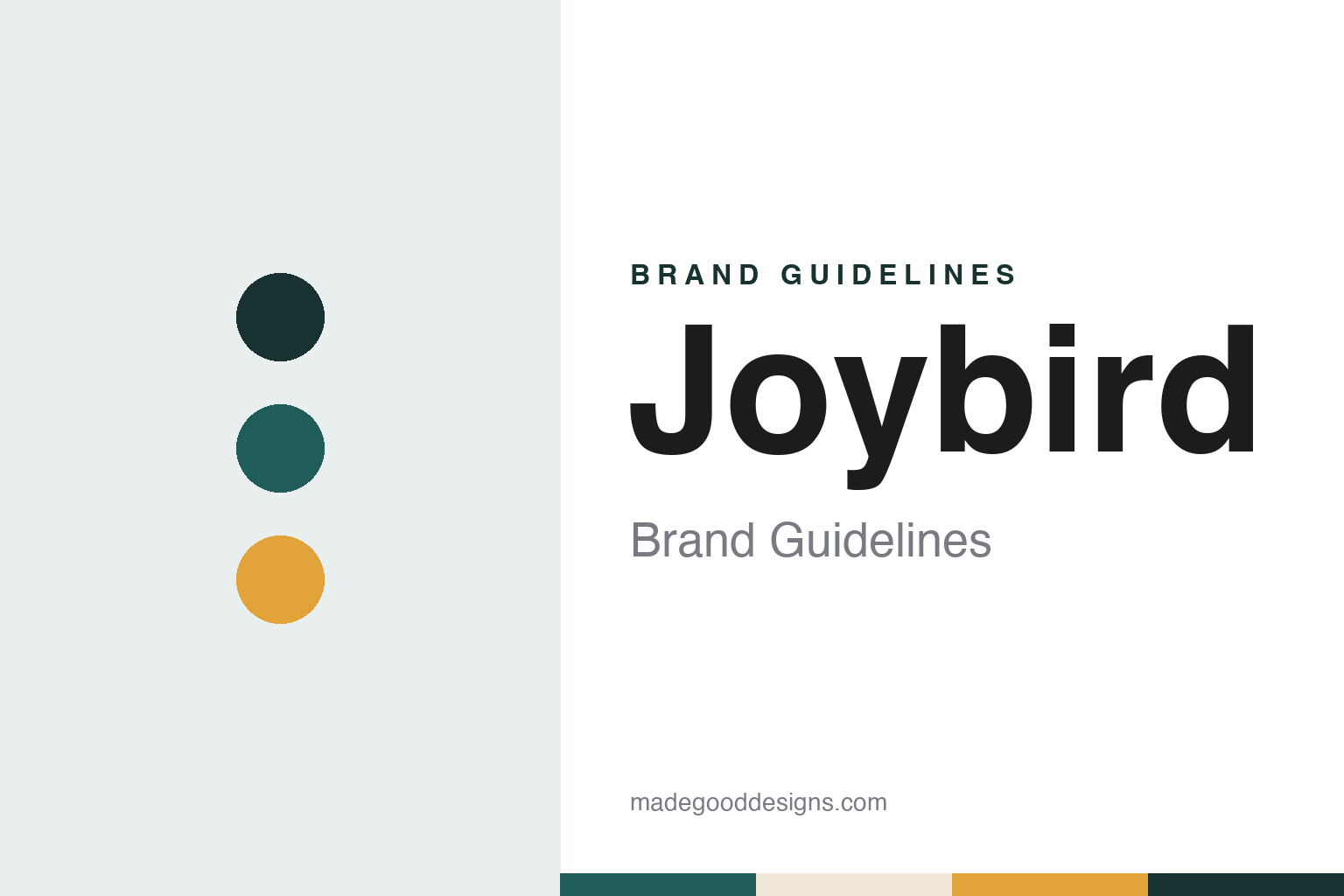
Joybird Brand Guidelines
Mid-century sofas made to order, owned by La-Z-Boy since 2018.
Aa
Two constants: a Joybird teal, mustard and walnut palette and a Geometric sans register. Abstract homage — not a Joybird product or mark; no sofa, logo or showroom is reproduced.
Mid-century, made to order
Four partners and an online upholstery business.
Joybird is an American furniture brand that sells custom, mid-century modern upholstered furniture, mostly online. Its founding details come from the announcement La-Z-Boy made when it agreed to buy the business on 16 July 2018, as reported that day by the Toledo Blade. According to that announcement, Joybird was formed in 2014 by four partners, Alex Del Toro, Andres Hinostroza, Joshua Stellin and Christopher Stormer. Joybird was the trade name of a company called Stitch Industries, which was headquartered in Commerce, California, in Los Angeles County, and which manufactured its furniture in Tijuana, Mexico, just across the border. The company name survives in La-Z-Boy’s SEC filings, which refer to the acquired company as Stitch Industries, Inc. and to the business as Joybird.
In 2018, then, Joybird had an online storefront run from California and a factory in Baja California. The 2018 announcement described the product as custom, mid-century modern upholstered furniture sold through Joybird’s e-commerce platform, the same platform Darrow would praise alongside the brand itself. The company’s own about page, as it appeared in October 2026, says the brand was founded on the idea that people should never have to settle, presents its role as helping customers express their own style, and that artisans in its workshop handcraft its made-to-order pieces.
Colour
A recliner maker buys an online upholsterer.
The buyer was La-Z-Boy. English Wikipedia says the company grew from a furniture business that the cousins Edward M. Knabusch and Edwin J. Shoemaker set up in 1927 in Monroe, Michigan, where it is still headquartered, and describes its products as upholstered recliners, sofas, stationary chairs, lift chairs and sleeper sofas. Wikipedia lists England, Hammary and Kincaid among the other names in its wholesale business. La-Z-Boy’s chairman, president and chief executive at the time, Kurt Darrow, said in the July 2018 announcement that the Joybird team had created “an incredible brand and online shopping platform,” and that the deal would allow La-Z-Boy to reach millennial and Generation X customers more effectively. He also said that Joybird’s growth had been held back by limited capital and production capacity, which La-Z-Boy’s supply chain, procurement and manufacturing could help to address.
The deal was then expected to close in the autumn of 2018, but it was completed within weeks. The co-founders were to stay on and run the business day to day, the announcement said, keeping responsibility for sales, customer service, marketing and brand development. La-Z-Boy’s quarterly filing with the US Securities and Exchange Commission for the period to July 2019 records that it completed the acquisition of Stitch Industries, Inc., which it calls Joybird, on 30 July 2018, and describes the business as an e-commerce retailer and manufacturer of upholstered furniture. La-Z-Boy has owned Joybird since July 2018.
The two names have stayed separate since. La-Z-Boy reports Joybird as its own tradename with its own website, and the brand’s co-founders were, under the 2018 terms, the people responsible for its brand development. Joybird’s website footer, in October 2026, described it simply as “a La-Z-Boy Incorporated Company.”
Typography
Design and documentation.
The brands in this group all sell furniture direct to the people who buy it, mainly through their own websites, rather than leaving the sale to a department store or a showroom chain. Direct-to-consumer furniture brands in general sit at many different points in the trade: some design in one city and build in workshops far away, some ship sofas flat in boxes, some build each piece to order, and some later open stores of their own or change hands.
A furniture brand of this kind usually carries its identity less through a single product than through its website, its photography, its packaging and the way it explains how a piece is made and delivered. The company behind the name may have changed owners, moved its production or grown well beyond the place where it began, so the plain questions behind each name are worth asking: who started it, who owns it now, and where its furniture is actually made.
Each guide separates what independent sources record from what the company says about itself — its founding story, its owners over time, where its pieces are made and how its identity has changed — and marks plainly what rests only on the company’s own word.
Aa
A geometric sans for a mid-century register. (Specimen set in Jost, a sans STAND-IN; NOT the Joybird logo.)
Joybird
An online brand that added stores.
Joybird has since moved beyond the purely online model it started with. La-Z-Boy’s annual report for the fiscal year ended 25 April 2026, filed with the SEC, describes Joybird as an omni-channel, direct-to-consumer retailer and manufacturer of upholstered furniture that sells through its website, joybird.com, through small-format stores in key markets and through other channels. The same filing says La-Z-Boy owns the Joybird trademark, which it treats, alongside the La-Z-Boy name, as essential to its e-commerce business, and that the Joybird name is also used on accessories and wooden casegoods that La-Z-Boy imports and sells. In the company’s own summary of its business, Joybird is one of three tradenames, with La-Z-Boy and England, under which it manufactures, markets, imports, exports, distributes and retails upholstered furniture.
On manufacturing, the 2026 report says the Joybird business keeps raw materials and work in progress at its manufacturing location, that finished Joybird goods are held at La-Z-Boy’s distribution centres and at Joybird’s own manufacturing and warehouse sites, and that La-Z-Boy leases manufacturing facilities in Mexico, without naming the Joybird plant’s city. The Tijuana location comes from the 2018 announcement. Joybird’s website today says its pieces are made to order in its workshop, offers a showroom finder for the physical stores, and describes digital, physical and virtual ways to shop.
The filing also places Joybird inside La-Z-Boy’s wider direct selling. La-Z-Boy says it sells to end consumers through its company-owned La-Z-Boy Stores, its small-format Joybird stores and its websites, la-z-boy.com and joybird.com. Among its risk factors it notes that Joybird sells a large portion of its product online, where there is significant competition for customer attention among online and direct-to-consumer brands. Joybird, in other words, still competes as a direct-to-consumer brand, even as part of a much older manufacturer.
For a design guide, Joybird shows how a direct-to-consumer furniture brand can build an identity from a single design period, mid-century modern, and keep its own name and storefront under a much larger parent. Compare West Elm, the home retailer founded in Brooklyn, and the Chicago custom-sofa brand Interior Define. For this guide we use teal, mustard and walnut with a geometric sans, an unofficial interpretation; no product or logo is reproduced.
Explore & save
Keep Joybird’s identity on hand — save it to a board in the Made Good inspiration library.
Joybird identity set
Pin the Joybird teal, mustard and walnut palette and the Geometric sans register to your own board.