Janus et Cie Brand Guidelines
The Los Angeles showroom that became an outdoor furniture maker with a material of its own.
Aa
Two constants: a Janus et Cie teak, stone and sage palette and a Geometric sans register. Abstract homage — not a Janus et Cie product or mark; no chair, logo or catalogue is reproduced.
West Hollywood, 1978
A showroom first, a maker later.
Janus et Cie began in 1978 in West Hollywood, Los Angeles, when its founder, Janice Feldman, opened her first showroom. That is how Haworth, the company’s majority owner today, tells the story on its own brand page, adding that the venture responded to the unmet needs of local customers shopping for furniture in a city known for indoor-outdoor modernist architecture. The Poltrona Frau Group’s 2016 announcement of its acquisition gives the same founding year and place: Los Angeles, 1978, founded by Feldman.
The name is a choice of meaning. Feldman’s profile at ArtCenter College of Design, where she studied, says she named the company after Janus, the two-headed Roman god, whose double profile stands for her interest in both innovation and tradition, and in both creativity and commerce. The company’s own About page puts it the same way: a god “whose two faces look both forward and back.” The “et Cie” — French for “and company” — completes the name.
The company started as a seller of other makers’ furniture. The ArtCenter profile says Feldman built the business from “a single representative showroom” in the Pacific Design Center, the West Hollywood design building, and Haworth describes the later change as a “transformation” from distributor to design company. According to ArtCenter, it was Feldman’s own designs that moved the firm into manufacturing.
Feldman’s background is in art and design. The profile says she began painting as a child, studied at ArtCenter without completing her degree, and worked in Los Angeles as a freelance graphic artist and interior designer before starting the company. She went on to design many of its collections herself, and her name still appears as the designer of several of them.
Colour
JANUSfiber, teak and named designers.
The most distinctive part of the Janus et Cie identity is a material. The company describes JANUSfiber as its “exclusive, proprietary synthetic fiber,” engineered to look like natural materials, and uses it for hand-woven seating. The ArtCenter profile traces its origin to an earlier engineered “lumber” Feldman developed called JANUSwood, which led to JANUSfiber and then to pieces made by hand-weaving a skin or surface over a frame — a process Feldman considers the meeting point of art, craft and industry. The company’s website lists JanusWood and JanusStone alongside teak, natural stone, mesh, metal, rope, resin wicker and ceramic among its materials.
The second part is the designers. The ArtCenter profile names Piero Lissoni, Paola Navone, Orlando Diaz-Azcuy, Mark Rios and Michael Vanderbyl among Feldman’s collaborators, and Haworth adds Philippe Starck and Patricia Urquiola. A product feature in Galerie magazine in November 2024 shows how those names sit in the range: Serengeti by Philippe Starck, with sanded teak frames and visible peg joinery; Gina by Piero Lissoni, with contoured seating and teak tables; Chopstix by Paola Navone, a dining collection with an oversized weave; and Savannah by Orlando Diaz-Azcuy, in solid aluminium.
Feldman’s own designs make up much of the rest. Galerie credits her with Matisse, a geometric collection in powder-coated aluminium that also comes in teak, as well as Kyoto Alu, which reworks the look of bamboo furniture in aluminium, and the hand-woven Boxwood and Arbor collections. The ArtCenter profile also mentions an exclusive arrangement for signed reproductions of pieces from the gardens at Chatsworth, in England, and a new generation of Loom woven furniture.
Showrooms carry the brand in public. ArtCenter says Feldman built an international network of showrooms and flagships, including Los Angeles, Sydney, Singapore and Milan, and Haworth names newer flagships in Bethesda, Maryland, and London.
Typography
Design and documentation.
The brands in this group are all American outdoor furniture makers. Outdoor furniture brands in general sit at many different points in the trade, from family workshops that still carry a founder’s name to labels that now belong to much larger furniture groups, and a single name can be sold through garden shops, specialist dealers, design showrooms and hotel contracts at once.
An outdoor furniture brand’s identity is usually carried less by a single chair than by a material, a way of building and a run of named collections, because the company behind the name may have changed hands, moved its factories or begun sourcing parts from elsewhere since it started. That makes the questions behind each name worth asking plainly: who started it, who owns it now, and where its frames, weaves and cushions are actually made and finished.
Each guide separates what independent sources record from what the company says about itself — its founding story, its owners over time, where its furniture is made and how its collections have changed — and marks plainly what rests only on the company’s own word.
Aa
A clean geometric sans — the voice of a design-district showroom. (Specimen set in Jost, a sans STAND-IN; NOT the Janus et Cie logo.)
Janus et Cie
Poltrona Frau Group, Haworth — and Haworth Lifestyle.
On 11 April 2016, in Milan, the Poltrona Frau Group and Haworth announced an agreement to acquire the majority share of Janus et Cie. Haworth, the office furniture company based in Holland, Michigan, owned the Poltrona Frau Group, and the deal placed Janus et Cie inside Haworth’s Lifestyle Design division, alongside Cassina, Cappellini and Poltrona Frau. Sleeper magazine reported the same terms on 26 April 2016.
The announcement set out how the company would run after the sale. Janus et Cie would “continue to operate independently.” Feldman would keep a significant equity stake and stay on as chief executive, and Paul Warren would continue as chief operating officer, both reporting to Dario Rinero, chief executive of the Poltrona Frau Group. Rinero said the purchase took the group into the outdoor furniture segment; Feldman listed the markets the company served as residential, hospitality, contract, site and marine.
The ArtCenter profile dates Feldman’s run of the company from 1978 “until the company’s acquisition by Haworth in 2016.” Today Janus et Cie describes itself on its own website as part of Haworth Lifestyle, a group of design brands within Haworth Inc., and Galerie in 2024 placed it in the same family as Cappellini, Cassina, Ceccotti Collezioni and Poltrona Frau. Haworth’s brand page credits the change of ownership with shaping the company’s culture, citing a 2021 ESG report and an annual student design competition.
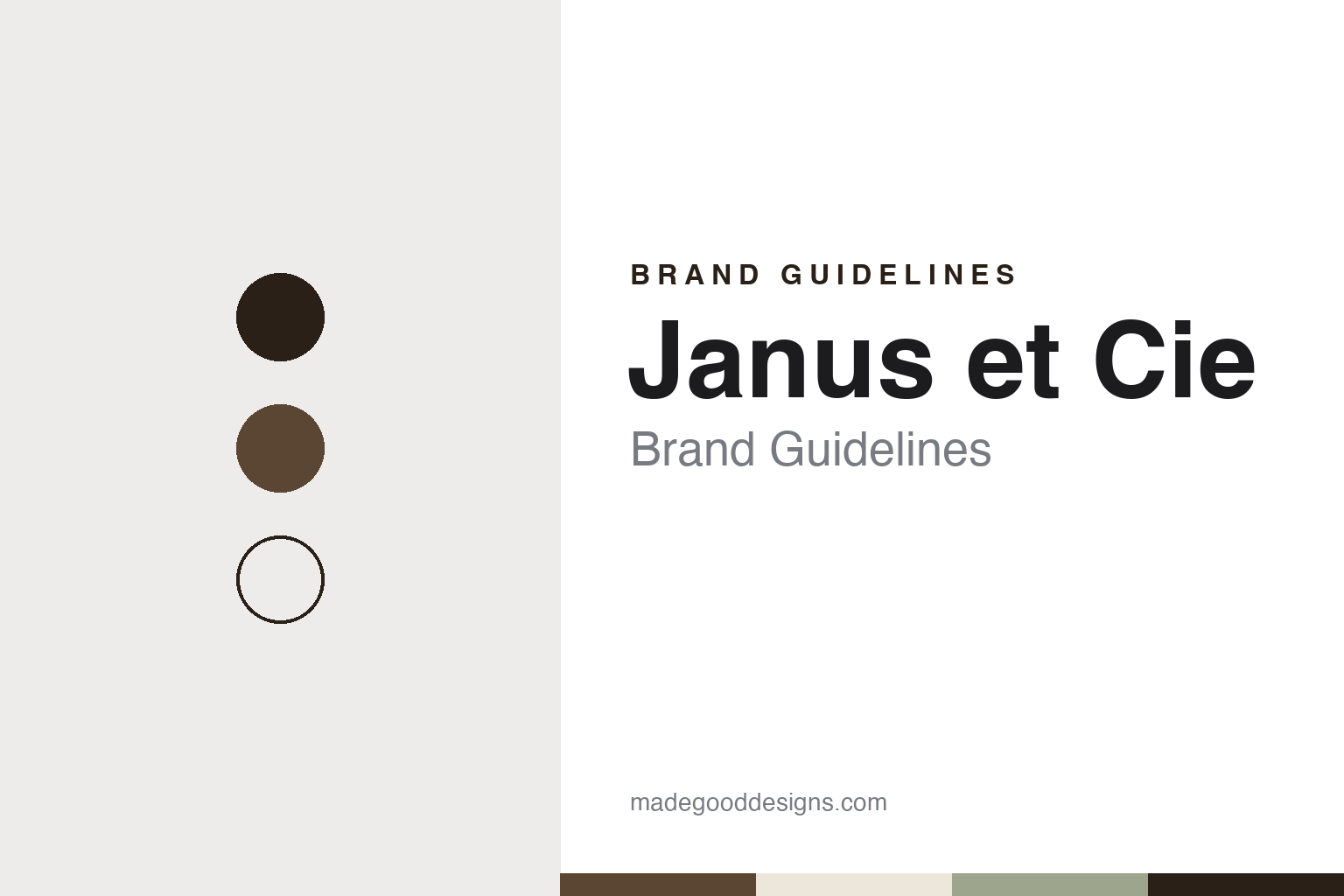
Visually, the brand lives in its showrooms and catalogues, where hand-woven fibre, teak and powder-coated aluminium do most of the work. The palette here is our own interpretation of a teak-and-stone outdoor brand: a teak brown, a stone white and a sage green.
For a design guide, Janus et Cie shows how a showroom name can turn into a maker’s brand, building its identity on a proprietary material and on collections credited to named designers, its founder among them. Compare Dedon, the German brand of woven outdoor fibre furniture, and Kettal, the Spanish outdoor design house. For this guide we use teak brown, stone and sage with a sans, an unofficial interpretation; no product or logo is reproduced.
Explore & save
Keep Janus et Cie’s identity on hand — save it to a board in the Made Good inspiration library.
Janus et Cie identity set
Pin the Janus et Cie teak, stone and sage palette and the Geometric sans register to your own board.


