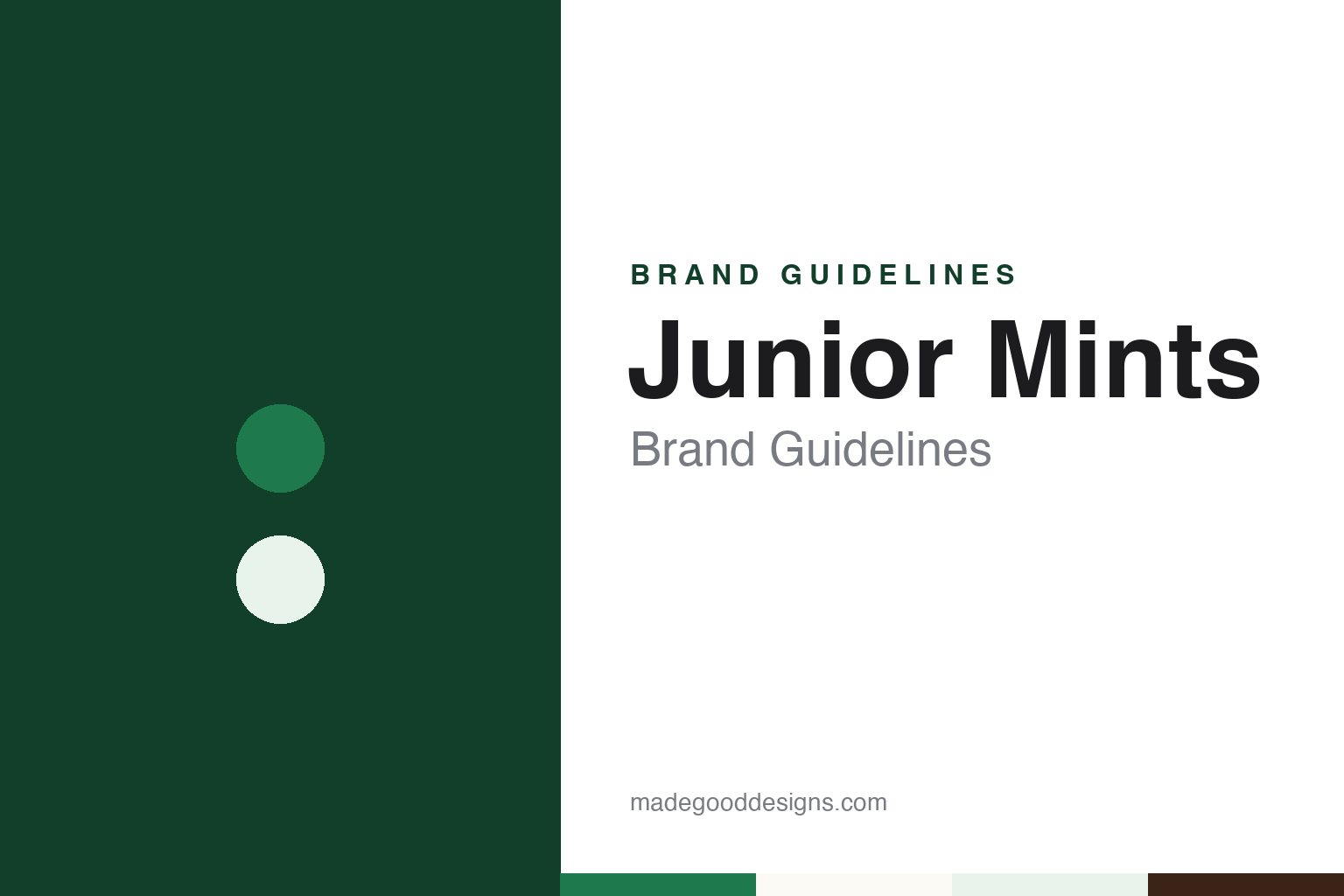
Junior Mints Brand Guidelines
A Cambridge chocolate mint named after a Broadway play.
Aa
Two constants: a mint green, deep mint and dark chocolate palette and a slab display register. Abstract homage — not a Junior Mints product or mark; no box or logo is reproduced.
A mint from Confectioner’s Row
A Cambridge candy maker and a Broadway pun.
Junior Mints come from a candy company founded in Cambridge, Massachusetts. According to its obituary of the founder in The New York Times, dated 1 February 1985, James O. Welch was born in Hertford, North Carolina, attended the University of North Carolina and founded his candy company in Cambridge in 1927. English Wikipedia says his partner in the business was his brother, Robert W. Welch Jr., who retired from the confectionery trade in 1956. The Boston Globe, in a 4 May 2018 column by Scott Kirsner, says the factory building that still stands between Kendall Square and Central Square was built in 1927 by the James O. Welch Company, in a part of the city then known as “Confectioner’s Row”. The same column cites the Cambridge Historical Society as saying that 1946 was the high point of the city’s candy-making era.
English Wikipedia says the James O. Welch Company introduced Junior Mints in 1949: small rounds of mint filling in a semi-sweet chocolate coating, with a dimple on one side. The company also made Sugar Babies, Welch’s Fudge and Pom Poms, Wikipedia says, and the Globe credits Welch with Sugar Babies and Sugar Daddies. Wikipedia, citing a 1984 article by Paula Gray in The Register, says the candy was developed by Charles Vaughan, a food chemist who worked on panned chocolate, after James Welch asked him for a small, chocolate-covered fondant peppermint; the same source credits Vaughan with Sugar Babies.
The name is a play on a title. Wikipedia, citing Andrew F. Smith’s Encyclopedia of Junk Food and Fast Food (Greenwood, 2006), says that according to one past official company history Welch named the candy after his favourite Broadway show, Junior Miss. That play was adapted by Jerome Chodorov and Joseph Fields from Sally Benson’s stories in The New Yorker, directed by Moss Hart and produced by Max Gordon, and ran on Broadway from 1941 to 1943. Tootsie Roll Industries, the present owner, dates the product to 1949 on its own website.
Colour
Nabisco, Warner-Lambert, Tootsie Roll.
The Welch company did not stay independent. The New York Times reported in its 1985 obituary that the National Biscuit Company, later Nabisco Brands, bought the James O. Welch Company in 1963, and that James Welch served as a director of Nabisco from 1963 until he retired in 1978. English Wikipedia gives the same 1963 date for Nabisco’s purchase of the brand and says Nabisco sold Junior Mints to the Warner-Lambert Company in 1988.
Warner-Lambert in turn sold the brand in 1993. Wikipedia says it went to Tootsie Roll Industries that year, and the Boston Globe column of 2018 dates the purchase of the Cambridge factory by Tootsie Roll to 1993, saying the acquisition was overseen by the company’s two top executives at the time, Melvin and Ellen Gordon. The Globe describes Tootsie Roll Industries as headquartered in Chicago. Tootsie Roll Industries has owned Junior Mints since 1993, and its website lists the brand beside Tootsie Rolls, Charms, Dubble Bubble, Dots, Andes and Charleston Chew.
Production has stayed in the city where the candy began. Wikipedia says Junior Mints are made in the Area 4 neighbourhood of Cambridge at a factory run by Cambridge Brands, a Tootsie Roll Industries subsidiary, and that the same plant makes Sugar Babies and Charleston Chew. The Globe describes the building as boxy and cream-coloured, with opaque windows and a small sign out front naming Tootsie Roll Industries as the owner, the sign carrying Tootsie’s white, red and brown colour scheme. The company’s own product page says Junior Mints are made daily in Cambridge, Massachusetts.
The range has grown around the original mint. Wikipedia says Tootsie Roll also makes Junior Caramels, with a caramel filling in a milk chocolate coating, and has sold limited editions, among them “Inside Outs”, with a mint-chocolate filling in a white shell, pastel Valentine’s Day and Easter versions, a Christmas edition with red and green fillings, and a Peppermint Crunch edition.
Typography
Design and documentation.
The candies in this group are American sweets whose identity lives on the outside of the pack. A candy brand’s look is carried by small, cheap and much-handled things: a twist wrapper in a single strong colour, a paper roll of identical pieces, a narrow cardboard box sized for a cinema counter, or a bar wrapper read in a second at a checkout.
Wrapper colour often signals a flavour before any words are read, and a roll pack or theatre box can become as recognisable as the name printed on it. Some wrappers carry more than a name, with jokes, riddles or slogans printed where a label would usually sit, so the packaging becomes part of the product.
Many American candy names have also outlived the companies that created them, passing between owners over the decades while keeping their names and packs. Each guide separates what independent sources record from what the company says about itself — who started the candy, who owns it now, where it is made and how its packaging has changed — and marks plainly what rests only on the company’s own word.
Aa
A heavy slab display — the confident register of a cinema-counter candy box. (Specimen set in Alfa Slab One, a slab STAND-IN; NOT the Junior Mints logo.)
At the cinema counter
A small box that became a film-night habit.
Junior Mints are sold by the box, and the box sizes say a lot about where the candy is eaten. English Wikipedia says the mints are packed in sizes from the small “fun-size” box up to a 12-ounce box, and that they are sold in movie-theatre-size boxes because the product continues to sell well in cinemas. Tootsie Roll’s own product page puts it in similar terms, calling the candy a movie theater favorite and describing it as a blend of dark chocolate and creamy peppermint.
The candy also has a place in television history. Wikipedia says Junior Mints feature heavily in the Seinfeld episode “The Junior Mint”, in which Jerry, watching a surgical operation, pushes Kramer’s hand away and a Junior Mint falls into the patient; the episode later implies that the mint cured the patient’s infection. Tootsie Roll mentions the connection on its own website, saying the candy is famous for its appearance in Seinfeld, so the episode has become part of how the owner presents the brand.
Seasonal editions extend the range. The limited editions Wikipedia lists include pastel versions for Valentine’s Day and Easter, a Christmas edition with red and green fillings and a Peppermint Crunch edition with peppermint flakes in the chocolate coating, while Tootsie Roll’s product page describes the standard mint as a blend of dark chocolate and creamy peppermint.
The Boston Globe column also places the brand inside a longer local story. It describes Cambridge in the first half of the twentieth century as a centre of American candy making, with factories producing Charleston Chews, Necco wafers, Squirrel Nut Zippers and Sugar Daddies, and says that in the second half of the century the industry consolidated and manufacturing moved out of the city. The column calls the Cambridge Brands plant the last remaining candy factory in Cambridge. Junior Mints are still made there, on the street the Globe associates with Confectioner’s Row.
For a design guide, Junior Mints shows how a single pack format, the theatre box, has stayed with a brand through four owners, from the James O. Welch Company to Tootsie Roll Industries. Compare it with York Peppermint Patties, another American chocolate-and-peppermint candy, and Altoids, a mint sold in a box of its own. For this guide we use mint green and deep mint with dark chocolate on peppermint cream and a slab display, an unofficial interpretation; no product or logo is reproduced.
Explore & save
Keep Junior Mints’s identity on hand — save it to a board in the Made Good inspiration library.
Junior Mints identity set
Pin the Junior Mints mint green, deep mint and dark-chocolate palette and the slab display register to your own board.