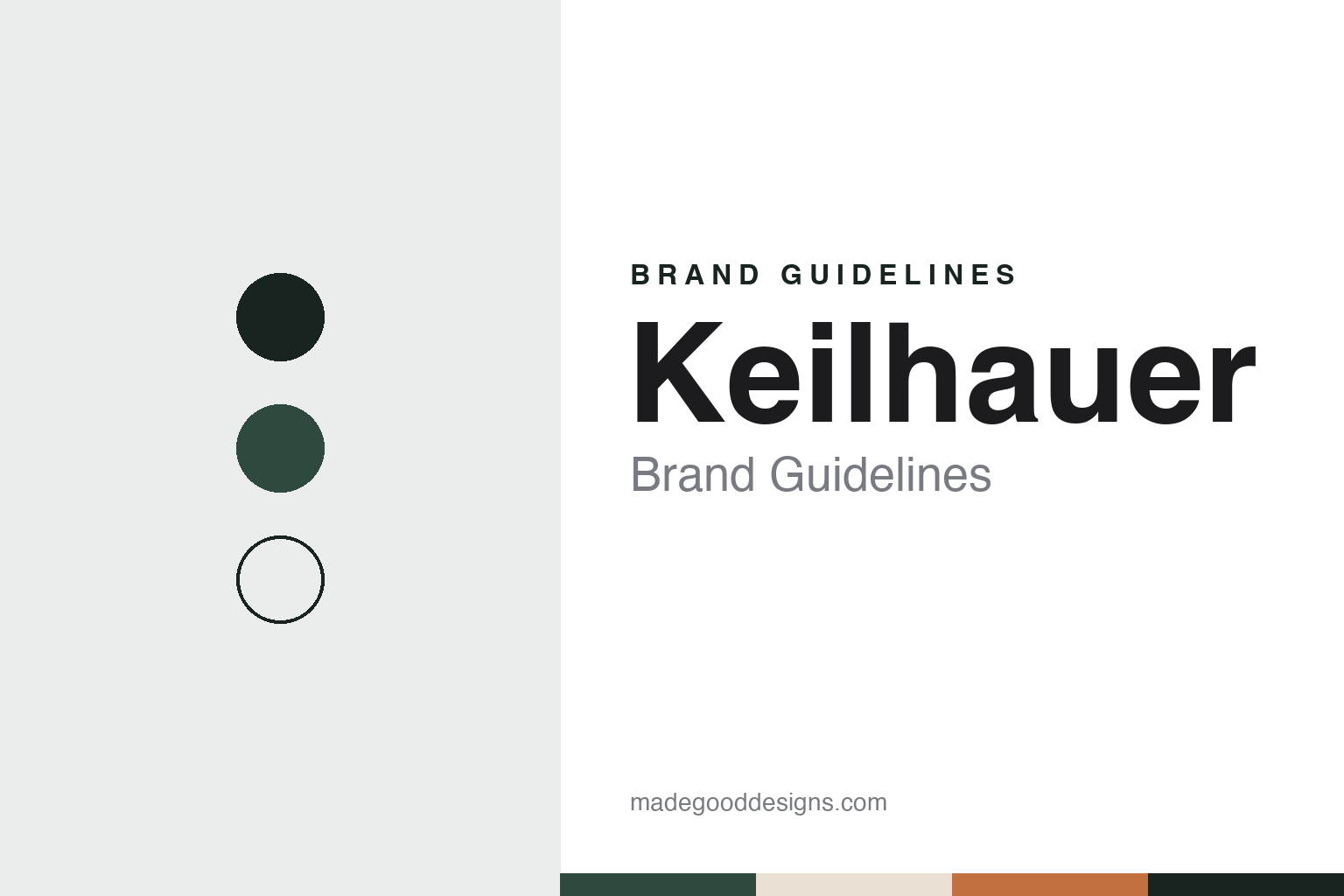
Keilhauer Brand Guidelines
A Toronto family workshop that grew up around one idea: make the chair well and deliver it on time.
Aa
Two constants: a ravine green, oat felt and bent copper palette and a Soft modern sans register. Abstract homage — not a Keilhauer product or mark; no chair, catalogue or logo is reproduced.
Toronto, 1981
An upholsterer’s sons and a chair company of their own.
Keilhauer is a contract-furniture maker based in Toronto, Ontario, known for office and lounge seating. On its own website the company says it was founded in 1981 and describes itself as “a privately owned, design focused contract furniture manufacturer.” Its leadership page names Mike Keilhauer as chief executive and Steve Keilhauer as vice-president of product development.
The family story goes back further than the company. The reference book Design in Canada (2004), as quoted in the collections database of Carleton University, says Mike Keilhauer founded the firm with his brothers Ron, Steve and Rick. Their father, Ed Keilhauer, had trained as an upholsterer-saddler; the book says he set up a business called Fine Art Upholstery in Scarborough in 1956 and started Cambridge Furniture in 1965, and that the two were combined as Fine Art International in 1976. The brothers’ own company was at first called Keilhauer Industries, and according to the same source it began by making foreign designs under licence.
The family name stayed on the chairs. Design in Canada says Ed Keilhauer’s Elite chair of 1983 was the company’s own design to go into production, and the company still lists Elite today, describing it as a fully upholstered executive conference chair designed by Ed Keilhauer, “one of the original founding members” of the company.
In the chief executive’s message on its site, the company sums up where it began: with “one focus, to manufacture quality seating on time.” The message is signed by Mike Keilhauer, and it goes on to say that the company sees itself as a caretaker of limited resources for future generations.
Colour
Deacon, Sorensen and a designer-led range.
Keilhauer built its identity on outside designers, many of them Canadian. Design in Canada credits the Montreal designer Christen Sorensen with the Respons chair of 1989, which the book describes as a multi-task chair. Respons is still in the catalogue, where Keilhauer presents it as a roomy chair for executive offices, boardrooms and general office work, and names Sorensen as its designer.
The other name that runs through the range is Tom Deacon. According to the same book, Deacon designed the wood-based Deacon chair (1989) and Danforth chair (1993), and then the Tom chair of 1997, which the book says marked the company’s move into plastics. The company’s current product page lists Tom as a multi-functional chair for workstations, executive offices and conference rooms, with a stool version, and credits Deacon as designer. Design in Canada also names Kerr Keller Design for the Chit Chat chair of 1996, and lists Andrew Jones, Scot Laughton, Gord Peteran and Jonathan Crinion among the designers working with the firm.
The look of the brand itself was shaped from outside too. Design in Canada says that Mike Keilhauer, as president, hired the San Francisco designer Michael Vanderbyl, described in the book as a branding specialist, as the company set out to sell beyond Canada. The book also records that the company was then making its furniture in factories in Toronto and selling much of it in the United States.
Product names stay short and spoken: Respons, Tom, Talk, Cahoots, Juxta, Wunder. In its current “About Us” text the company says it works “with world-renowned designers” and makes seating and tables for offices, lobbies and lunchrooms.
Typography
Design and documentation.
The brands in this group all make furniture for workplaces: office chairs, desks, storage, panel systems and the tables and seating that fill meeting rooms, reception areas and, for some of them, hospitals and schools. Contract office-furniture makers come from very different starting points, from family workshops that once made chairs for the home to metal-goods firms and companies founded around a single product, and over the decades many of them have changed owners, joined larger groups or moved where their furniture is built.
In this trade a brand’s identity is carried less by a logo on a box than by a catalogue, a showroom, a named chair or system and the designers credited with it, because the furniture is usually chosen by architects, designers and facilities buyers rather than picked off a shelf. That makes the plain questions behind each name worth asking: who started it, who owns it now, and where its furniture is actually made.
Each guide separates what independent sources record from what the company says about itself, and marks plainly what rests only on the company’s own word.
Aa
A soft modern sans — rounded and calm, like a well-upholstered seat back. (Specimen set in DM Sans, a sans STAND-IN; NOT the Keilhauer logo.)
Keilhauer
Division Twelve, Yabu Pushelberg and a family company.
The company has grown by acquisition as well as by design. In a press release dated 30 January 2020 and headlined “Keilhauer Gets Bent,” Keilhauer announced that it had acquired Division Twelve, a maker of bent-metal tables, chairs and stools. The release said Division Twelve had been founded in Edmonton in 2017 by the industrial designer Geof Lilge, known for founding Pure Design, and that Lilge would stay on as Division Twelve’s creative director. Mike Keilhauer, then described as president, said in the release that the purchase gave the company a new solution for office design inspired by the hospitality sector.
The Division Twelve line arrived with its own visual voice. The release said the first collection featured designs by Lilge, Scot Laughton and Samuel Petterson, in a set of powder-coat colours, and that the palette would be updated each year to include the Pantone Color of the Year. Products such as Winny, a stacking chair with a nod to the Windsor chair, and Dek, a stool with a seat inspired by a skateboard deck, carried the short-name habit into metal.
More recent work has come from interior designers. Keilhauer’s product page for the Etta collection credits the design studio Yabu Pushelberg, and describes Etta as a group of lounge and side chairs, sofas, a privacy chair and tables.
Ownership has stayed with the founding family: the company calls itself privately owned, and Mike Keilhauer remains chief executive, with Meghan Sherwin as president. The company says it is headquartered in Toronto.
For a design guide, Keilhauer shows how a family seating maker can let named designers and plain, spoken product names carry its identity, with upholstery doing the visual work. Compare Teknion, another Toronto office-furniture maker, and Global Furniture Group. For this guide we use ravine green, oat felt and bent copper with a sans, an unofficial interpretation; no product or logo is reproduced.
Explore & save
Keep Keilhauer’s identity on hand — save it to a board in the Made Good inspiration library.
Keilhauer identity set
Pin the Keilhauer ravine green, oat felt and bent copper palette and the Soft modern sans register to your own board.


