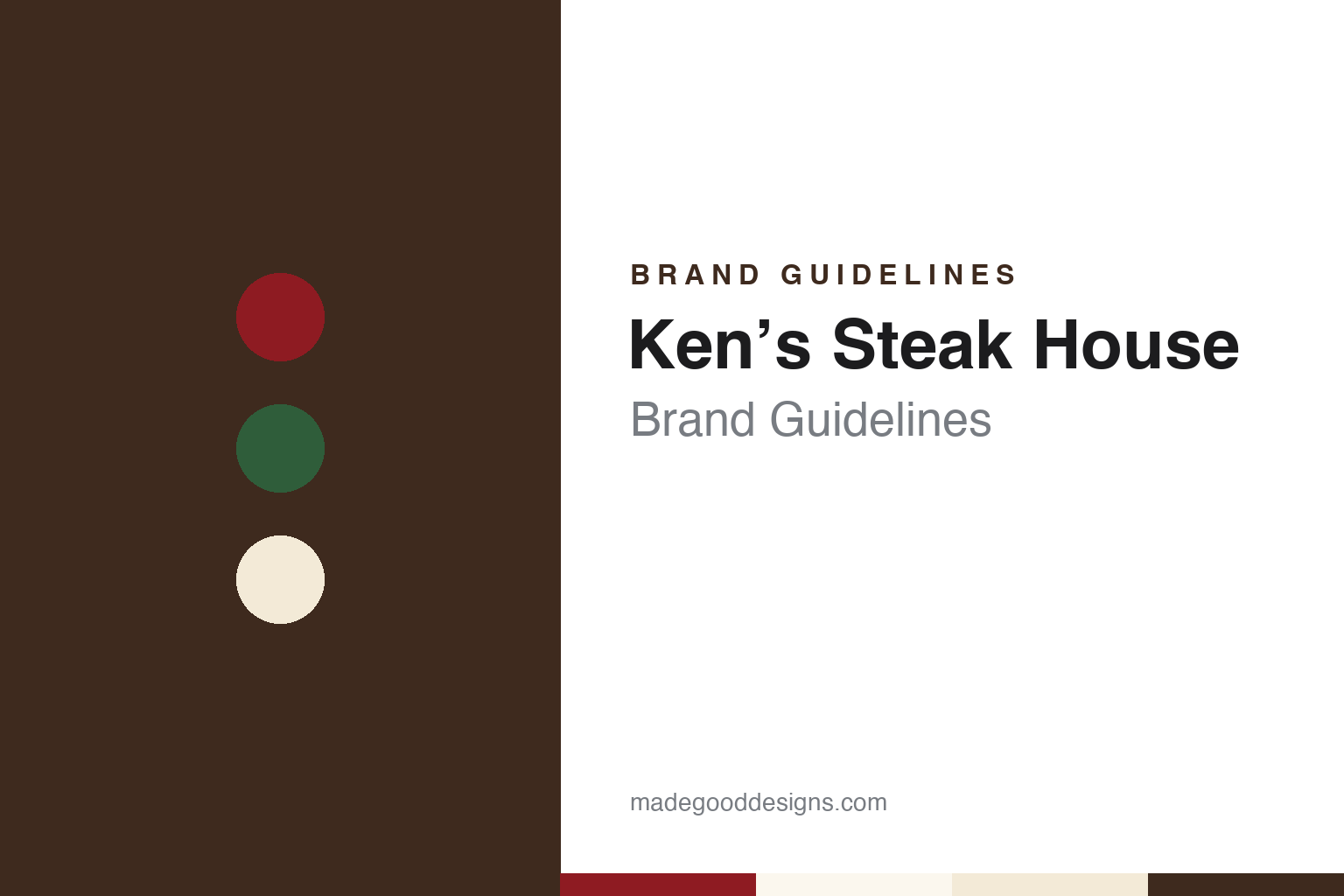
Ken’s Steak House Brand Guidelines
A roadside restaurant whose salad dressing outgrew the dining room.
Aa
Two constants: a red, walnut and herb-green palette and an old-style serif register. Abstract homage — not a Ken’s Steak House product or mark; no bottle, label or logo is reproduced.
A dressing from Route 9
The salads that upstaged the steaks.
The brand on the bottle is the name of a restaurant. Ken’s Foods’ own heritage page, as archived in 2009, says the story began in 1941, when Ken and Florence Hanna opened Ken’s Steak House in Framingham, Massachusetts. English Wikipedia gives the same year. Court documents summarised by Nation’s Restaurant News in May 2002 put the opening a year earlier, in 1940, and describe the start as a small roadside diner on Route 9 in Framingham, trading under a different name, which the Hannas grew over time and officially renamed Ken’s Steak House in the mid-1950s.
Steaks were meant to be the draw. The company’s heritage page says both Ken and Florence wanted something special to serve alongside them, and that the answer was a salad tossed with a house dressing. It quotes Ken Hanna saying the salads became “probably more popular than our steaks”, and that customers began asking why he did not put the dressing in a bottle and sell it. A 2012 version of the company’s website, also preserved by the Wayback Machine, told the same story in shorter form: the dressing began at the table in a steakhouse, moved to a basement, and grew from a recipe attributed to Ken’s mother-in-law.
The restaurant has carried on alongside the dressing business. Its own website, live in October 2026, still presents Ken’s Steak House on Route 9 in Framingham as a working restaurant with dinner menus, function rooms for group celebrations and live music.
Colour
Two couples, one recipe, a company in Marlborough.
The bottling was done by friends. Ken’s Foods’ 2009 heritage page says Frank and Louise Crowley started the business of Ken’s Foods in their kitchen in 1958, based on the house dressing served in the restaurant. Nation’s Restaurant News, citing court documents in 2002, says the Crowleys approached the Hannas in the mid-1950s with the idea of producing the restaurant’s Italian-style dressing for commercial sale, that Frank Crowley had experience in the grocery business, that the two couples agreed to form an independent company and share in its profits, and that the company was incorporated in 1958 as Ken’s Foods Inc. Wikipedia describes the arrangement as the Hannas licensing the name to a family friend.
Ownership was rearranged within the families. Nation’s Restaurant News reported that in 1973 Ken and Florence Hanna sold their remaining shares to their son, Timothy Hanna, and their son-in-law, Joseph Shay, and that by 2002 Timothy Hanna owned the restaurant while Ken’s Foods was run by the Crowleys’ son, Frank Andrew Crowley II. The company’s 2009 heritage page described Ken’s Foods as “family owned and operated”, and its 2017 About page said the business was still owned by the same family.
The company grew well beyond the original Italian dressing. Wikipedia describes Ken’s Foods as a privately held food manufacturer headquartered in Marlborough, Massachusetts, making salad dressings, sauces and marinades for retail and for foodservice, with further facilities in McDonough, Georgia, Lebanon, Indiana, and Las Vegas, Nevada. The company’s 2009 heritage page listed plants in Marlborough, McDonough and Las Vegas, and said customers also came to it for custom dressings and sauces. Wikipedia, citing a 2003 essay by Paul Newman in Time, says Ken’s has produced dressings under contract for Newman’s Own; the heritage page put it more plainly, saying Newman brought his own ideas for dressings and asked Ken’s to produce and bottle them.
Typography
Design and documentation.
The brands in this group are American mayonnaise, salad-dressing and syrup names, the jars and bottles that sit in a refrigerator door or on a pantry shelf. Many began somewhere small and specific — a home kitchen, a restaurant dining room, a regional factory — before passing through larger food companies, and several are still loyally bought in one part of the country more than another.
Their identities are carried mostly by packaging rather than by advertising alone: the shape of a wide-mouthed jar or a squeeze bottle, a label colour that shoppers learn to spot from the end of an aisle, a script or serif name, and sometimes the memory of the restaurant or cook the product came from. Because owners change and recipes travel, the questions behind each name are worth asking plainly: who started it, who owns it now, and where it is made.
Each guide separates what independent sources record from what the company says about itself — its founding story, its owners over time and how its labels have changed — and marks plainly what rests only on the company’s own word.
Aa
An old-style serif — the register of a restaurant menu and a family name. (Specimen set in Libre Caslon Text, a serif STAND-IN; NOT the Ken’s Steak House logo.)
The restaurant on the label
A building used as a brand mark.
The label has long pointed back to the dining room. Nation’s Restaurant News reported in May 2002 that the dressing was, and continued to be, marketed under the Ken’s Steak House brand with an image of the restaurant on the label. Three marks were at stake in a dispute between the restaurant and Ken’s Foods that the trade paper covered that year: the word “Ken’s”, the name “Ken’s Steak House” and a rendering of the restaurant that appeared on dressing labels and on menus. Ken’s Foods’ lawyer told the paper that the company had obtained a Massachusetts trademark registration in 1959 and a federal registration in 1980 for all three, and that the restaurant was able to use the symbols for its own purposes.
Ken’s Foods filed suit against the restaurant operator in the U.S. District Court in Boston in November 2001, and the restaurant answered with a counterclaim asking to be recognised as the licensor of the brand, Nation’s Restaurant News reported in May 2002.
In the identity, the family name of the restaurant’s founders became the product name; the restaurant itself became the picture; and the phrase “Steak House” travelled onto a grocery shelf far from Route 9. Wikipedia says the company’s products are sold both at retail and to foodservice operators, so the same name reaches kitchens that diners never see. In its 2017 About page, the company framed the story under the line “A Family Tradition of Feeding Yours”, and described itself as a family business tracing back to the basement of Ken’s Steak House, a restaurant that became known for its salad dressings.
For a design guide, Ken’s Steak House shows how a single place can anchor a packaged brand: a restaurant name, a picture of the building and a family story doing the work that a mascot or slogan does for other labels. Compare Hidden Valley, another dressing named after the place it came from, and Wish-Bone, a dressing that also began in a restaurant. For this guide we use steakhouse red, walnut brown and herb green with an old-style serif, an unofficial interpretation; no product or logo is reproduced.
Explore & save
Keep Ken’s Steak House’s identity on hand — save it to a board in the Made Good inspiration library.
Ken’s Steak House identity set
Pin the Ken’s Steak House red, walnut and herb-green palette and the old-style serif register to your own board.
